Breaking
Latest tech news from South Africa and around the world•Stay updated with breaking technology developments•Innovation and digital transformation news•AI, gaming, and gadget updates daily•Crypto and fintech news from Africa•
 SA Tech News Desk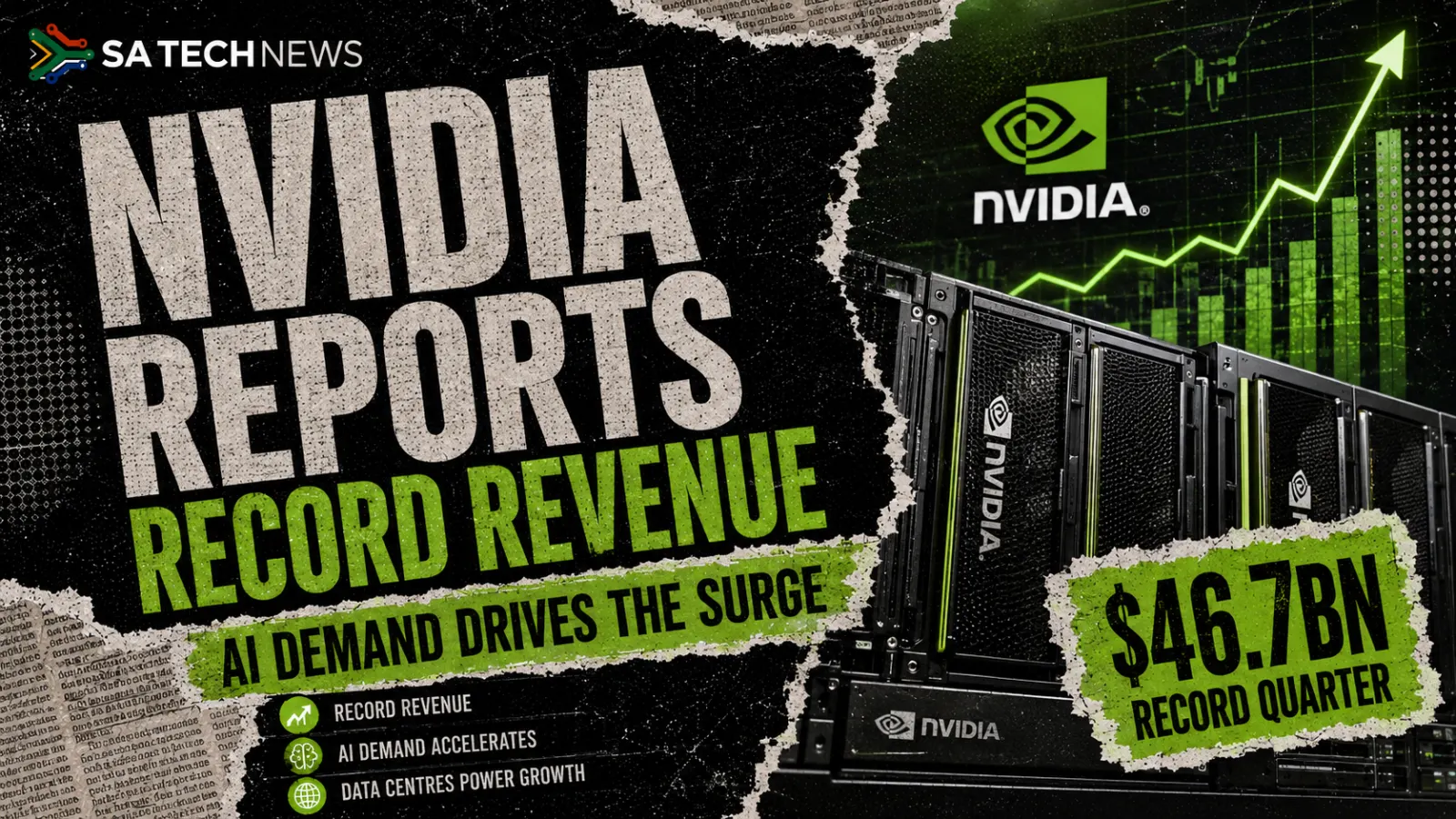
Nvidia's $46.7 billion quarter showed how deeply global AI spending has become tied to accelerated computing and data-centre infrastructure.
Nvidia's AI boom has turned what was once primarily a graphics-chip company into one of the central infrastructure suppliers of the generative-AI era.
The company reported revenue of $46.7 billion for its second quarter of fiscal 2026, a record at the time and another sharp increase driven by demand for accelerated computing and data-centre systems. Data-centre revenue accounted for the overwhelming majority of the quarter, underlining how far Nvidia's centre of gravity has shifted from gaming GPUs to the hardware behind large-scale AI training and inference.
The number matters because it captures something bigger than a strong chip cycle. Hyperscalers, cloud providers, governments and AI companies have been building increasingly expensive clusters around Nvidia's GPUs, networking products and software stack. Every new generation of frontier models has increased pressure for more compute, while enterprise adoption has widened the market beyond the handful of companies training the largest models.
Nvidia's Blackwell platform has been central to that expansion. The architecture was designed for large AI workloads and is sold as part of complete systems rather than as a standalone graphics card story. That lets Nvidia capture revenue across GPUs, networking, interconnects and software.
For customers, the attraction is performance and a mature CUDA ecosystem. For Nvidia, the advantage is that the ecosystem makes it difficult for rivals to compete on silicon alone. AMD, custom accelerators from cloud providers and specialised AI-chip startups are all chasing the same spending pool, but switching costs are not purely about hardware benchmarks.
That is why the company's earnings have become a proxy for the wider AI infrastructure market. A strong quarter suggests that capital spending on AI remains elevated; any slowdown would immediately raise questions about how quickly customers can turn that investment into revenue.
South African companies are not buying frontier-scale GPU clusters at the same pace as the largest US technology firms, but Nvidia's growth still matters locally. Cloud pricing, access to accelerated compute, data-centre capacity and the cost of building local AI services are all influenced by the global race for the same hardware.
Local banks, telecoms operators, retailers, universities and software companies increasingly depend on GPU-backed cloud services for model training, inference, analytics and computer vision. The more constrained the global supply of high-end accelerators becomes, the more expensive ambitious local AI projects can be.
The other question is sovereignty. African governments and large enterprises are increasingly interested in keeping sensitive workloads and data closer to home. That creates an opening for regional data centres with serious AI capacity, but the economics are demanding: power, cooling, networking and scarce accelerators all need to line up.
Nvidia's record quarter therefore says as much about the scale of global AI infrastructure spending as it does about one company's results. The next test is whether that spending keeps translating into sustainable demand once customers move from building AI capacity to proving what they can earn from it.
South Africa does not manufacture GPUs at scale, but the country is wired into Nvidia's story through data-centre build-outs, cloud regions and JSE exposure via Naspers and Prosus, both linked to Tencent, a major Nvidia customer. Local AI startups and enterprises rent capacity abroad or through South African cloud partners; Nvidia's pricing and supply cycle therefore feeds directly into the cost of running models here. When hyperscalers pause spending, SA firms feel it in longer procurement cycles and higher spot prices for compute.
Source: SA Tech News