Breaking
Latest tech news from South Africa and around the world•Stay updated with breaking technology developments•Innovation and digital transformation news•AI, gaming, and gadget updates daily•Crypto and fintech news from Africa•
 SA Tech News Desk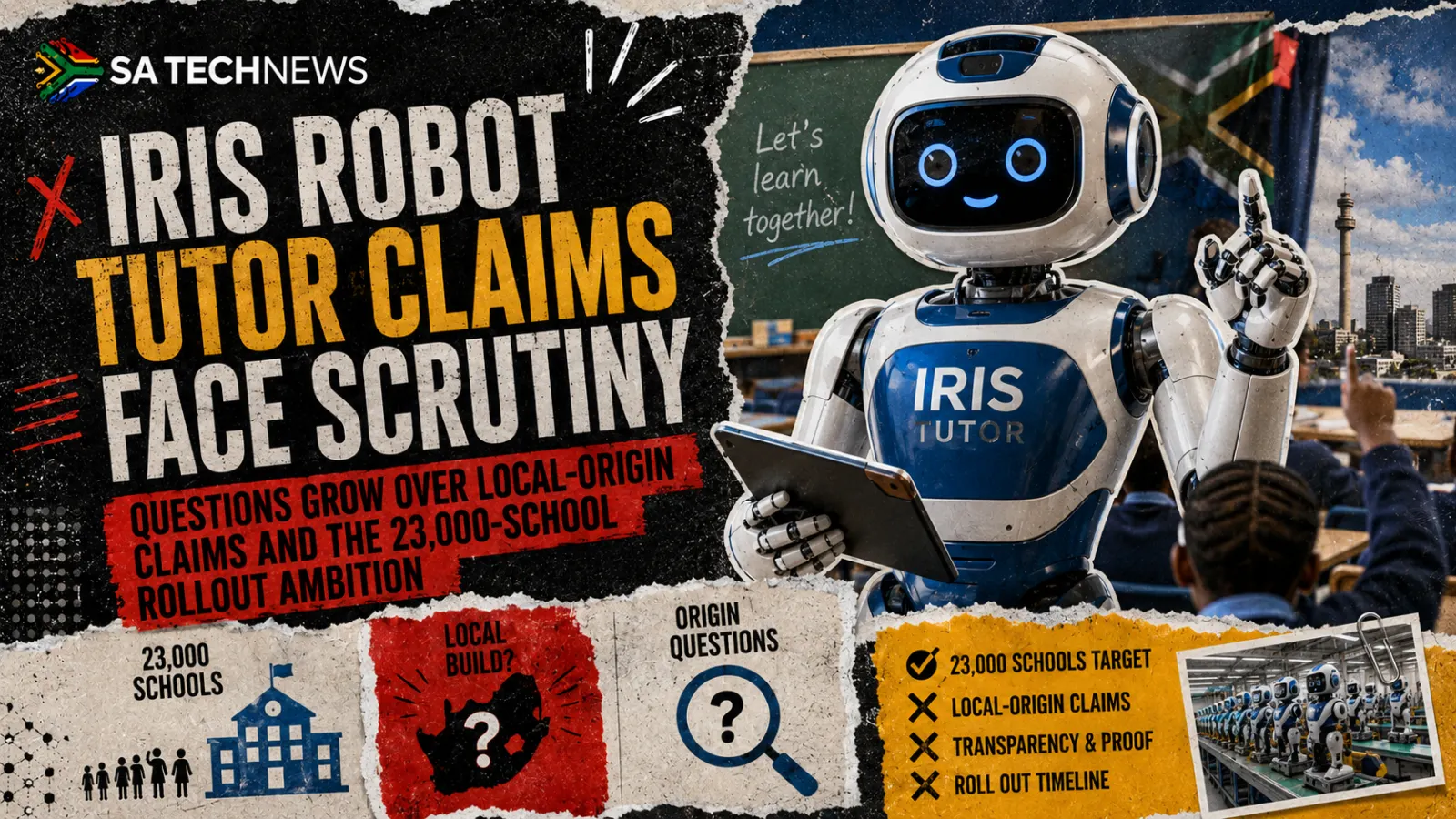
South Africa is being sold a locally developed AI tutor for 23,000 schools. Evidence about the robot hardware complicates that story.
There is a version of the IRIS story that is almost irresistible.
A former KwaZulu-Natal teacher struggles with the everyday grind of teaching maths and physical science, teaches herself to code, spends years building an AI tutor, opens a manufacturing plant at Dube TradePort and sets her sights on putting the robot into roughly 23,000 public schools.
It is the kind of technology story South Africa badly wants more of: local invention, a woman founder, manufacturing, jobs, AI that solves a real problem and a product aimed at schools rather than another enterprise dashboard nobody asked for.
That is why the details matter.
In August, the Department of Science, Technology and Innovation welcomed the opening of a manufacturing plant and showroom for IRIS at Dube TradePort in Durban. The department described IRIS as a locally developed AI humanoid tutor and said BSG and Technologies founder Thando Gumede wants the platform deployed across all 23,000 schools in South Africa. The department also highlighted a target of 20,000 jobs over five years through manufacturing, technical support, training and a broader innovation ecosystem.
Those are big claims. They deserve more than applause.
A subsequent MyBroadband investigation found that the humanoid robot being presented as IRIS closely matches a robot developed by MakerLabs, a company based in Kerala, India. MakerLabs publicly unveiled an IRIS educational robot in 2024, before the South African product was launched. Images from the Indian launch show the same broad humanoid form, tablet interface and education-focused positioning.
MyBroadband said it approached Gumede, the Department of Science and MakerLabs for comment and had not received responses by publication time.
That does not automatically mean the South African project is fake. It does mean the phrase "locally developed" now needs a much more precise explanation.
Technology products are rarely built entirely in one country. A South African smartphone brand may source displays in China, chips from the US or Taiwan and cameras from Japan, while doing industrial design, software, assembly or support locally. A local electric vehicle project may import battery cells but build packs, software and chassis systems here.
That is normal.
The problem comes when different layers of a product are collapsed into one convenient word: local.
With IRIS, there are at least four separate questions.
First: who designed and manufactures the physical humanoid robot platform?
Second: who owns and develops the software that turns that hardware into a tutor for South African classrooms?
Third: what localisation has BSG and Technologies added, languages, curriculum content, assessment tools, learner analytics, teacher workflows, school management features or integrations?
Fourth: what will actually be manufactured at Dube TradePort? Full robot bodies? Electronics? Final assembly? Software installation? Testing? Repairs? Spare parts?
Those distinctions are not pedantic. They determine how much local intellectual property is being created, how many manufacturing jobs are realistic and where public money would ultimately flow if a large school rollout were funded.
The Department of Science has already outlined a wide set of proposed IRIS capabilities, including AI tutoring across subjects, voice-based interaction, marking, learner performance analysis, personalised learning, coding and robotics support, and tools for teachers and parents. It has also said the system is intended to support teachers rather than replace them.
That is a far more credible education pitch than pretending a humanoid robot can walk into an overcrowded classroom and solve structural problems on its own.
But the software matters more than the shell.
If BSG has built a genuinely strong South African education platform on top of commercially sourced humanoid hardware, that can still be meaningful local innovation. In fact, it may be a smarter route than trying to invent every motor, joint and controller from scratch. Local value could sit in the curriculum engine, multilingual interaction, learner data systems, teacher tools, deployment model and support network.
If that is the case, the company and government should say so plainly.
The second issue is scale.
A goal of reaching every public school in the country makes for a strong launch line. It is not yet the same thing as a funded deployment plan.
The government statement did not disclose the expected cost of the robots, the first production run, how many schools have committed to pilots, who would buy the systems, or what the annual support bill would look like.
Those are not small omissions.
South African schools vary dramatically in electricity reliability, connectivity, classroom size, staffing and technical support. An AI tutor that works beautifully in a demonstration room at Dube TradePort has to survive a much harsher test in real schools: weak Wi-Fi, load interruptions, broken tablets, crowded classrooms and teachers who cannot spend half the day troubleshooting a robot.
Then there is maintenance. A humanoid machine has motors, joints, sensors, batteries, screens and moving parts. Schools would need parts, technicians and service-level agreements. If the hardware is imported, local availability of components matters. If the product depends heavily on cloud AI services, connectivity and recurring software costs matter too.
A national rollout also raises data questions. A system that tracks learner performance and potentially interacts by voice with children needs a clear approach to privacy, consent, storage, security and access. The more useful the system becomes, the more sensitive the data around it is likely to be.
None of this makes IRIS a bad idea. It simply moves the conversation from launch-day spectacle to implementation.
There is a strange habit in local technology coverage where scrutiny is treated as hostility. If a startup has a good social mission, critics are expected to clap first and ask questions later.
That does the founder no favours.
If BSG has spent years developing South African education software, adapting a hardware platform, building language capability and setting up local production, the company should be able to explain the architecture of that work. Doing so would strengthen the story, not weaken it.
The same applies to the Department of Science. When a government department publicly describes a technology as locally developed, that wording carries weight. It can influence media coverage, investors, education departments and future procurement decisions.
The department should therefore be precise about what was independently verified before the endorsement.
Was the robot hardware designed locally? Is BSG licensing a MakerLabs platform? Is there a manufacturing or distribution agreement? Which components will be made in Durban? Who owns the education software and AI layer? What percentage of the final product is expected to be local over time?
Those answers would turn a fuzzy argument about whether IRIS is "really South African" into a much more useful picture of the product and the business behind it.
The humanoid form makes IRIS easy to photograph, but it may not be the most important part of the project.
South Africa has a genuine teacher-support problem. The country entered August with tens of thousands of vacant teaching posts, while teachers who are in classrooms carry heavy administrative and marking loads. A well-designed AI system that helps with revision, personalised practice, marking and progress tracking could be valuable even if it ran on an ordinary tablet.
That should be the benchmark.
Does IRIS improve learning outcomes? Does it save teachers time? Can it work in multiple South African languages reliably? Can schools afford it? Can it be supported outside major cities? Does the system still make sense when the novelty of a talking robot wears off?
The origin controversy makes those questions more urgent, not less.
South Africa does not need another technology launch built around a patriotic label. It needs locally relevant technology with transparent sourcing, clear ownership of intellectual property and evidence that it solves the problem it was built for.
IRIS may yet meet that standard. But with ambitions this large, 23,000 schools, 20,000 jobs and a national education footprint, the project has moved beyond the stage where "locally developed" can remain an undefined phrase.
Source: SA Tech News