
Breaking
Latest tech news from South Africa and around the world•Stay updated with breaking technology developments•Innovation and digital transformation news•AI, gaming, and gadget updates daily•Crypto and fintech news from Africa•
 SA Tech News Desk
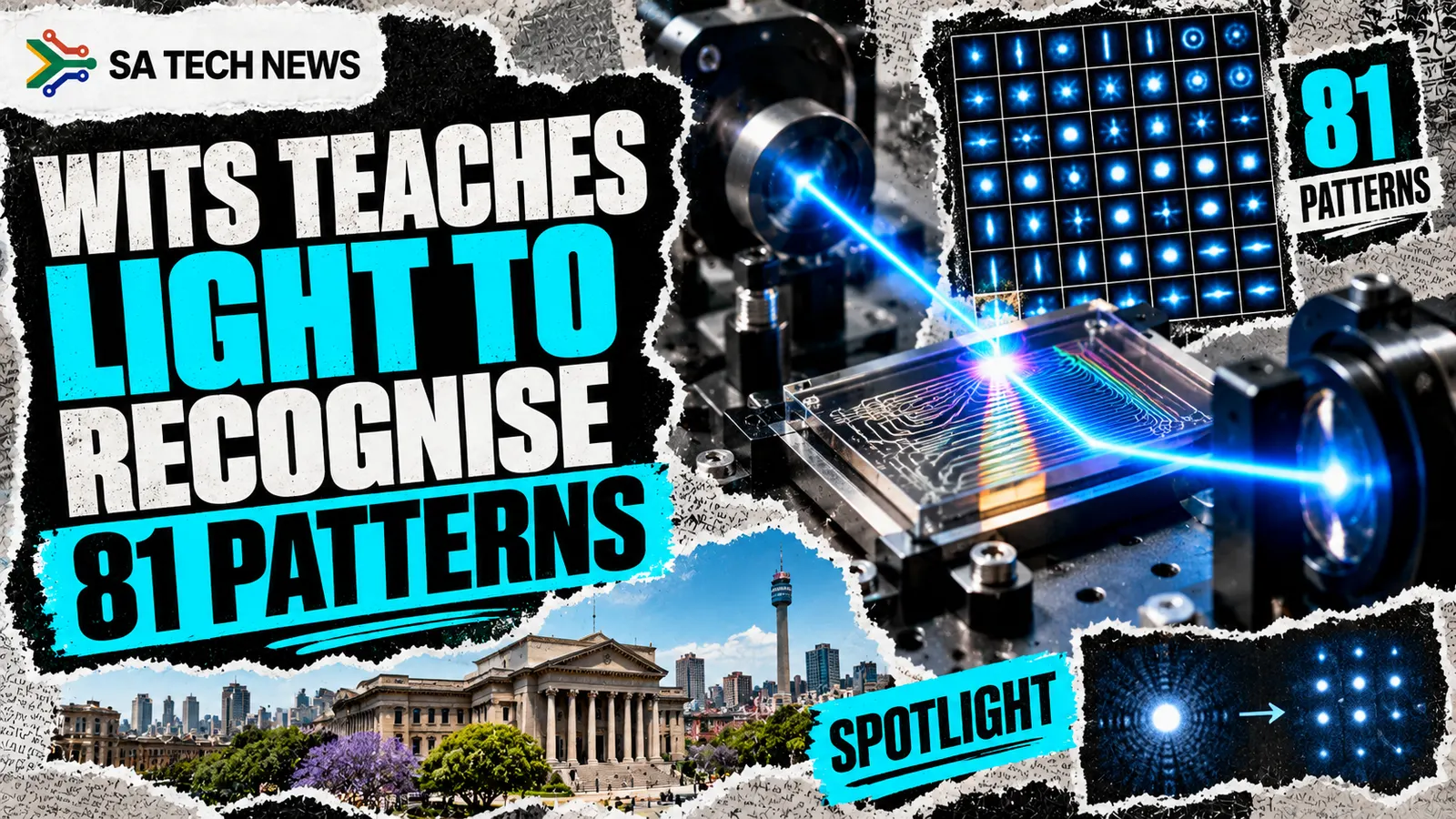
Wits researchers have trained an optical neural network to identify 81 light structures. What the Johannesburg experiment proves and what remains untested.
A team at the University of the Witwatersrand has built an optical neural network that identifies information carried in complex light patterns without first recording a detailed image. In tests reported by Wits on 13 October, the system recognised 81 light structures after training on a much smaller set of examples.
The work matters to South Africa because optical communications could eventually help move more information across laser links, including routes where conventional beams are distorted. That is a research possibility, however, rather than a new broadband service. The apparatus is a laboratory demonstration and no operator deployment or commercial price has been announced.
The study was published in Nature Communications on 7 October. MSc student Hadrian Bezuidenhout led the work, conceived and supervised by Isaac Nape and Andrew Forbes at Wits' Structured Light Laboratory, with contributions from Cade Peters and Ram Nandan Kumar. Wits described the device as a light-powered brain, a shorthand that needs unpacking: it is an optical classifier, not a general-purpose computer or an electronic AI model replacing an entire network.
Conventional optical links already move enormous amounts of data, mainly through fibre. Researchers can also encode information in the shape and polarisation of light. Some complex shapes carry a property called topology, which can remain unchanged even when the beam is bent or distorted. The team's target structures are known as optical skyrmions.
Think of a ribbon with a fixed number of twists. It can be folded into a different shape while retaining the twist count. The optical equivalent gives a receiver something more stable to measure than the appearance of the beam at one instant.
Reading that property has usually required detailed measurement of the light pattern followed by substantial calculation. The Wits approach directs light through designed optical layers and towards detectors. The location where the signal arrives identifies the class of pattern. The underlying neural-network idea is built into the optical behaviour of the system rather than added only as software after image capture.
The university says the team trained the setup on 15 examples and successfully identified 81 structures from the family under study, including patterns it had not seen during training. It also recognised patterns when detector noise was introduced. Those findings show useful generalisation within the experiment; they do not establish how the device would perform across every possible light structure or a working city-wide network.
A more detailed account of the experiment published by TechCentral reports two channels with five diffractive layers each. In the laboratory, the layers were implemented using patterns on a spatial light modulator, not a finished mass-produced optical chip. That distinction matters for any claim that the technology is ready to be installed in existing communications equipment.
Wits already has a research programme investigating how information encoded in light survives atmospheric distortion. In August, university researchers reported a separate experiment transmitting topological light across its West Campus in Johannesburg. That work dealt with sending the signal through turbulent air; the new paper concentrates on reading the information efficiently at the receiving end.
The two problems belong together. A beam can carry information that survives disturbance, but the idea is commercially useful only if receivers can identify that information quickly, reliably and at an acceptable cost. Laboratory performance is one part of that chain. Equipment packaging, power consumption, alignment, weather exposure, maintenance and economics are others.
For South African network planners, this is a longer-term research question rather than a reason to postpone fibre or radio investment. Laser links may eventually suit specific buildings, difficult terrain or satellite communications. They are not automatically better than microwave backhaul or fibre once weather, line-of-sight and uptime requirements are considered.
The university also links the research to quantum communication, where measuring fragile optical states can be especially difficult. That application is further from everyday connectivity than the demonstration itself. Wits' Structured Light Laboratory and its Machine Intelligence and Neural Discovery Institute bring optics and machine-learning expertise together, but there is no evidence in the announcement of a telecoms contract, commercial receiver or deployment timetable.
A laboratory classifier must eventually be judged by more than the number of patterns it recognises. Relevant tests would include the rate at which it reads them, error performance at different signal strengths, resilience to real atmospheric turbulence, optical losses and how much supporting hardware is required. The published result does not mean every part of the signal chain runs without electronic processing.
The team's work offers a concrete answer to one research bottleneck: extracting a stable label from structured light without reconstructing a full image first. It does not yet answer what a network operator would pay for such a receiver, how it would be serviced or whether the method improves total system costs.
The next useful milestone is a demonstration that couples this reader to a real-world link and reports measured throughput, error rates and power consumption. Until then, Johannesburg has a promising piece of optical research, not a replacement for the connectivity equipment already in the field.
Training on 15 examples and recognising 81 structures is a strong laboratory result inside the family’s topology. It is not a claim that the apparatus has classified every optical skyrmion of practical interest, nor that it has been stress-tested against Johannesburg weather on a live free-space link. The TechCentral detail that the diffractive layers ran on a spatial light modulator is the reminder that this is reconfigurable lab hardware, not a fielded receiver card.
For South African readers, the temptation is to jump from “Wits breakthrough” to “cheaper rural broadband.” That leap skips packaging, cost, alignment tolerance and operator economics. The honest next milestone remains a coupled demonstration: this reader on a real turbulent path, with throughput, error rate and power numbers that a network planner can compare with microwave or fibre alternatives.
Treat the 13 October Wits announcement and the 7 October Nature Communications paper as the ledger. The system is an optical classifier for topological light patterns, led from the Structured Light Laboratory, not a consumer AI product and not a scheduled telecoms deployment. Update when a field link reports measured performance — not when a metaphor about a “light-powered brain” travels without the caveats.
Source: SA Tech News


