
Breaking
Latest tech news from South Africa and around the world•Stay updated with breaking technology developments•Innovation and digital transformation news•AI, gaming, and gadget updates daily•Crypto and fintech news from Africa•
 SA Tech News Desk
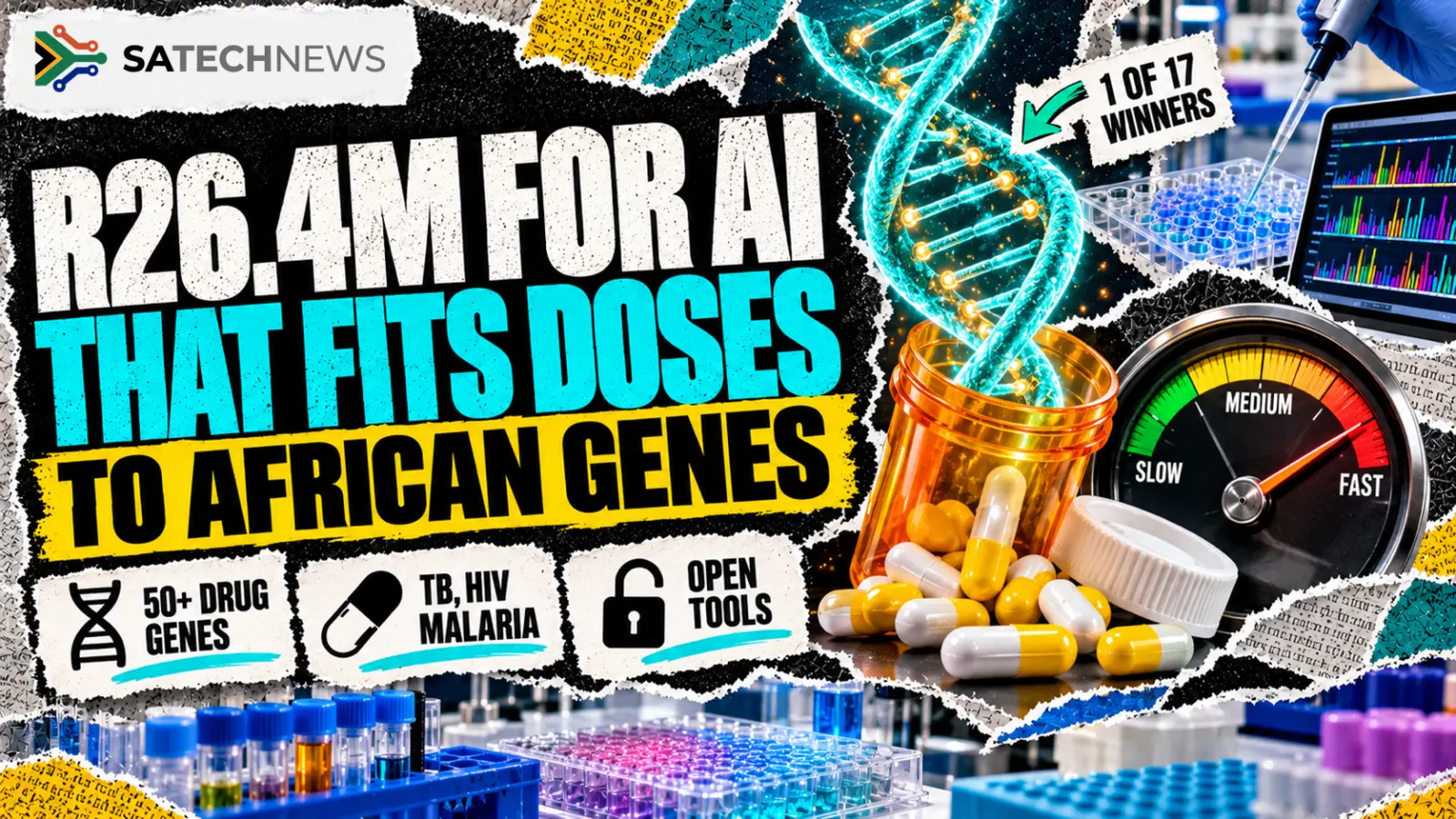
UCT's AfriPGx-AI project gets $1.6m (about R26.4m) from Google.org to predict how African genetic variants affect TB, HIV and malaria drug doses.
The University of Cape Town has won $1.6 million, about R26.4 million, from Google.org to build an AI platform that predicts how African patients' genes change the way their bodies process medicines. The project, AfriPGx-AI, is meant to help clinicians choose drugs and doses for tuberculosis, HIV and malaria with more confidence.
The money comes from Google.org's first Impact Challenge: AI for Science. Google's philanthropic arm named 17 organisations on 14 October to share $36 million, after applications from 30 countries. The only other recipient on Google's list with an explicitly African focus is AfriClimate AI, which studies the atmospheric conditions behind deadly storms.
African populations are underrepresented in pharmacogenomics, the research field that studies how genes affect drug response. Professor Kelly Chibale, who leads the project, put the problem plainly: "Medicines do not work the same way in everyone." He also noted that Africa is home to the greatest human genetic diversity on Earth.
The practical risk runs both ways. A patient who breaks a drug down slowly can build up toxic levels, while one who clears it quickly may not get enough of the drug for it to work, raising the chance of treatment failure and resistance.
According to UCT's account of the award, the team will use AI and computational tools to catalogue variation across more than 50 drug-metabolising genes and predict which variants are most likely to change how specific treatments are processed. Laboratory tests will then check the strongest predictions. The AI output, lab results and mathematical modelling will be combined into decision-support tools built for low-bandwidth settings.
UCT says the software, models and curated datasets will be openly available, and that the project will train postdoctoral fellows and master's and doctoral students in AI, bioinformatics and pharmacogenomics. Chibale is the founder and director of H3D, UCT's drug discovery and development centre, and works with researchers from the Department of Integrative Biomedical Sciences and the UCT AI Initiative.
The work builds on a proof of concept H3D published in Nature Communications in December 2025 with the Barcelona-based Ersilia Open Source Initiative. That study paired machine learning with pharmacometric modelling to suggest which African gene variants might affect malaria and TB drugs, and how doses might need to change. Its stated next step was incubating common medicines with human liver microsomes from donors of African ancestry to sort people into fast, medium and slow metabolisers.
Google.org's Leslie Yeh, director of scientific progress, said: "We're at an extraordinary moment for science." Recipients can also join an optional six-month Google.org accelerator that offers engineering support, mentoring and Google infrastructure.
Neither UCT nor Google.org has published a timeline for AfriPGx-AI or said when its tools might reach clinics. The announcement also does not say which regulatory approvals a dosing tool would need before clinicians could use it on patients in South Africa. The first measurable output is the laboratory validation of the model's predictions across those 50-plus genes, and no date has been given for it.
Source: SA Tech News


