Breaking
Latest tech news from South Africa and around the world•Stay updated with breaking technology developments•Innovation and digital transformation news•AI, gaming, and gadget updates daily•Crypto and fintech news from Africa•
 Tech Team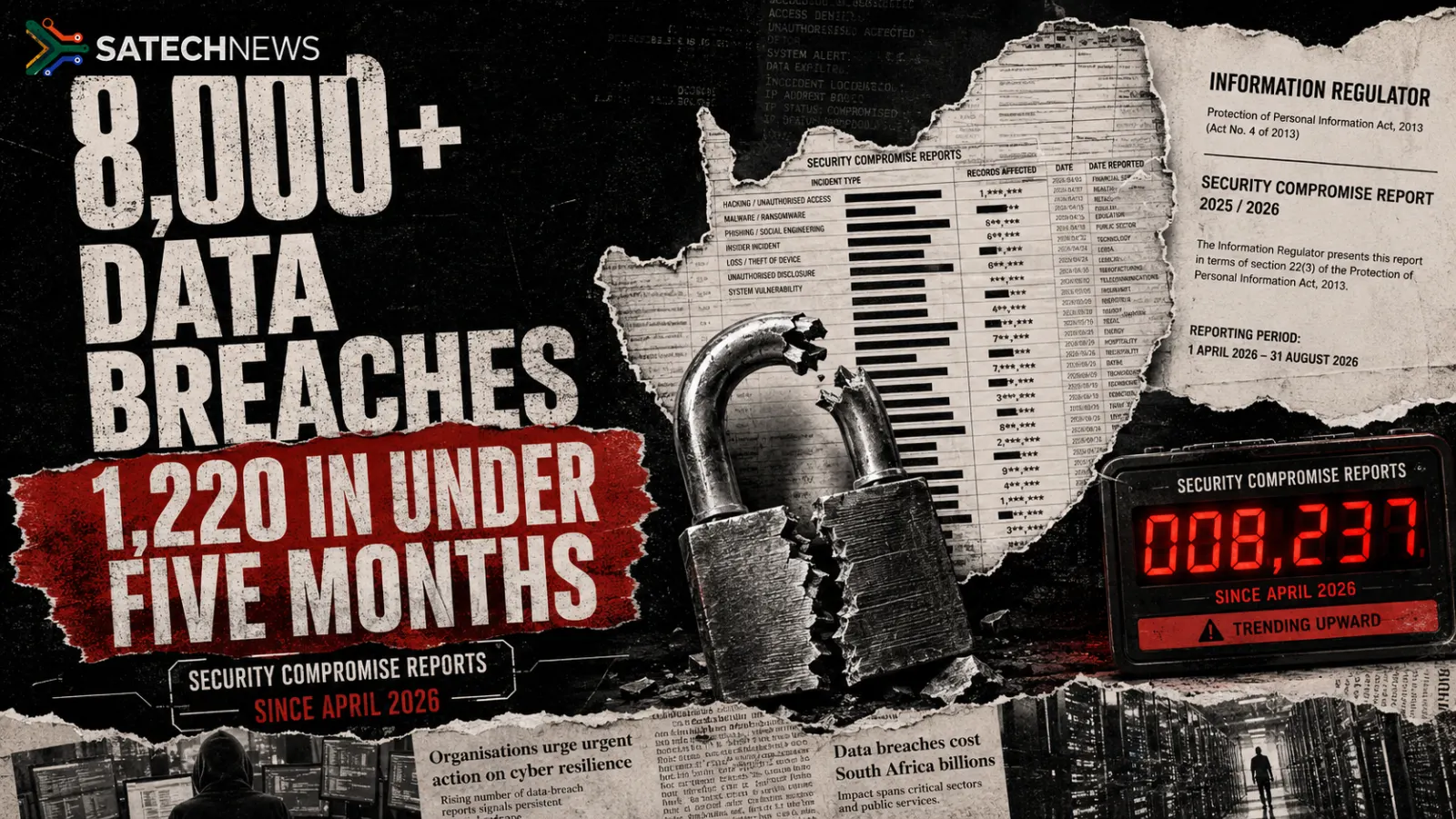
The Information Regulator says it has received more than 8,000 security-compromise reports, including 1,220 since April 2026.
South Africa's Information Regulator has now received more than 8,000 security-compromise reports, a number that puts the country's persistent breach problem into uncomfortable perspective.
The regulator says 1,220 of those reports were submitted from April 2026, less than five months into its 2026/27 financial year when the figure was disclosed at the end of August.
A security-compromise report does not automatically mean millions of records were stolen or that every incident was a sophisticated cyberattack. But the volume is still important: under the Protection of Personal Information Act, responsible parties must notify the regulator when there are reasonable grounds to believe personal information has been accessed or acquired by an unauthorised person.
South Africa has spent years dealing with high-profile leaks, ransomware incidents and compromised customer databases across government and the private sector. The regulator's cumulative figure shows that the visible incidents making headlines are only the top layer of a much larger reporting pipeline.
The 1,220 reports since April work out to hundreds of incidents a month. That creates a second problem beyond the breaches themselves: regulatory capacity. Each notification has to be triaged, assessed and, where necessary, investigated or escalated.
The Information Regulator has repeatedly pushed organisations to take breach notification seriously. POPIA does not allow companies to quietly decide that an incident is too embarrassing to disclose when the legal threshold for notification has been met.
The breach count also reinforces why cyber risk has moved into boardrooms. A compromised system can trigger operational disruption, customer notification costs, legal exposure and regulatory scrutiny at the same time.
The practical weakness is often not a single dramatic hack. Credentials can be harvested from consumer devices, old systems can remain exposed, third-party suppliers can become entry points and stolen data can circulate for months before an organisation understands the extent of the problem.
That makes basic controls, multifactor authentication, patching, access management, tested backups, logging and incident-response procedures, less glamorous than the latest security product but far more consequential.
More reported breaches can mean the threat environment is getting worse, but it can also reflect better compliance and a greater willingness to notify the regulator. The raw number therefore should not be treated as a direct measure of successful cyberattacks.
What is difficult to dismiss is the sustained scale. More than 8,000 reports give South Africa a substantial body of breach data that could help identify recurring weaknesses by sector, incident type and root cause.
The next useful step would be richer public reporting from the regulator: how many incidents involve ransomware, credential theft, misdirected information, insider abuse or third-party compromise; how quickly organisations report; and how many cases result in enforcement.
Without that detail, the 8,000 figure is a warning light rather than a diagnostic tool.
It is still a bright warning light. South African organisations are generating security-compromise notifications at a pace that makes data protection an everyday operational issue, not an occasional crisis.
Source: SA Tech News