Breaking
Latest tech news from South Africa and around the world•Stay updated with breaking technology developments•Innovation and digital transformation news•AI, gaming, and gadget updates daily•Crypto and fintech news from Africa•
 Tech Team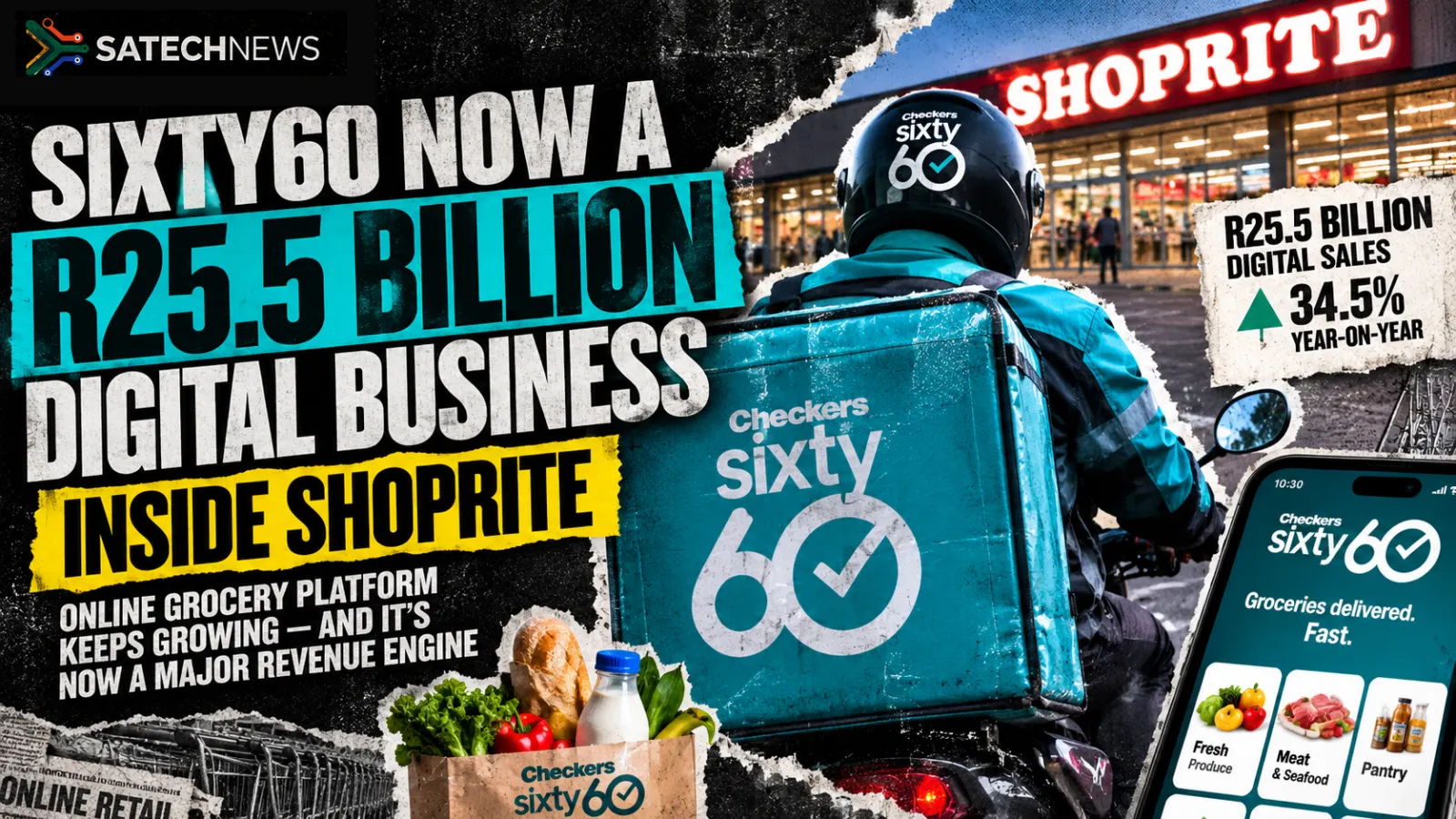
Checkers Sixty60 generated R25.5 billion in annual sales and contributed about 36% of Shoprite group incremental sales growth.
Shoprite's annual results have put a harder number on just how important Checkers Sixty60 has become to Africa's largest retailer: the on-demand platform generated R25.5 billion in sales in the year to 28 June 2026.
Sixty60 sales grew 34.5% over the year, while Shoprite's broader South African supermarket business grew 7.1%. That means the delivery platform expanded at almost five times the rate of the core local supermarket operation.
The contrast is even sharper when measured against the group's total growth.
Shoprite added roughly R18.1 billion in merchandise sales from continuing operations over the year. Group merchandise sales reached R270.8 billion. Sixty60 alone added about R6.6 billion versus the previous year, when its sales were around R18.9 billion.
On that arithmetic, the app contributed roughly 36% of the group's total incremental sales.
For a service launched in 2019 as a fast-grocery delivery product, that is no longer a side business.
Shoprite's full-year figures, released on 1 September, showed headline earnings per share from continuing operations rising 12.2% to R15.32, while EBITDA increased 7.7% to R25.8 billion.
Group sales rose 7.2% to R270.8 billion and the core South African supermarkets segment reached R228.7 billion in sales.
The board declared a final dividend of 566 cents per share, up 14.1%.
Those are strong conventional retail numbers. But Sixty60 is the part that shows how much Shoprite's growth model has changed.
The digital platform does not sit outside the retailer's store network. It sits on top of it.
The group has thousands of physical stores across South Africa, and those stores double as fulfilment infrastructure for digital orders. That gives Sixty60 a network advantage that pure-play delivery businesses have to build separately through dark stores, warehouses or third-party merchants.
The result is a digital service that can scale without replacing the company's physical footprint.
That distinction is important. Management is not choosing between stores and e-commerce. It is turning the stores into part of the e-commerce stack.
Sixty60's R25.5 billion in annual sales is large enough that it should no longer be treated as a feature attached to Checkers.
The platform grew by R6.6 billion in one year. Shoprite's total group sales increased by roughly R18.1 billion.
That means more than one rand in every three rand of new group sales came through the growth of Sixty60.
It is difficult to find another digital product inside a major South African legacy retailer with the same scale of impact on top-line growth.
The platform's growth has also remained consistently above the underlying store business. Shoprite reported 34.6% Sixty60 sales growth in the first half of the financial year, and the full-year rate ended at 34.5%.
This is not a one-quarter spike.
The company has also pushed the service beyond its original grocery-only proposition. Sixty60 increasingly supports broader Checkers merchandise, while subscription products such as Xtra Savings Plus are designed to increase frequency and lock in customers who order often.
That is the same playbook used by large digital platforms globally: build convenience first, then use membership, loyalty and data to deepen the customer relationship.
The strongest part of the model may be the thing that initially looks least digital.
Shoprite opened a net 262 stores in South Africa during the year, taking its corporate-owned and operated local store base to 2,839 outlets.
Every additional store potentially expands the physical infrastructure available to support digital fulfilment.
This is why the usual argument that e-commerce threatens physical retail does not fully apply here. For Shoprite, physical scale can improve digital economics rather than fight against them.
The company already owns the shelves, stock, procurement systems, customer traffic and local distribution footprint. Sixty60 adds software, ordering, picking, delivery and digital customer acquisition on top of that base.
Shoprite's acquisition of delivery partner Pingo has also brought more of that logistics layer under the group's control.
The strategic effect is that a store in a suburb is not only a retail outlet. It can also function as a local fulfilment node for an app serving customers nearby.
There is still one big gap in what investors can see: Shoprite does not report Sixty60 as a standalone operating segment with its own margin, profit or return-on-capital figure.
The company discloses sales generated through the platform, but those sales are included in the underlying retail brands.
That means outsiders can see how fast Sixty60 is growing without being able to cleanly separate how profitable that growth is after picking, delivery, technology, customer support and promotional costs.
That matters more as the platform becomes a larger contributor to group growth.
Fast digital growth is valuable, but the quality of that growth depends on the economics underneath it.
Shoprite's wider results suggest the group is managing growth and profitability well at consolidated level. Gross margin rose to 24.5% from 24.3%, while annual headline earnings increased 12.2%.
Still, as Sixty60 becomes a bigger part of the business, pressure will grow for clearer disclosure around the economics of the platform itself.
The bigger takeaway from Shoprite's results is that South African e-commerce is no longer a separate niche sitting beside traditional retail.
In grocery, the strongest digital services are becoming part of the core competitive structure of the sector.
Sixty60 now has enough scale to influence where Shoprite's growth comes from, how its stores are used and how customers interact with the Checkers brand.
R25.5 billion is the number that makes that shift hard to ignore.
The next stage is not proving that South Africans will buy groceries through an app. Shoprite has already proved that.
The next stage is proving just how much profit, loyalty and strategic advantage a digital commerce engine of this size can produce inside a retail group that still makes most of its money from physical stores.
Source: SA Tech News