Breaking
Latest tech news from South Africa and around the world•Stay updated with breaking technology developments•Innovation and digital transformation news•AI, gaming, and gadget updates daily•Crypto and fintech news from Africa•
 Tech Team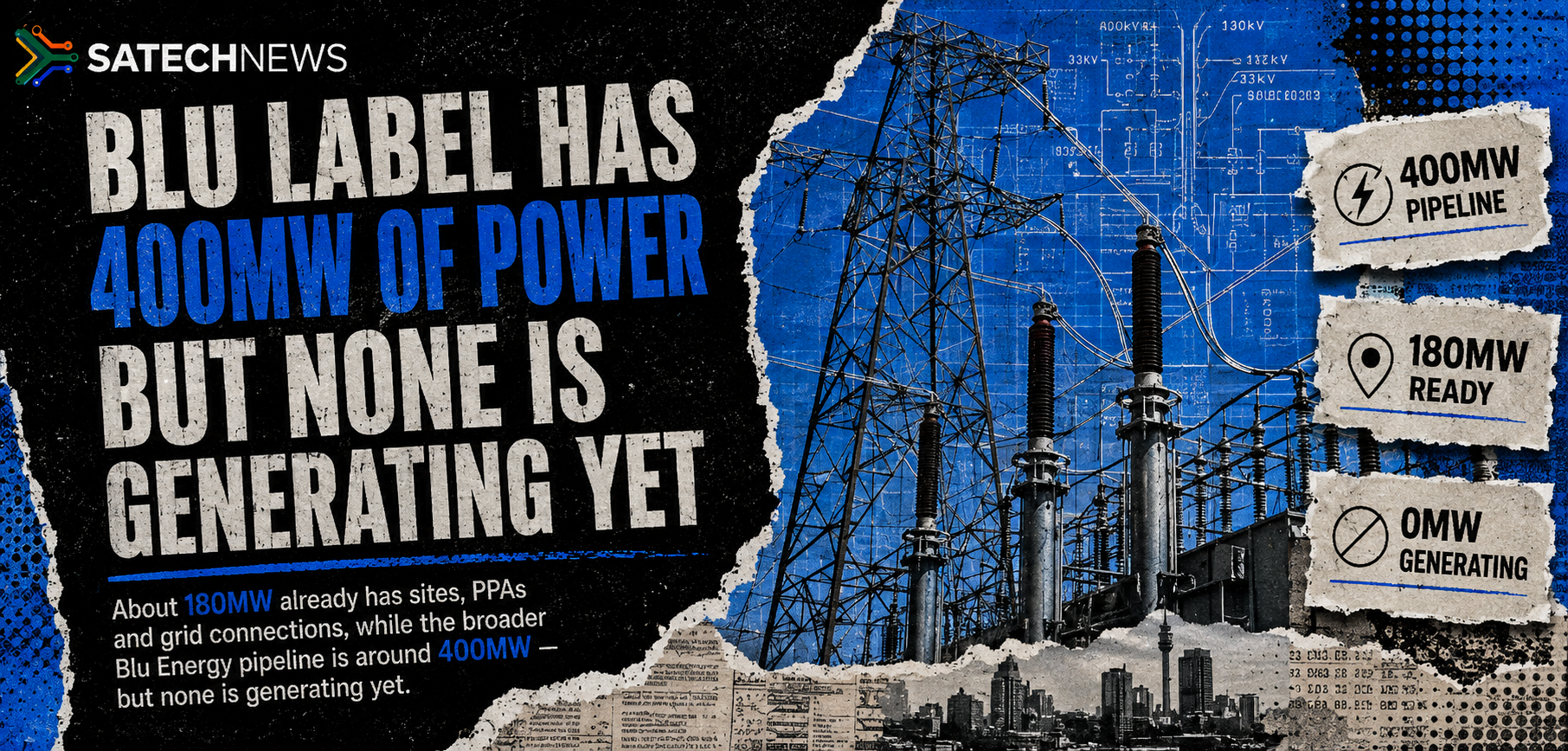
Blu Label says Blu Energy has about 400MW of generation projects in its pipeline and 180MW with sites, PPAs and grid connections, but no capacity is operating yet.
Blu Label Unlimited Group's move into electricity is starting to look less like a side project and more like a second infrastructure business.
The company says its Blu Energy unit has secured access to about 400MW of generation projects, with sites, power-purchase agreements and grid connections already in place for 180MW.
There is one important caveat: none of that capacity is producing electricity yet.
Co-CEO Mark Levy set out the project pipeline after Blu Label's annual results, giving the clearest numbers yet on a strategy the group first outlined earlier this year.
Blu Label says two rooftop solar projects — 9MW and 19MW — are contracted. It also has ground-mounted projects of 50MW, 20MW and 12MW contracted, with a further 70MW identified.
Construction on the rooftop sites is expected to start later this year, while the ground-mounted projects are intended to move in parallel.
The company is deliberately avoiding the idea of one giant power station.
Levy's preferred model is a network of smaller plants, often in the 10MW to 40MW range, supplying individual municipal substations. The argument is that distributed projects can be built faster, reduce concentration risk and fit more closely around existing municipal demand.
A very large plant can take years to develop because of grid studies, environmental approvals, land, financing and transmission constraints. Smaller projects do not remove those hurdles, but they can make the build more modular.
The strategy makes more sense when viewed alongside Cigicell, Blu Label's municipal electricity collections business.
In the year to 31 May 2026, the group processed R46.2 billion worth of prepaid electricity sales for municipalities and utilities, up 4% from the previous year.
Its commission from those transactions fell 13% to R279 million, however, despite the higher electricity value moving through the system.
That squeeze is part of the reason the generation move matters.
Blu Label is already deeply embedded in prepaid electricity distribution and municipal collections. Owning or arranging generation gives it a way to move further up the value chain rather than relying only on thin transaction commissions.
Cigicell has also deployed more than 50,000 smart meters and says another 10,000 to 15,000 are committed.
Blu Label says the generation projects are intended to be financed mainly through infrastructure lenders and green-energy funds instead of loading the parent company's balance sheet with the full construction cost.
The attraction for lenders is visibility.
Because Cigicell already collects municipal electricity payments, the group can potentially structure project cash flows around existing collection systems and escrow arrangements. A municipality signs a power-purchase agreement, customers pay for electricity, and the revenue stream can be used to support project finance.
That is the theory.
South African municipal power projects still carry real risks: weak municipal finances, grid constraints, delayed approvals, political changes and the practical difficulty of securing reliable long-term payment agreements.
The projects will only become meaningful once construction starts and power actually reaches the grid.
Blu Energy has secured a multi-year electricity trading licence from energy regulator Nersa. That allows it to buy and sell electricity and, where the rules and grid arrangements permit, wheel power to large customers.
Electricity trading is becoming a more important part of South Africa's power market as private generation grows and the country moves toward a more competitive wholesale structure.
But the retail market is not fully open. Households still cannot simply choose an electricity supplier in the way they can choose a mobile network.
Blu Label is therefore building around the parts of the market that are already commercially accessible: municipal generation deals, smart meters, collections and power trading for larger users.
A 400MW pipeline is significant, especially for a company best known for airtime, prepaid products and its long involvement with Cell C.
But a pipeline is not a power station.
Blu Label still has to finance, build, connect and operate the projects. The 180MW with more advanced site and grid arrangements is therefore the number to watch first.
If those projects reach commercial operation, Blu Label will have turned a low-margin electricity distribution business into something far more substantial.
If they stall, the 400MW figure will remain exactly what it is today: a plan with projects attached, but no electrons flowing yet.
Source: SA Tech News