Breaking
Latest tech news from South Africa and around the world•Stay updated with breaking technology developments•Innovation and digital transformation news•AI, gaming, and gadget updates daily•Crypto and fintech news from Africa•
 Tech Team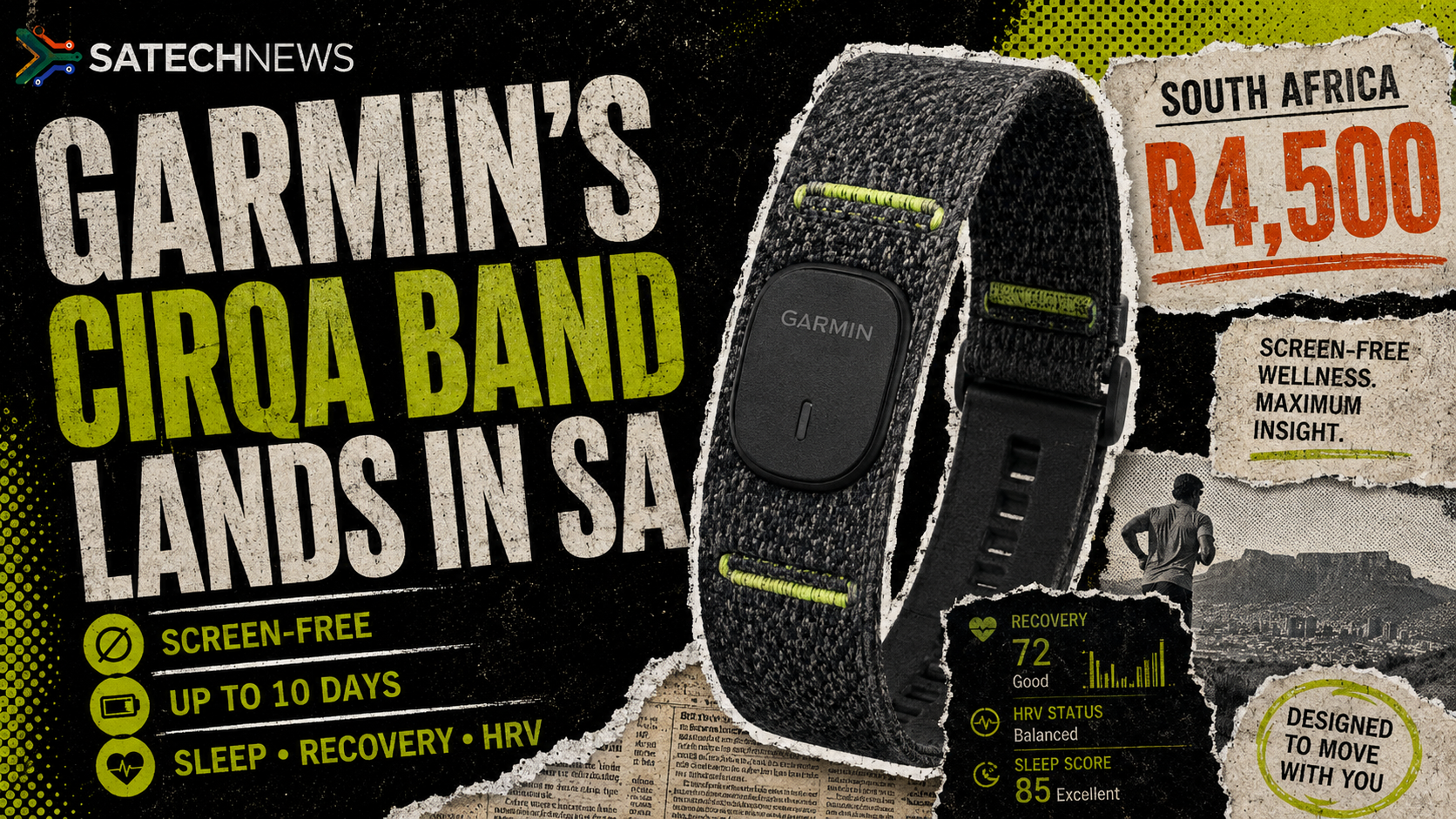
Garmin’s first screenless smart band is now available locally, offering up to 10 days of battery life, 24/7 health tracking and no required subscription.
Garmin has brought its first screen-free smart band to South Africa, giving people who want the company’s health and training data a way to get it without wearing another display on their wrist.
The CIRQA Smart Band is priced at about R4,500 locally and is now being promoted on Garmin’s South African site.
Its central idea is simple: collect the data, put the detailed analysis in Garmin Connect and leave the wrist alone.
There is no display for notifications, apps or workout pages. Garmin instead uses the band for continuous health and activity tracking, with the phone app acting as the main interface.
It is a very different proposition from a smartwatch, and also a direct answer to the growing category of screenless trackers that prioritise recovery and sleep data over notifications.
Garmin says CIRQA can monitor heart rate, heart-rate variability, stress, sleep, sleep score, Pulse Ox and Body Battery, its estimate of how much energy a user has available based on factors such as sleep, activity and stress.
The band also uses skin-temperature data, including for women’s health features, and can contribute to metrics such as training readiness and VO2 max.
Garmin says it supports automatic activity detection and can track a range of workouts, while users can also start activities manually.
There is no built-in display and no on-device map interface. The point is to let the hardware disappear into the background and move the analysis into Garmin Connect.
Battery life is rated at up to 10 days.
The device can be worn on the wrist or upper arm and uses a fabric strap intended for day-and-night wear.
The other notable part of CIRQA is what Garmin is not charging for.
The company says the band does not require a subscription to access its core health and fitness features.
That gives it a different cost profile from some recovery-focused wearables that pair a hardware purchase with an ongoing membership fee.
At roughly R4,500, CIRQA is not cheap for a device with no screen. But the absence of a mandatory subscription means the long-term cost is relatively easy to understand.
For existing Garmin users, the more interesting use case may be as a companion device.
Someone who trains with a large Fenix or Forerunner watch may not want to sleep with it, wear it with formal clothing or keep it on all day. CIRQA can keep feeding health data into the same Garmin Connect account while the main watch is off the wrist.
That ecosystem advantage matters because the value of a health tracker is not just the sensor hardware. It is the history of data around it.
Fitness trackers spent years becoming miniature smartwatches.
They added colour screens, notifications, music controls, payments and increasingly complex interfaces until many products in the category started to overlap with watches.
CIRQA moves in the other direction.
Its appeal is built around reducing distraction and making the tracker less visible in everyday life.
That also changes how it competes. A screenless band is less about glanceable workout stats and more about whether the user trusts the recovery, sleep and health data collected over weeks and months.
Garmin has a strong position here because its Connect platform already combines activity history, training load and wellness metrics for a large base of existing sports-watch users.
The limitation is that people who want to leave their phone behind during a workout will still need another device for GPS and live feedback.
South Africa’s wearable market is split between relatively cheap fitness bands and much more expensive smartwatches.
CIRQA sits between those categories.
It costs more than mainstream screen-equipped bands from companies such as Xiaomi or Huawei, yet significantly less than many premium Garmin watches.
That means Garmin is asking buyers to pay for the sensors, software ecosystem and long-term health analysis rather than for a display.
For someone already committed to Garmin Connect, that can make sense.
For a first-time fitness tracker buyer, the comparison is harder because R4,500 buys several capable devices with screens, GPS or broader smartwatch functions.
CIRQA therefore looks less like a mass-market replacement for a smartwatch and more like a specialised accessory for people who actively do not want one.
That is what makes it interesting.
The wearable industry spent years assuming every wrist device needed to demand more attention. Garmin is now betting there is a meaningful group of South African buyers willing to pay for a device whose main feature is that it stays out of the way.
Source: SA Tech News