Breaking
Latest tech news from South Africa and around the world•Stay updated with breaking technology developments•Innovation and digital transformation news•AI, gaming, and gadget updates daily•Crypto and fintech news from Africa•
 Tech Team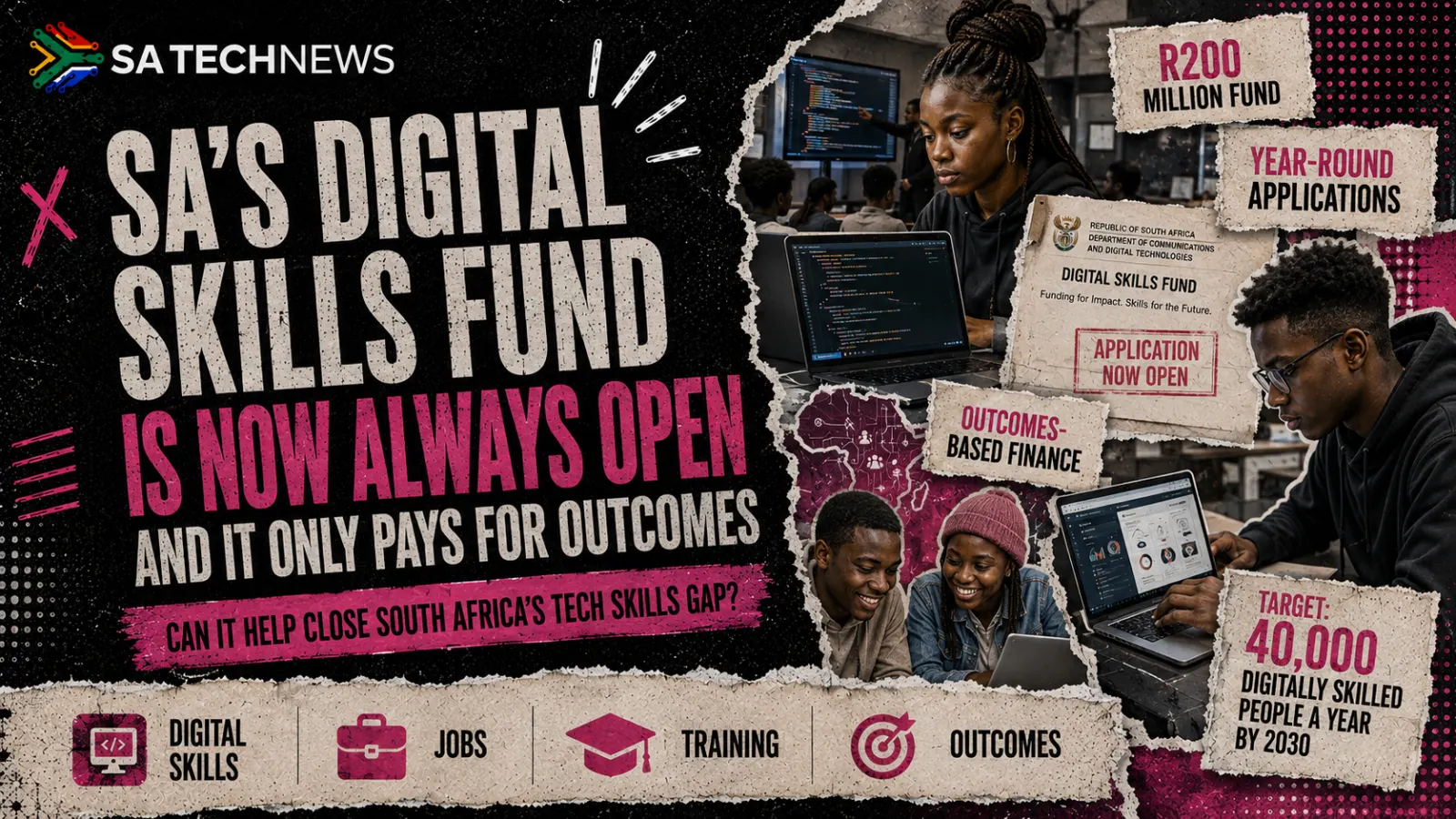
The Digital Skills Impact Fund has R200 million this year and more than R600 million committed, paying for verified jobs rather than course seats.
South Africa has no shortage of training programmes. The harder question is what happens after the certificate.
Collective X is trying to force that question to the front of the funding model.
Its Digital Skills Impact Fund has scrapped fixed application windows and moved to an always-open system, with R200 million committed for the next 12 months. Employers, training providers and programme aggregators can now apply whenever they have a cohort ready to move through an approved pathway.
The interesting part is not simply that applications are open. It is what the fund pays for.
Instead of funding training inputs and hoping jobs appear later, the model co-pays partners for verified outcomes, recognised digital skills, structured workplace experience and, ultimately, employment.
That is a much harder standard than counting how many people attended a course.
The fund has more than R600 million in current multi-year financing commitments, according to Collective X. R200 million of that is allocated to the year ahead.
Since the fund launched in 2024, more than 1,800 young people have participated or are currently participating in supported programmes across all nine provinces.
Collective X says 97% of participants have been absorbed into employment, with more than 75% employed after six months.
Those numbers are unusually strong for a youth-skilling programme and deserve scrutiny as the fund scales. But the underlying design is sensible: employers have to be part of the pipeline before training starts, rather than being treated as the final audience for graduates somebody else decided to produce.
Training is mapped to the Skills Framework for the Information Age, or SFIA, an international framework used to describe technology roles and skill levels. That means a programme is supposed to train toward a recognisable job capability rather than a vague "digital skills" certificate.
Collective X estimates that South Africa currently produces about 20,000 digitally skilled workers a year.
The National Digital Skills Plan wants that number above 40,000 a year by 2030 and aims to help 500,000 young people move into in-demand digital roles by 2034.
The gap is not theoretical.
Companies regularly complain that entry-level technology vacancies attract large applicant pools but a much smaller number of candidates who can actually do the work. At the same time, South Africa has one of the world's toughest youth-employment problems.
Those two realities should create an obvious opportunity. In practice, the bridge between them is messy.
Training providers are rewarded for completions. Employers want people who can contribute quickly. Young candidates are often told to accumulate certificates without being given the workplace experience that makes those certificates useful.
The fund's two pathways are designed around that bottleneck.
The full route to competence is aimed at young people without post-school technology training and combines foundational learning with structured, paid work-integrated learning. A second route is for candidates who already have relevant training and mainly need workplace experience.
Funding windows make sense when a programme is small. At scale, they can become an administrative traffic jam.
An employer with 30 junior roles ready in October should not have to wait for a funding call in February. A training provider should not have to reshape a real hiring pipeline around a grant calendar.
Collective X says moving to year-round applications should help grow its active employer and implementation partners from about 30 to 100 by the end of 2026.
That will test whether the model can preserve quality as it expands.
The fund has participation targets of 85% Black African beneficiaries, 70% women and 1.5% people with disabilities. Employers must also be able to demonstrate genuine job opportunities and are expected to place at least 70% of participants after workplace experience.
Those requirements are important because outcomes-based funding only works if the outcomes are difficult to game.
R200 million is significant, but it will not solve South Africa's technology talent shortage on its own.
The more interesting possibility is that the model changes employer behaviour.
If companies can bring junior talent in through structured work experience, share some of the early cost and train against clearly defined roles, they may be more willing to hire people who do not arrive with the traditional degree-plus-experience combination.
That is where the fund could have an effect beyond the people it directly supports.
South Africa does not only need more coding courses. It needs a better conversion rate between learning and a first real job.
A fund that is judged by who gets employed rather than who gets trained is at least measuring the right end of the problem.
Source: SA Tech News