Breaking
Latest tech news from South Africa and around the world•Stay updated with breaking technology developments•Innovation and digital transformation news•AI, gaming, and gadget updates daily•Crypto and fintech news from Africa•
 Tech Team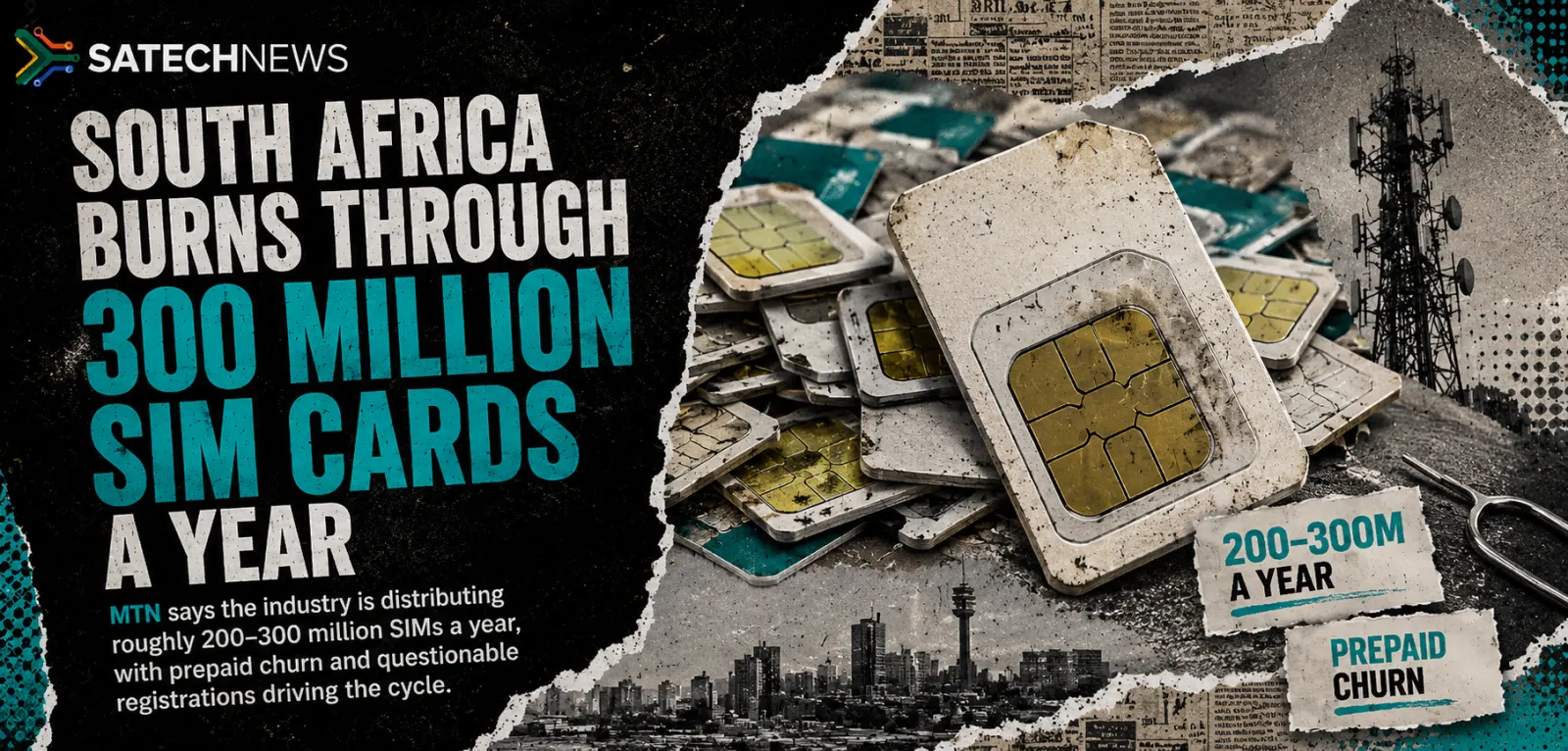
MTN says South Africa's mobile industry may distribute 200 to 300 million SIM cards a year, driven by prepaid churn and weak registration.
South Africa's prepaid mobile market has produced a number that looks absurd even before you compare it with the population: the industry may be putting between 200 million and 300 million SIM cards into the market every year.
MTN South Africa CEO Ferdi Moolman says his company alone has been distributing about 90 million prepaid SIMs annually.
South Africa has roughly 65 million people.
The explanation is not that the country suddenly has hundreds of millions of active mobile users. It is churn: people repeatedly buying, registering, using and discarding prepaid SIMs as they move between networks and promotions.
That behaviour is exposing weaknesses in both the economics of prepaid mobile and the country's SIM-registration system.
MTN Group CEO Ralph Mupita said South Africa has become a much more aggressive multi-SIM market, with some customers carrying several SIMs and switching network by network depending on which recharge or data deal is cheapest.
That is a rational response in a price-sensitive market.
For operators, however, it creates an ugly cycle. They spend money producing and distributing huge volumes of SIMs, retailers push those SIMs into the market, and a large share eventually becomes dormant or gets discarded.
The volumes can generate activation and recharge revenue in the short term, but MTN says it does not regard that pattern as sustainable.
The problem is not entirely new. Industry estimates in 2024 already suggested roughly 180 million SIMs were being produced annually. The latest figures indicate the churn may have become even more extreme.
Every South African SIM is supposed to be registered under RICA, the Regulation of Interception of Communications and Provision of Communication-Related Information Act.
In theory, that means a mobile number should be tied to a verified identity and address information.
In practice, the prepaid ecosystem has long struggled with inaccurate registrations, fraudulent identity use, informal sales channels and SIMs activated under details that do not reliably identify the person using them.
MTN says the active base contains registrations it does not trust.
That is more than an administrative nuisance. SIM registration sits inside fraud prevention, banking security, law-enforcement requests, account recovery and the growing use of mobile numbers as identity credentials.
If the underlying registration data is poor, every system that assumes a mobile number equals a verified person becomes weaker.
There is also a physical cost.
SIM cards are small, but they are not harmless. They contain plastic, metals and silicon, and usually arrive in larger plastic or cardboard carriers. When customers continually rotate prepaid SIMs, those materials become a high-volume waste stream.
Operators have already reduced the physical size of SIM cards and their packaging, but that only reduces the waste per unit. It does not solve the basic problem if hundreds of millions of units are still being pushed through the market.
eSIM could eventually remove much of the physical waste, but it is not yet a complete answer in South Africa. Many lower-cost phones still rely on physical SIMs, and prepaid eSIM distribution is not as universal or frictionless as buying a cheap starter pack from a shop or street vendor.
The deeper issue is that South Africa's prepaid market rewards constant switching.
If a customer can save money by buying a new starter pack or moving to a temporary promotion, the market is effectively encouraging churn. Networks then respond by producing more SIMs and fighting harder for each short-lived activation.
The result is a strange mismatch: operators spend heavily on customer acquisition while customers become less attached to any one network.
Cleaning up RICA registrations may reduce fraud, but it will not by itself stop the SIM-card conveyor belt.
That will require better long-term prepaid value, easier number portability, stronger digital SIM onboarding and fewer incentives that make a fresh SIM cheaper or more attractive than staying with an existing number.
The latest numbers make the scale of the problem difficult to ignore. A country of around 65 million people should not need anything close to 300 million new SIM cards every year.
Source: SA Tech News