Breaking
Latest tech news from South Africa and around the world•Stay updated with breaking technology developments•Innovation and digital transformation news•AI, gaming, and gadget updates daily•Crypto and fintech news from Africa•
 SA Tech News Desk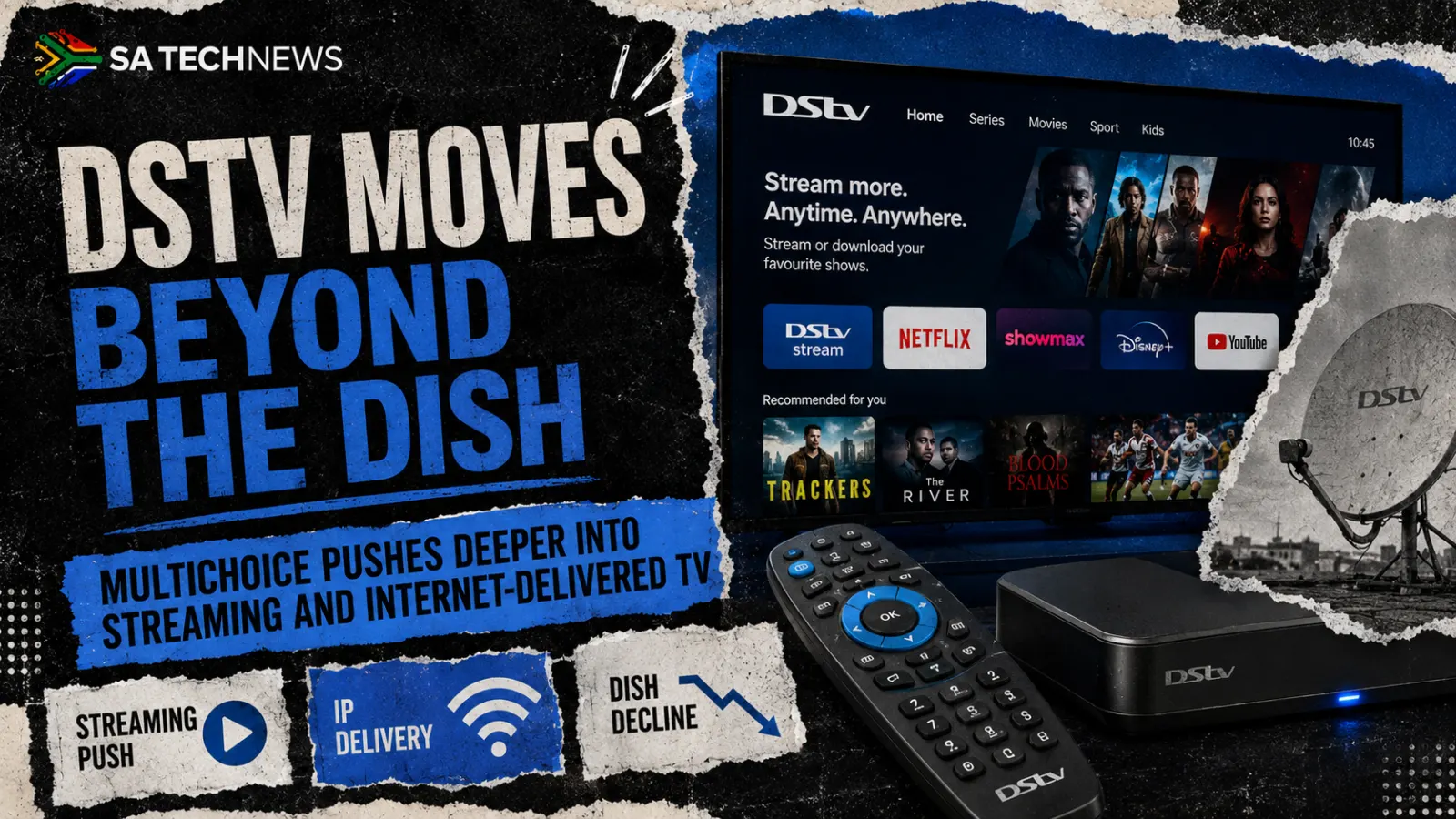
DStv streaming-only packages can cost less than satellite equivalents. MultiChoice is slowly separating TV from the dish that built it.
For decades, the DStv dish was part of the South African suburban households.
You moved into a house, looked at the roof and there it was: a pale grey oval pointing north-east, usually attached with the sort of permanent confidence that suggested television would always arrive from space.
That assumption is starting to look old.
DStv customers can now buy several packages as streaming-only subscriptions with no decoder, no satellite installation and, on some tiers, a noticeably lower monthly bill than the traditional satellite equivalent.
MyBroadband calculated that satellite customers switching to streaming-only products can save as much as 38%, provided they already have a reliable Internet connection that they pay for anyway.
The exact saving depends on the package. Premium, for example, is listed at R799 for streaming-only compared with R979 for satellite. Family is R299 streaming-only versus R339 on satellite, while Access is R99 for streaming and R150 for satellite. Compact and other tiers vary, and DStv has changed package structures several times in recent years.
The immediate story is price.
The more interesting one is what this says about MultiChoice.
DStv is slowly becoming a television service that happens to support satellite, rather than a satellite service that happens to have an app.
Satellite broadcasting is extraordinarily good at one thing: sending the same high-quality television signal to millions of households at once.
It does not care whether the home is in Sandton, Soweto, Upington or a farm outside Mthatha. If there is a clear view of the satellite and electricity for the decoder, the signal arrives without consuming household data.
That remains a huge advantage in a country where fixed broadband is uneven and mobile data can still be expensive.
But satellite has costs that streaming does not.
A new customer may need a dish, LNB, cabling, installation and a decoder. MultiChoice has to subsidise and support that hardware, manage installers and maintain an entire physical distribution chain.
A streaming customer signs up, downloads an app and starts watching on hardware they already own.
The network cost does not disappear; it shifts to the customer's Internet provider.
That shift is increasingly attractive to MultiChoice because millions of South African households already pay for fibre or fixed wireless broadband for work, gaming, social media and other streaming services.
For those customers, the DStv satellite infrastructure becomes duplicated connectivity.
If Netflix, YouTube, Disney+ and Amazon Prime Video all arrive through the router, it becomes harder to explain why live television must still enter the house through a separate dish.
The timing matters.
Canal+ took control of MultiChoice in 2025 after a long takeover process and later completed the acquisition of the remaining shares. It inherited a company under pressure from declining traditional pay-TV economics across parts of Africa.
MultiChoice revenue has continued to slide, while South African viewers have spent the past decade becoming comfortable with on-demand streaming.
DStv Premium is the clearest example of the structural problem. The top-end bouquet once had more than two million South African subscribers and was the default choice for households that wanted premium international entertainment and sport. Netflix's local launch in 2016 coincided with the beginning of a long decline in the Premium base.
DStv still has a formidable asset that international streaming services struggle to match: live sport, particularly SuperSport's portfolio.
But even that strength no longer requires a satellite dish.
DStv Stream can deliver live channels over broadband, and the company has spent years improving its streaming-only products. Its own marketing now explicitly tells customers they can start watching without a decoder or satellite dish.
That is a meaningful psychological change for a brand that spent decades training customers to associate DStv with installed hardware.
Streaming-only DStv is not automatically the right choice for every household.
The first requirement is obvious: Internet.
A satellite customer can watch hours of television without thinking about data usage. A streaming household needs a connection that is fast enough, stable enough and preferably uncapped.
If you already have fibre, the comparison is relatively simple. If you would need to buy a new broadband package purely to replace the DStv dish, the apparent saving can evaporate.
Reliability works differently too.
Satellite television can be affected by severe weather, but it is not dependent on a neighbourhood fibre outage, router problem or congested mobile tower. Streaming is only as good as the connection underneath it.
There are also differences in how people use television. Traditional decoder customers may value PVR recording, familiar channel surfing and a dedicated remote. Streaming is better suited to households already comfortable moving between apps on smart TVs, phones and tablets.
For many younger households, that transition happened years ago. For others, the decoder remains simpler.
That is why MultiChoice is unlikely to kill satellite abruptly. The dish continues to solve a real distribution problem across South Africa and the rest of the continent.
The shift will be gradual and economic: streaming becomes the default where broadband is good enough, while satellite remains important where it is not.
The uncomfortable part for MultiChoice is that once DStv enters the app row on a smart TV, it loses some of the protective power of the decoder.
On satellite, DStv owns the entire television environment. On a smart TV, DStv sits next to Netflix, YouTube, Disney+, Prime Video, Apple TV and dozens of free services.
Switching is one button press.
That forces the company to compete more directly on price, interface quality, recommendation systems and content value.
It also explains some of the broader changes around the business. MultiChoice shut down Showmax as a standalone service in April 2026 after Canal+ reviewed the group's streaming operations, with selected Showmax content moving into DStv Stream for eligible customers. The move simplified the portfolio but also concentrated more of the company's online strategy around the DStv platform itself.
Meanwhile, linear channel line-ups are being trimmed and reorganised. Four DStv channels are scheduled to close in September, while other international channels have disappeared during the year.
A streaming-first future gives MultiChoice more flexibility to package content differently instead of treating every customer as a fixed bundle of linear channels.
Whether it uses that flexibility well is another question.
The old framing was simple: DStv versus Netflix.
That is no longer quite right because DStv itself is now a streaming service.
The real competition is for monthly household entertainment spend.
A South African family with fibre might choose DStv Compact, Netflix and YouTube. Another might spend the same money on Disney+, Prime Video, a sports-specific service and free local platforms. A football household may still see DStv as non-negotiable because of SuperSport, while a household that mainly watches drama and films may struggle to justify it.
Once distribution is no longer tied to a dish, those comparisons become easier and more brutal.
DStv's response has included lower streaming-only prices, bill splitting, promotions and a stronger attempt to bundle its content in ways that feel closer to modern subscription services.
The company is also keeping satellite alive through decoder subsidies because millions of customers still need it.
That dual strategy is sensible. South Africa is not a market where one technology can replace the other overnight.
It is tempting to declare the end of satellite television because streaming is cheaper on a spreadsheet.
That would be premature.
Satellite remains efficient, proven and widely accessible. It will continue to serve customers in areas where fibre is absent, mobile networks are inconsistent or households simply prefer the reliability of broadcast TV.
But the direction of travel is hard to miss.
DStv itself is telling customers that a dish is no longer necessary. Streaming-only packages are cheaper on several tiers. Showmax content has been folded into the DStv app. Smart TVs are increasingly the main screen rather than passive displays attached to a decoder.
The technology that defined MultiChoice is becoming one delivery option among several.
For customers, that is good news. More delivery options create room for price competition and make it easier to cancel, downgrade or switch without an installer visiting the house.
For MultiChoice, it is more complicated. The company has to give up some of the lock-in that made satellite pay-TV such a powerful business in exchange for a better chance of staying relevant in a broadband world.
The DStv dish is not disappearing tomorrow.
It is just no longer the centre of the product, and that may be the biggest change South African television has seen since Netflix arrived.
Source: SA Tech News