Breaking
Latest tech news from South Africa and around the world•Stay updated with breaking technology developments•Innovation and digital transformation news•AI, gaming, and gadget updates daily•Crypto and fintech news from Africa•
 Tech Team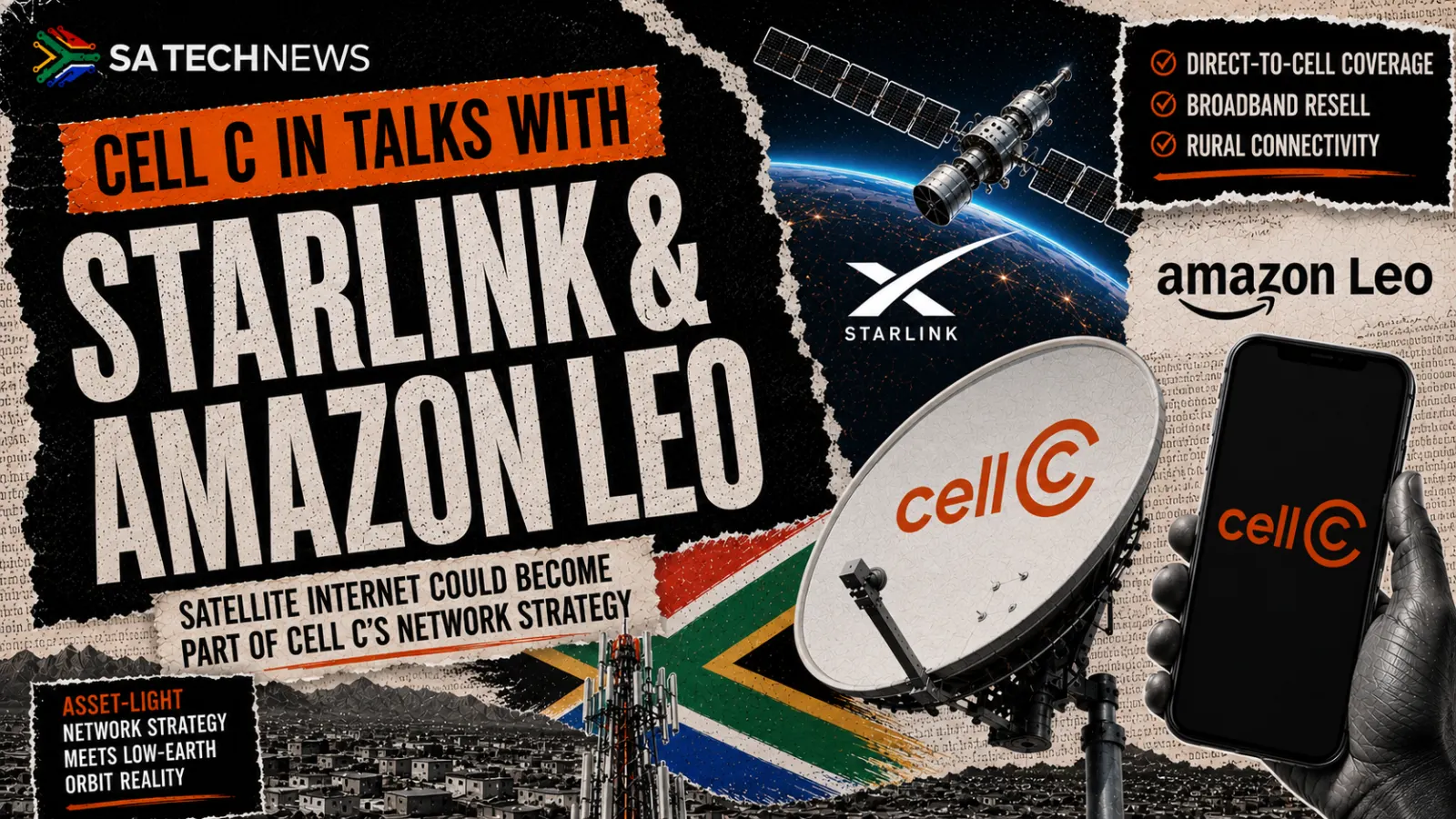
Cell C confirms talks with Starlink and Amazon Leo, and how satellite fits its asset-light network and rural coverage plans.
Cell C has confirmed that it is in discussions with low-Earth orbit satellite operators including Starlink and Amazon Leo as it weighs two very different satellite opportunities: extending mobile coverage directly from space and reselling satellite broadband to customers beyond the reach of terrestrial networks.
The talks do not amount to a signed South African launch deal, and Cell C has not disclosed which providers it expects to work with, on what terms, or when any service could go live. But the direction matters because it fits neatly into the operator's broader strategy: use other companies' infrastructure where it makes sense, keep capital requirements lower, and focus on the customer relationship rather than owning every layer of the network.
Cell C told MyBroadband that it continues to engage with a range of industry participants, including LEO satellite providers, as part of its assessment of future connectivity opportunities. The company is considering both direct-to-cell arrangements and the resale of satellite broadband packages.
Direct-to-cell and fixed satellite broadband are often discussed as though they are the same thing. They are not.
A direct-to-cell service uses satellites to communicate with compatible ordinary mobile phones, potentially filling gaps where there is no terrestrial cell tower. That could be useful on farms, along roads and in sparsely populated areas where building conventional radio sites is difficult to justify commercially.
Fixed LEO broadband is closer to a satellite version of fibre or fixed wireless. Customers use a dedicated terminal or antenna at a home or business, with the satellite constellation providing the backhaul connection.
For Cell C, the first option could add coverage without requiring it to build thousands of rural sites. The second could give it a product to sell in places where fibre, fixed wireless and conventional mobile broadband are weak or unavailable.
That is why the satellite question is especially relevant to Cell C. The operator has spent years moving away from a traditional infrastructure-heavy mobile model. It relies extensively on roaming and network-sharing arrangements with larger operators while retaining its own spectrum, core network, brand and customer base. Satellite could become another wholesale network layer in that mix.
Amazon Leo already has a publicly announced South African partner. In July, Amazon said Herotel would use its satellite network for a new residential service called evry, with commercial launch expected in 2027. Amazon says the agreement is intended to reach homes and small businesses beyond fibre and fixed-wireless coverage.
Herotel will bring an existing local footprint to the deal. Amazon says the ISP serves more than 350,000 active customers across more than 550 towns and has 120 local offices.
The regulatory groundwork is also moving. ICASA is in the middle of updating South Africa's satellite licensing framework. Its 2026 draft changes cover a registration regime for satellite space-segment operators, blanket licensing for satellite terminal networks and revised spectrum fees. Amazon Leo, SpaceX, MTN, Vodacom and other industry players have all participated in the regulator's consultation process.
That means there is a plausible path for more satellite wholesale partnerships, but it does not mean every provider can simply switch on service. Local electronic communications licences, spectrum authorisations and the final shape of ICASA's satellite rules still matter.
Starlink is the obvious name in LEO broadband because SpaceX already has the world's most mature consumer satellite network. It also has coverage over South Africa. What it does not have is a commercial South African service.
That distinction matters when reading too much into Cell C's discussions. A conversation with Starlink is not the same as regulatory approval, a reseller agreement or a launch date.
SpaceX has participated in ICASA's satellite and communications-licensing consultations, so the company is clearly engaged with the South African regulatory process. But there is still no announced Starlink consumer launch in the country.
Cell C therefore has more certainty, at least publicly, around Amazon Leo's planned South African market entry than it does around Starlink. Amazon has named a local partner and a 2027 target.
The operator does not need to win a satellite race on engineering. Its value could be in distribution, billing, customer support and bundling.
A Cell C customer could theoretically buy terrestrial mobile service for everyday use and a satellite product for a farm, lodge, remote business or backup connection under the same commercial relationship. Direct-to-cell could eventually make that proposition more interesting by reducing dead zones without requiring a separate broadband terminal for basic mobile connectivity.
None of that is confirmed yet. Cell C has not announced a product, pricing, launch window or provider. There is also no evidence yet that a satellite partnership would materially change the operator's economics.
What is confirmed is that South Africa's satellite market is becoming less theoretical. Amazon Leo has a local commercial route, ICASA is rewriting the satellite rulebook, and multiple mobile operators are exploring partnerships with LEO providers.
For Cell C, that creates an opportunity that looks unusually well matched to the company it has become: a mobile operator trying to compete without owning every piece of the network underneath the service.
Source: SA Tech News