Breaking
Latest tech news from South Africa and around the world•Stay updated with breaking technology developments•Innovation and digital transformation news•AI, gaming, and gadget updates daily•Crypto and fintech news from Africa•
 SA Tech News Desk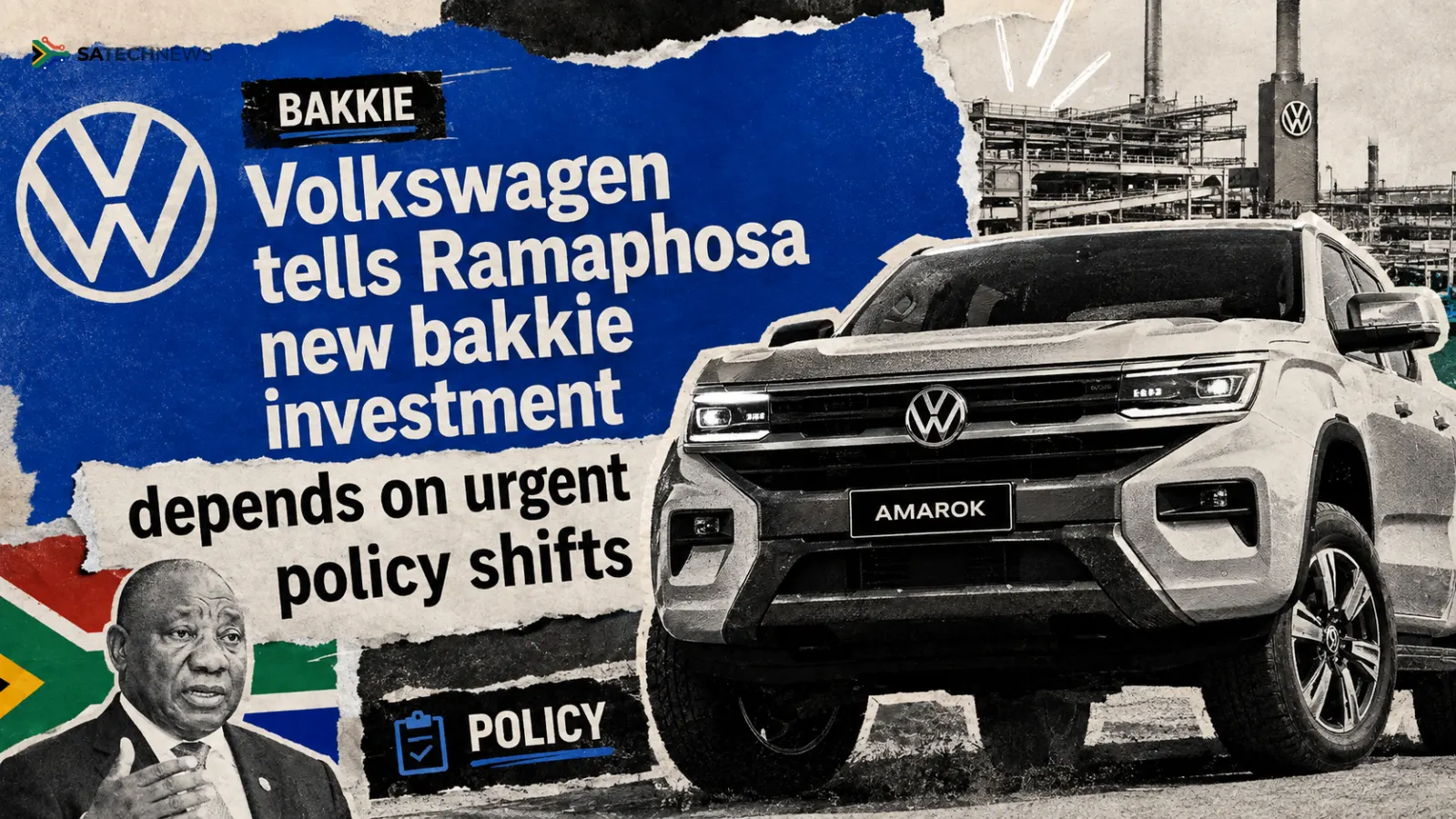
Volkswagen says a new bakkie programme at Kariega depends on tax and incentive changes as local vehicle manufacturing faces rising costs.
Volkswagen has warned the South African government that a proposed new pick-up truck programme will not proceed without changes to taxes and incentives, adding pressure on policymakers already facing an erosion of local vehicle manufacturing.
The message reached President Cyril Ramaphosa in a letter last year that has only recently drawn wider attention. Martina Biene, chair of Volkswagen Group Africa, has since made the stakes public: without policy movement, the economics of a new bakkie line at the Kariega plant in the Eastern Cape do not close.
Volkswagen is evaluating a compact pick-up similar to the Tukan programme planned for Brazil from 2027. Executives argue a bakkie is a better fit for South African demand than another high-volume passenger car, and that Kariega needs a anchor product beyond the Polo and Polo Vivo if it is to run at sustainable capacity through the next decade.
A decision to invest would likely land in the 2029-2030 window, and only if government adjusts the framework that determines whether exporting from South Africa still makes sense.
Volkswagen has pressed for a higher ad valorem tax threshold on vehicles, more flexible use of export rebates, and demand-side measures that support local sales rather than export-only production. These are not new complaints in the automotive sector; they surface whenever global platforms are allocated across plants in Mexico, Eastern Europe and South Africa.
The Department of Trade, Industry and Competition said in December that it is reviewing automotive policy. No timeline for decisions has been published.
South Africa's vehicle industry still matters, thousands of jobs in Kariega and across suppliers, but the export model that sustained it is under strain. Europe and the United Kingdom are tightening rules on internal-combustion exports. Only about a third of vehicles sold locally are built here, down from more than half two decades ago.
Biene has framed the bakkie decision as existential for the plant: a bet that South Africa can compete on cost and quality, not on history alone.
Volkswagen has board-level interest in the product concept. It does not yet have a funded commitment. Government has acknowledged the pressure without announcing concessions. Until one side moves, Kariega waits, and so do the suppliers whose contracts depend on volume that a new bakkie would protect.
A bakkie programme is not only a Volkswagen decision. Tooling houses, seat plants and logistics contractors in the Eastern Cape plan capacity years ahead. Without a clear product, those firms delay hiring and equipment orders. That is how a national manufacturing story becomes a local employment one before any press release lands.
If the policy review stalls into another year of statements without thresholds or rebate rules, rival plants outside South Africa will keep winning platform allocations by default.
Biene's letter to Ramaphosa makes the sequence explicit: policy first, product decision second. Government can answer with timelines, or Kariega keeps waiting while Brazil's Tukan programme moves.
Source: SA Tech News