
Breaking
Latest tech news from South Africa and around the world•Stay updated with breaking technology developments•Innovation and digital transformation news•AI, gaming, and gadget updates daily•Crypto and fintech news from Africa•
 SA Tech News Desk
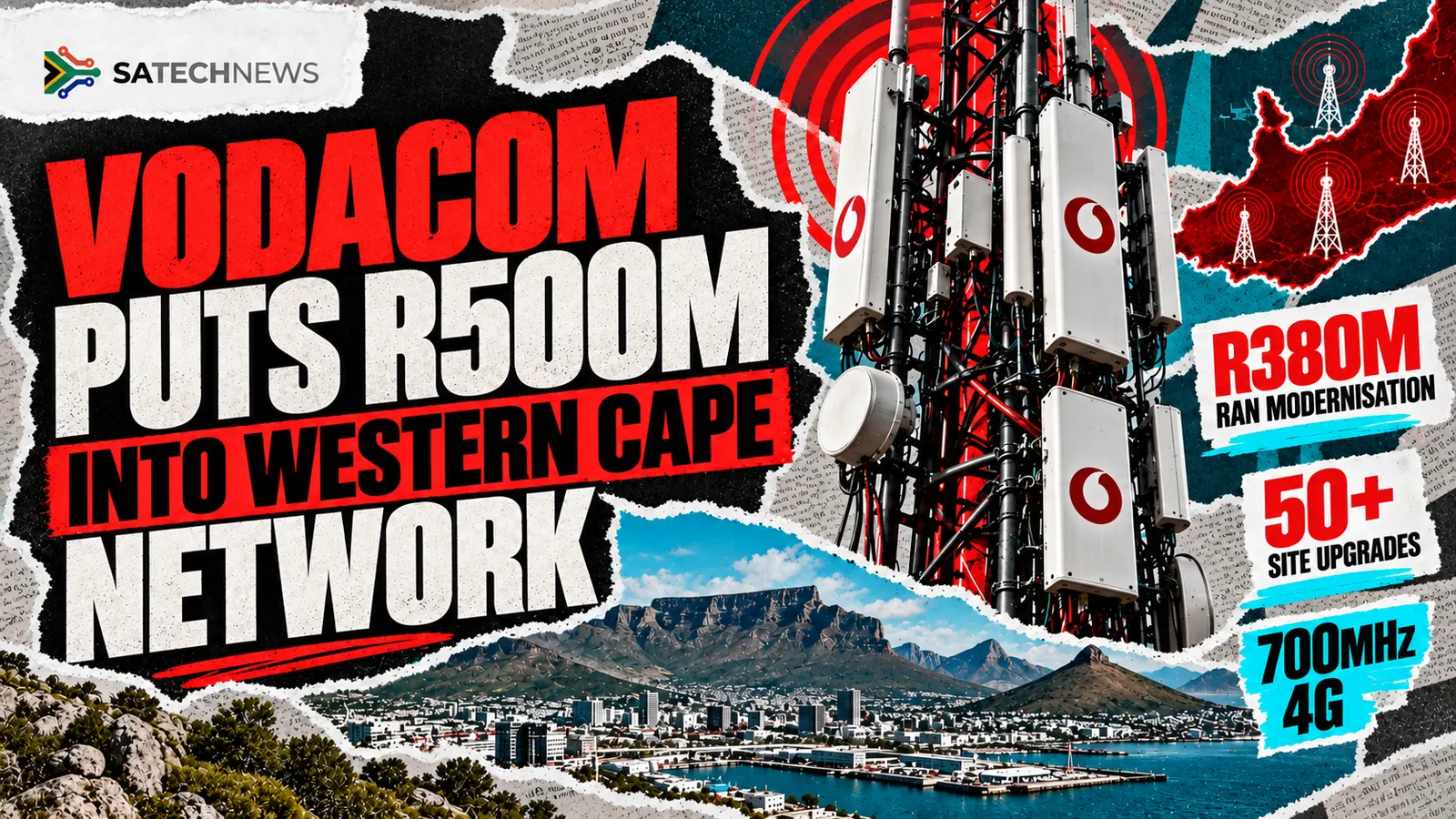
Vodacom will spend more than R500m on Western Cape network upgrades, including 4G capacity, 5G expansion and RAN modernisation.
Vodacom plans to invest more than R500 million in its Western Cape network during the current financial year, with radio upgrades, additional 4G capacity and new 5G sites forming the core of the programme.
The spending is material for customers because it targets both capacity and coverage rather than a single headline 5G rollout. More than 50 sites are due to be upgraded or replaced, while another 50-plus sites will receive additional 4G capacity using 700MHz spectrum.
Around R380 million is earmarked for radio access network modernisation, including newer hardware, software and network architecture.
Low-band spectrum travels further and penetrates buildings better than the higher frequencies often associated with mobile broadband.
Vodacom's use of 700MHz for 4G capacity therefore matters outside dense city centres as well as inside buildings where higher-frequency signals can struggle.
The operator also plans to accelerate new 5G deployments across Western Cape towns. That adds capacity for mobile users and gives Vodacom more room to sell fixed-wireless home internet where fibre is unavailable or uneconomic.
Cape Town's CBD and Atlantic Seaboard already get the marketing attention. The useful test is whether 700MHz and site swaps improve service in George, Worcester, the Cape Flats and indoor coverage where mid-band 5G still fades.
South Africa's large operators are no longer dealing with the same spectrum constraints they faced before the 2022 auction.
The competitive question is increasingly about how efficiently that spectrum is deployed, how quickly older radio equipment is modernised and how much capacity operators can add without pushing site costs sharply higher.
Vodacom has also been testing more compact antenna configurations with Nokia in the Western Cape, aimed at crowded tower sites where physical space and power consumption can constrain upgrades.
The new capital programme sits in that broader modernisation effort. Compact radios and RAN swaps are boring engineering. They are how operators fit more capacity onto towers that already host three networks and a landlord who will not approve another cabinet.
MTN and Cell C will answer with their own provincial spend. Customers will not read the R500 million figure on a SIM. They will notice whether evening congestion drops on the N2 corridor and whether indoor calls hold.
Network investment can improve speed, reliability and coverage, but it does not guarantee cheaper data.
South African mobile pricing is shaped by spectrum costs, network capital expenditure, electricity and backup-power costs, competition and the structure of prepaid bundles.
For users, the useful measures will be whether congestion falls in busy areas, whether indoor coverage improves and whether 5G becomes available beyond the province's wealthiest urban zones.
Fixed-wireless on 5G is the commercial upside Vodacom wants from denser Western Cape sites. That product only works if backhaul and radio capacity survive peak video hours. A 5G icon on a phone in a load-shedding suburb is not a home broadband substitute.
Vodacom has not published a town-by-town rollout schedule for every new 5G site or a complete list of the 4G sites receiving 700MHz upgrades.
That makes the R500 million figure clear while the customer-level impact remains harder to measure. The test will be visible in coverage maps, real-world capacity and the number of Western Cape communities that see a meaningful service improvement rather than another 5G icon on a phone.
Watch the 50-plus site upgrades completing, the 700MHz 4G layer lighting up outside Cape Town, and whether fixed-wireless take-up follows the radio build. The Wire Room scoreboard is congestion and indoor coverage — not the capital announcement.
R380 million of the package is RAN modernisation. That is the least glamorous line and the one customers feel first when an old radio stops dropping mid-band capacity after 18:00.
Western Cape tourism and call-centre traffic spike seasonally. Network plans that only chase permanent residents miss December congestion. Ask whether the site list includes holiday corridors as well as suburban densification.
Compact Nokia gear tested in the province is a space-and-power story as much as a 5G story. Towers are crowded. Backup batteries are expensive. Smaller radios help if landlords and municipalities approve swaps fast enough.
The R500 million headline is clear. The town list is not. Until Vodacom publishes more geography, the provincial spend is a capital figure looking for proof on the street.
Provincial totals hide site lists. Customers in Mitchells Plain, Stellenbosch, George and the Garden Route experience different networks. Without a public breakdown by town or corridor, the headline remains a corporate number.
Ask whether the spend includes backhaul and core upgrades or only radio access. RAN modernisation without transport capacity moves the bottleneck rather than removing it. Nokia's compact radios help on tower real estate; they do not replace fibre where fibre is the constraint.
Also separate coverage claims from capacity claims. Lighting a new site in a thin area is different from densifying Cape Town suburbs that already have bars but collapse at peak. Vodacom's language leans capacity. Proof is evening throughput and indoor consistency after the swap programme completes.
The Wire Room will mark this investment as delivered when Vodacom publishes clearer geography and when independent speed and availability checks show the evening cliff flattening in named Cape corridors — not when the capital figure is repeated in another release.
Source: SA Tech News


