
Breaking
Latest tech news from South Africa and around the world•Stay updated with breaking technology developments•Innovation and digital transformation news•AI, gaming, and gadget updates daily•Crypto and fintech news from Africa•
 SA Tech News Desk
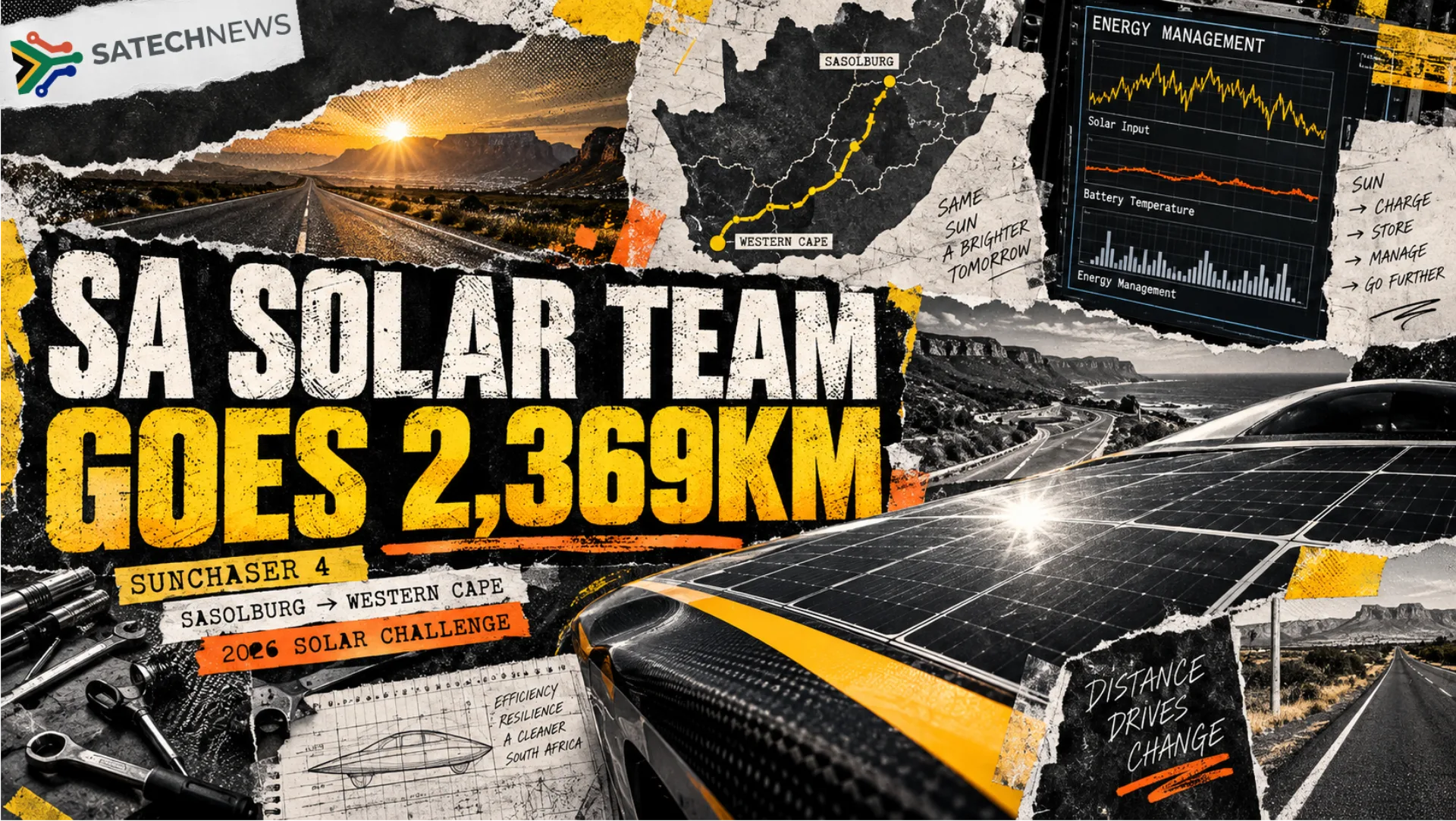
TUT’s SunChaser 4 completed 2,369.2km to win the 2026 Sasol Solar Challenge, putting South African student engineering through a real road test.
Tshwane University of Technology’s SunChaser 4 has won the 2026 Sasol Solar Challenge after completing 2,369.2km from Sasolburg to the Western Cape. The result gives a South African student engineering team the top spot in a competition where distance and energy management matter more than outright speed.
For South Africa, the useful part of the result is what happened between the start and finish. TUT says SunChaser 4 became the first South African team to complete this specific route without being trailered. Engineering News reports that the team finished ahead of Solar Energy Racers from Switzerland and Team AgniRath from India.
The eight-day challenge forces teams to manage a solar car through changing weather, road surfaces and energy constraints. Each day includes a mandatory route, with teams able to add optional loops when their battery charge and available solar energy allow it. Distance covered while a vehicle is on a trailer does not count.
TUT says the car uses a lightweight carbon-fibre body, an integrated battery system and a roof-mounted solar array. During the event, the team had to adjust cruising speed and energy use against wind, cloud cover and heat. Engineering News reports that telemetry data was used continuously, while the team changed battery-cooling cycles, cleaned the solar array and checked suspension, tyre pressure and wheel alignment as conditions shifted.
Ford Motor Company of Southern Africa supported the team with engineers, transport and a mobile workshop. Its engineers also helped 3D-print components during the challenge. That makes the project more than a university demonstration: students were working through the same trade-offs between efficiency, reliability, diagnostics and rapid manufacturing that appear in commercial engineering programmes.
The win also follows a difficult 2024 campaign in which TUT’s previous car was damaged in a crash and the team withdrew. SunChaser 4 therefore represents both a competition result and a two-year engineering recovery cycle.
What remains unresolved is how much of the technical work developed around the car will move into longer-lived research, commercial projects or South Africa’s automotive skills pipeline. The race proves the system can survive 2,369km. The next question is what the team does with the engineering knowledge after the finish line.
Source: SA Tech News


