
Breaking
Latest tech news from South Africa and around the world•Stay updated with breaking technology developments•Innovation and digital transformation news•AI, gaming, and gadget updates daily•Crypto and fintech news from Africa•
 SA Tech News Desk
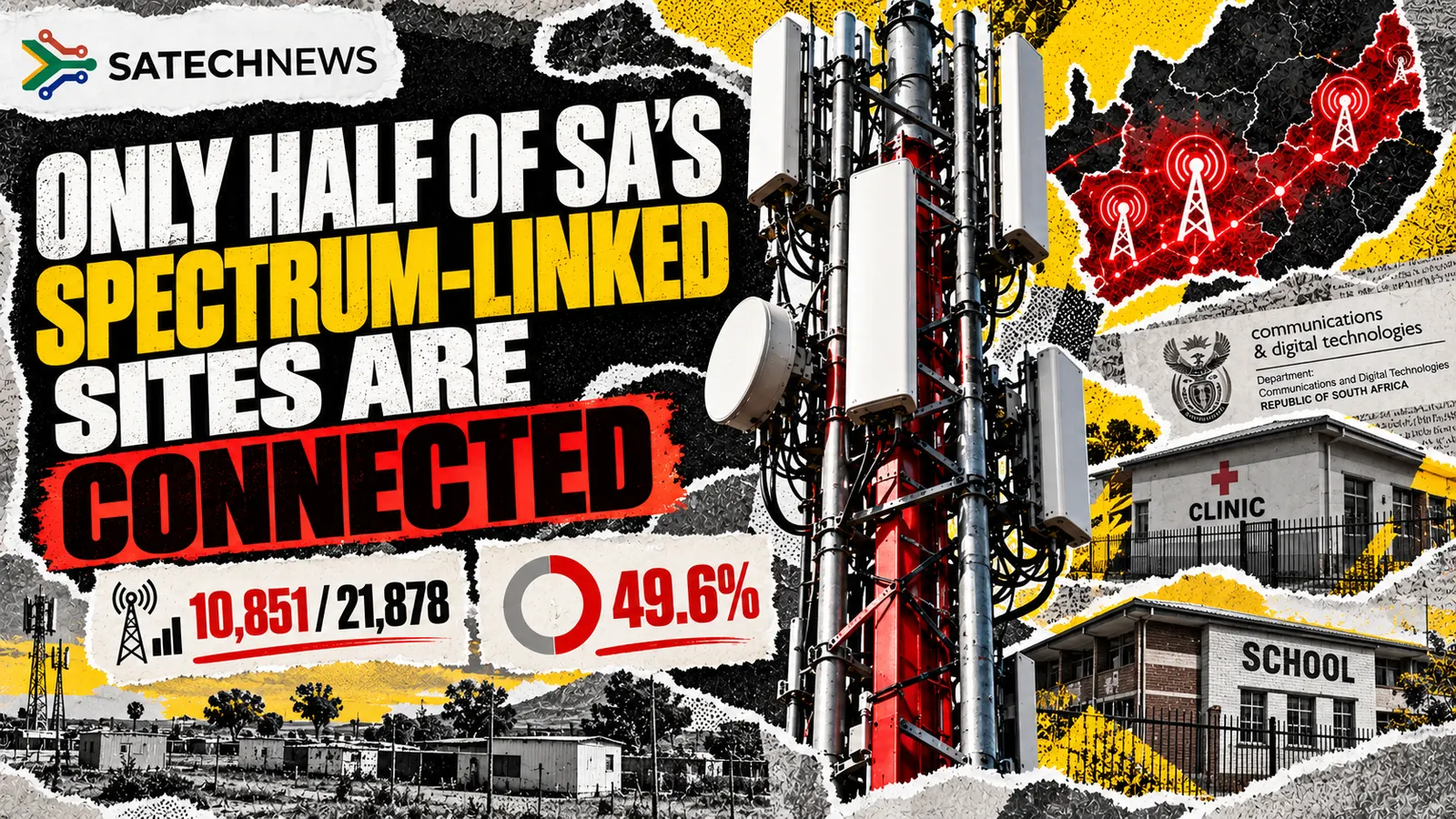
Parliament says 10,851 of 21,878 spectrum-linked public sites were connected by March. Its reported 49.1% figure also needs an arithmetic correction.
South Africa's mobile operators had connected 10,851 of the 21,878 public service institutions assigned under their 2022 spectrum licence obligations by March 2026, Parliament said on 14 October. The institutions include schools, health facilities, libraries and traditional authorities. The programme is intended to turn valuable mobile spectrum into measurable public connectivity.
The parliamentary committee described that progress as 49.1%, although the published totals calculate to approximately 49.6%. The discrepancy is small in percentage-point terms but worth correcting in a regulatory programme where operators are judged against numerical targets. Either way, roughly half the assigned sites remained unconnected at the reporting date.
Only Vodacom, Telkom and Liquid had reached the 65% minimum threshold against their respective targets by March, according to ICASA's briefing to MPs. MTN and Rain had not. The committee wants the regulator to consider enforcement rather than wait until the end of the programme before responding to missed obligations.
The commitments stem from South Africa's 2022 radio-frequency spectrum auction. Operators received access to spectrum needed for mobile networks, with obligations to connect specified public institutions. The idea was to ensure the auction delivered benefits beyond additional capacity for paying mobile customers.
Parliament lists the allocated totals as 8,131 for Vodacom, 7,390 for MTN, 3,103 for Telkom, 2,956 for Rain and 298 for Liquid. Together they make 21,878 institutions. The committee's aggregate connected count is 10,851. Dividing that count by the target gives 49.6%, not the 49.1% stated in its media release.
A more detailed ICASA breakdown reported by MyBroadband shows Vodacom had connected 5,295 of its 8,131 assigned institutions, or 65.12%, while Telkom had connected 2,020 of 3,103, or 65.10%. MTN had connected 3,042 of 7,390, or 41.16%, at the March reporting date. Those are different denominators, so the raw site counts cannot be compared without the operator-specific targets.
MTN told MyBroadband that its rollout had advanced since March and that it had completed approximately 63% of its allocated sites by the time of the publication. That later company statement is not the same measurement date as the regulator's March snapshot. It should be assessed against independently verified figures before being used to declare the compliance issue resolved.
Liquid’s small allocation reached the threshold on the March snapshot; Rain’s larger book did not, according to the same ICASA briefing to MPs. The committee’s political signal is that waiting until the obligation window closes before acting would leave schools and clinics offline while spectrum rights remain valuable to the operators that won them.
A site counted as connected for licence reporting is not automatically a site with reliable classroom or clinic service. Connection can mean a circuit was delivered to a premises; it does not by itself prove device density, affordable access for users, uptime through load-related outages, or that the institution’s staff know how to keep the service running. Parliament’s percentage is therefore a compliance metric first. Service-quality claims need separate evidence.
That gap matters because the 2022 auction sold spectrum as a public-interest bargain: operators gained mid-band capacity; the public was promised institutions on the obligation lists. If the denominator is 21,878 and only about half were connected by March 2026, the programme is mid-stream, not finished. Celebrating individual operator thresholds without the aggregate still leaves thousands of assigned sites dark on the regulator’s own scoreboard.
Readers should also keep the March measurement date visible when MTN cites later progress. A company update to roughly 63% after March may be true for MTN’s own tracker and still leave the parliamentary compliance picture unchanged until ICASA republishes verified figures. Mixing dates is how a lagging March score becomes an unearned “almost there” headline.
The portfolio committee’s push for earlier enforcement is a regulatory-timing argument. Spectrum obligations often tempt end-loaded rollouts: operators prioritise commercially dense sites, then rush obligation sites near the deadline. If ICASA only reacts at the end, communities on the list absorb years of delay while the spectrum is already in commercial use.
Enforcement tools available to the regulator typically include notices, remedial plans, fines and, in extreme cases, conditions tied to spectrum rights. Which tool fits depends on how far each licensee sits from its own target and whether the shortfall is explained by site access, power, landlord issues or simple under-investment. The public record from the 14 October parliamentary engagement does not yet spell out a sanction schedule. It does establish that MPs want action before the programme ends.
For schools and health facilities still waiting, the practical question is queue position and power readiness as much as radio planning. Obligation rollouts repeatedly stall where premises lack secure rooms, electricity or responsible on-site contacts. Those constraints do not erase the licence duty; they do explain why raw site counts move slower than auction rhetoric suggested in 2022.
Vodacom and Telkom clearing just above 65% on the March ICASA cut shows the threshold is achievable at scale, not only on Liquid’s small book. MTN’s 41% March figure is the clearest large-operator lag on that snapshot. Rain’s miss of the same threshold keeps a smaller challenger in the enforcement conversation. None of those readings should be flattened into a single “operators failed” line — the allocations and completion rates differ by thousands of sites.
Nor should South African readers treat the programme as a substitute for broader universal-service policy. Connecting assigned public institutions is one instrument. Household coverage, affordability and public Wi-Fi are related but separate. Collapsing them produces false comfort when a school fibre drop exists while learners still cannot afford devices, or false despair when an operator hits 65% while national digital divides remain.
Stick to the parliamentary ledger dated 14 October for the March 2026 snapshot: 10,851 of 21,878 assigned public institutions connected; aggregate about 49.6% against the committee’s stated 49.1%; Vodacom, Telkom and Liquid at or above the 65% minimum on ICASA’s briefing; MTN and Rain below it; committee pressure for earlier enforcement. Treat later company percentage updates as provisional until ICASA verifies them. The spectrum was awarded in 2022; the public connectivity half of the bargain is still unfinished.
Source: SA Tech News


