
Breaking
Latest tech news from South Africa and around the world•Stay updated with breaking technology developments•Innovation and digital transformation news•AI, gaming, and gadget updates daily•Crypto and fintech news from Africa•
 SA Tech News Desk
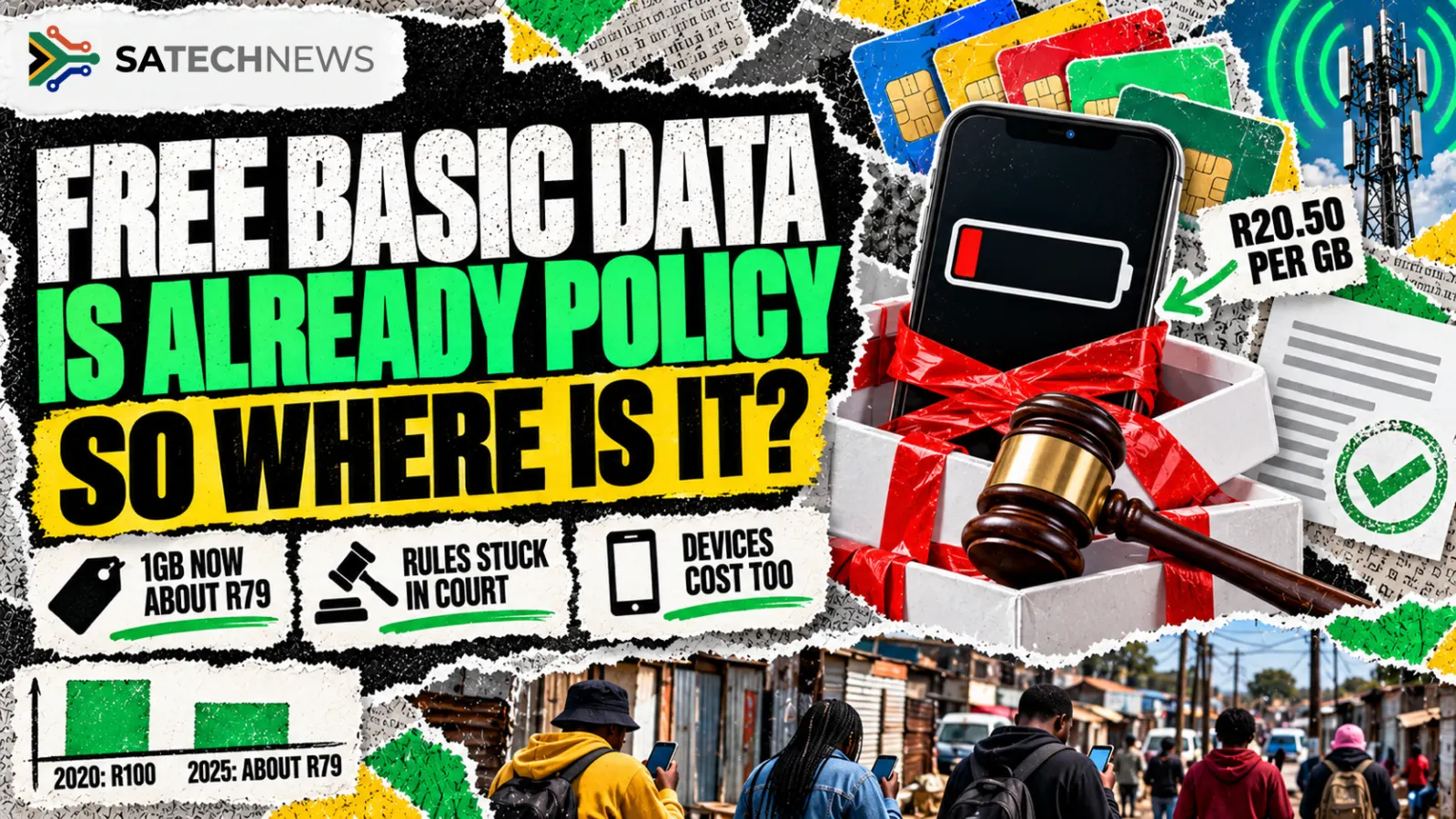
Ispa says free basic data for the poorest is already policy but not delivered, while Icasa's affordability rules face a Vodacom and MTN court challenge.
The Internet Service Providers' Association (Ispa) has asked whether cutting the cost to communicate is still a government priority, and says the place to start is free basic data for people below the poverty line. That allowance is already government policy, it says, under the National Infrastructure Plan and the National Radio Frequency Spectrum Policy. It just has not happened.
The statement, issued on 19 October, matters because data has become the cheaper half of the problem. Ispa accepts that data prices are falling but says the full cost of getting online, which includes buying a device, "requires urgent attention". It cites the Competition Commission's 2026 cost of living report, which found that the affordability of services and devices is still a substantial barrier, and a 2025 Development Bank of Southern Africa study that said both data and devices have to be tackled.
"Reducing the cost to communicate is key to poverty reduction," said Ispa chair Sasha Booth-Beharilal.
Ispa's complaint is aimed mostly at the Department of Communications and Digital Technologies. It says the department has listed a cost-to-communicate programme among its deliverables for years without giving it substance or a clear position.
It gives the Independent Communications Authority of South Africa (Icasa) partial credit for rules on data rollover and out-of-bundle charges. But Icasa's latest amendment to the End-User and Subscriber Service Charter Regulations, which would widen those protections, is being challenged in the High Court by Vodacom and MTN. TechCentral reported that the amended rules are due to take effect on 23 January 2027. An earlier Icasa attempt to increase competition in mobile broadband was declared unlawful by the High Court and dropped.
Icasa gave notice of a telecoms affordability inquiry in September, withdrew it and reissued it on 30 September, according to TechCentral, which said findings are not expected before 2027.
Ispa names two interventions it regards as the most effective so far. One is the Competition Commission's data services inquiry, which concluded in December 2019 and secured cheaper entry-level bundles for low-income users. The other is the removal of the ad valorem excise duty on low-end smartphones, championed by communications minister Solly Malatsi. TechCentral put the duty at 9% on phones under R2,500, removed from April 2025.
The commission also recommended changes to the Electronic Communications Act. Ispa says those took almost seven years to reach Parliament and are unlikely to be finalised before the end of 2027.
The price data TechCentral cited shows why the industry body is not satisfied. A prepaid 1GB bundle that cost R100 in 2020 cost about R79 by 2025, and South Africa's blended average of about R20.50 per gigabyte, measured on ITU price brackets, still trails 27 other African countries.
Ispa did not say how a free basic data allowance should be funded or delivered, or which operators should carry it. On the department's side, TechCentral reported that in August it put out a tender for a study into why past interventions have not delivered affordable voice and data, which means the government is still at the stage of asking why.
The next fixed date is 23 January 2027, when Icasa's amended service charter rules are meant to take effect, unless the High Court challenge by Vodacom and MTN stops them first.
Source: SA Tech News


