Breaking
Latest tech news from South Africa and around the world•Stay updated with breaking technology developments•Innovation and digital transformation news•AI, gaming, and gadget updates daily•Crypto and fintech news from Africa•
 Tech Team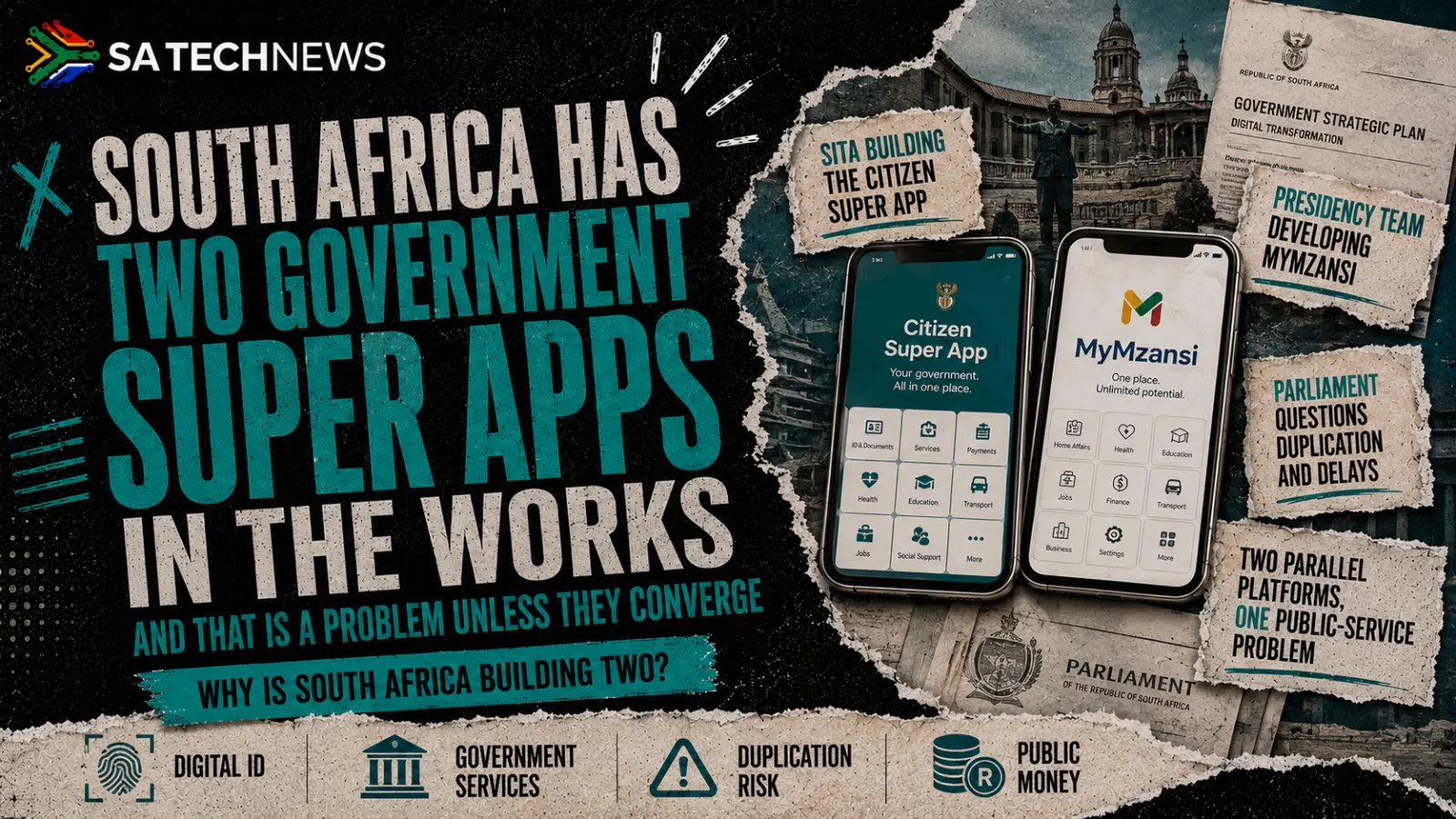
SITA has a Citizen Super App. The Presidency has MyMzansi. Both promise one-stop services, but their relationship is still unclear.
South Africa is trying to fix one of the most frustrating parts of dealing with the state: every department behaves as if it has never met you before.
You prove who you are again. You upload the same documents again. You stand in another queue, create another login and repeat information another part of government already holds.
The answer is supposed to be a more joined-up digital state. The awkward part is that government currently appears to have two overlapping answers.
The State Information Technology Agency, SITA, has been developing a Citizen Super App. At the same time, the Presidency-led Digital Services Unit is building MyMzansi, the national digital-government programme that promises a single trusted channel for government services, digital identity, document sharing, payments and data exchange.
On paper, the two projects sound remarkably similar.
That does not automatically mean taxpayers are funding two completely separate identity systems. Government has not publicly established that. The problem is simpler: from the outside, there is still no clear explanation of how these two citizen-facing platforms fit together.
And for a digital-transformation programme explicitly designed to eliminate duplication, that ambiguity matters.
SITA publicly demonstrated the Citizen Super App at GovTech 2025 as a proof of concept intended to simplify identity verification and digitise government interactions.
The agency said the platform could become an integrated gateway for services including e-permits, e-recruitment, queue management and an indigent register. Demonstrations also included a One ID concept, electronic certificates and licences, and access to services such as birth-certificate applications, grants and police clearances.
The idea is straightforward: authenticate once, then use that identity across multiple public services.
That is also one of the central ideas behind MyMzansi.
MyMzansi's official roadmap describes digital identity, verified document sharing, data exchange, digital payments and a trusted government-services platform as core pieces of South Africa's new digital public infrastructure.
Its slogan is effectively the architecture: one person, one government, one touch.
The first phase runs through the fourth quarter of 2027 and includes a functional Digital ID, a verified document wallet and the MyMzansi services platform.
The question is no longer just technical.
Parliament's Portfolio Committee on Communications has raised concerns about delays around SITA's super-app work and asked Communications and Digital Technologies Minister Solly Malatsi for clearer timelines, implementation milestones and adoption targets.
That scrutiny lands at an uncomfortable moment because MyMzansi is moving ahead through a separate delivery structure led by the Presidency under Operation Vulindlela, with National Treasury and the communications department involved in governance.
MyMzansi's own service principles say government should assess existing solutions first, adapt and reuse where possible, build only where necessary and avoid unnecessary duplication.
That is exactly why the relationship between the two projects needs to be explicit.
If SITA's Citizen Super App is a prototype that will be absorbed into MyMzansi, say so. If SITA is building components that MyMzansi will reuse, publish the architecture. If the projects serve different layers of government, explain the split.
What would be difficult to defend is two teams independently building citizen identity, document, payment and service-access layers that later have to be forced together.
South Africa does not need a prettier government app nearly as much as it needs government systems that can safely talk to one another.
The important work in MyMzansi sits below the interface: a functional digital identity, MzansiXchange for controlled data sharing, common payment rails, consent management, audit trails and shared technical standards.
Get those pieces right and the front end can evolve without forcing citizens to start over every few years.
Get them wrong and the country simply creates a new layer of digital bureaucracy on top of the old one.
There is also a trust problem. A national digital ID and document wallet will eventually touch some of the most sensitive information South Africans have. People need to know which institution is responsible, which systems store what, how consent works, how breaches are handled and what happens when a person cannot or does not want to use a smartphone.
The MyMzansi roadmap explicitly says non-digital channels must remain available. That is important. A digital government cannot become a government that only works for people with modern phones, cheap data and reliable connectivity.
The technology is not the confusing part. The governance is.
South Africa already has a national digital-transformation roadmap, a Digital Services Unit in the Presidency, an interdepartmental working group and a stated commitment to shared infrastructure.
If SITA's Citizen Super App belongs inside that plan, the public should be able to see how.
Because the worst possible outcome is not that one of the apps launches late. It is that both launch, both ask citizens to trust them, and government discovers afterwards that it has digitised the very fragmentation it was trying to remove.
Source: SA Tech News