Breaking
Latest tech news from South Africa and around the world•Stay updated with breaking technology developments•Innovation and digital transformation news•AI, gaming, and gadget updates daily•Crypto and fintech news from Africa•
 SA Tech News Desk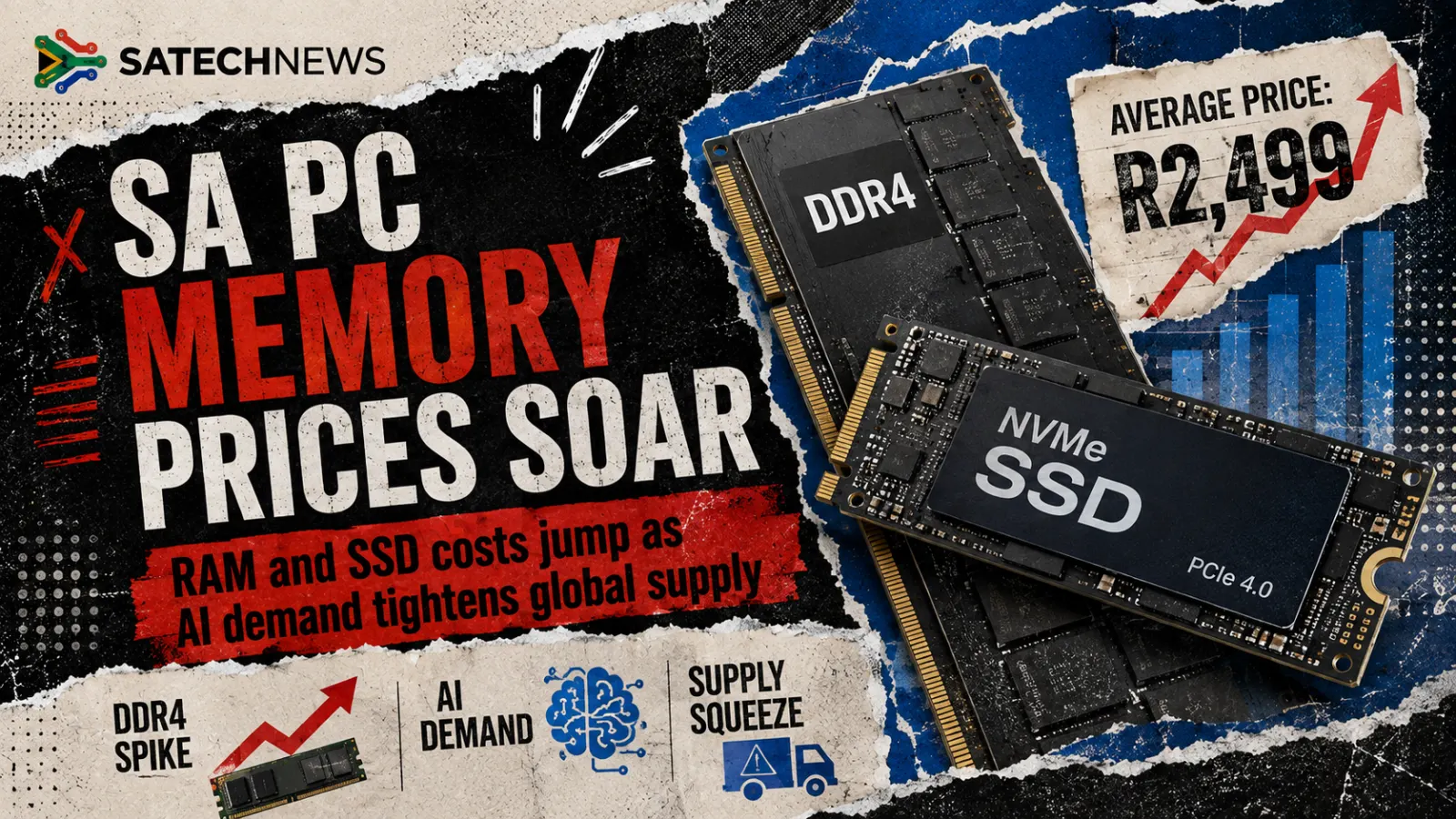
A 16GB DDR4 kit that cost R699 last year is now about R2,299. The AI infrastructure boom is showing up in ordinary South African PC builds.
There was a time when building a sensible mid-range PC in South Africa meant compromising on the graphics card and then quietly making yourself feel better by adding more RAM and a decent SSD.
In 2026, even the comforting bits have become expensive.
A MyBroadband comparison of a mid-range gaming PC built from similar components in 2025 and 2026 found that the overall machine had risen from R15,567 to R18,835, roughly 21%. That is painful, but it hides how violent the move has been in memory and storage.
The same G.Skill 16GB DDR4 kit that cost R699 in 2025 was selling for R2,299 when MyBroadband checked this month. That is a R1,600 increase, or just over 229%.
Storage is not much better. A comparable 1TB SSD in the publication's build was more than 150% more expensive than the drive used in 2025, adding roughly R1,800 to the bill.
What makes this particularly irritating for buyers is that these are not exotic enthusiast parts. DDR4 is an older memory standard. A 1TB SSD is now the baseline many users expect in a modern desktop. These are the components people usually choose precisely because they deliver straightforward value.
That value has been mugged by the AI boom.
For most South Africans, "AI infrastructure spending" sounds like something happening in huge American data centres packed with Nvidia GPUs. It feels distant from a gaming PC in Pretoria or a workstation in Cape Town.
The connection is memory.
The world's largest technology companies are spending enormous amounts on data-centre hardware for AI training and inference. Those systems do not only consume GPUs. They consume vast quantities of high-bandwidth memory, server DRAM, NAND flash and storage.
Memory manufacturers have responded rationally: they are prioritising the products and customers with the best margins and the biggest guaranteed orders.
That shift affects the consumer market in two ways. Capacity moves towards data-centre products, and suppliers become less motivated to keep older consumer memory lines cheap and abundant. When inventories run down, replacement stock arrives at new wholesale prices.
South Africa feels that process later than some markets because distributors and retailers can cushion increases while old stock remains on shelves. Once that inventory is gone, the reset can be brutal.
Acer South Africa country manager Glenn du Toit previously warned that the full impact of hardware price increases would reach the local market around May to July 2026 as older inventory was depleted.
That prediction now looks uncomfortably accurate.
Evetech told MyBroadband earlier this year that DDR4 prices had already climbed between 90% and 140% across late 2025 into April 2026. SSD prices were up 70% to 95% and GPUs 20% to 25%, with the retailer warning that more increases were still coming.
The latest pricing shows that the cheaper escape route, simply buying older DDR4 instead of DDR5, has largely disappeared.
At first glance, an old memory technology becoming more expensive seems backwards. Normally, ageing components get cheaper until nobody wants them.
DDR4 is now caught in a less friendly transition.
Manufacturers are moving production towards newer and more profitable memory products. At the same time, there are millions of perfectly usable PCs, motherboards and business systems that still depend on DDR4.
That leaves a shrinking supply base serving a very large installed market.
For someone building a brand-new PC, it changes the calculation. A DDR4 motherboard used to be a clever budget choice because the platform and memory were cheap. If the RAM itself costs several times what it did a year ago, the savings can vanish.
For someone upgrading an existing PC, there may be no choice at all. If your machine needs DDR4, it needs DDR4.
The same dynamic is showing up in NAND flash and SSDs. Cloud providers and AI companies are buying more storage, while flash makers are managing production more tightly after years of brutal boom-and-bust pricing. Consumers are left with less of the oversupply that once made SSD prices fall almost every quarter.
It would be easy to blame the usual South African villain: the rand.
Exchange rates absolutely affect local hardware. So do shipping costs, distributor margins, import timing and the amount of stock held locally. Mustek brand executive Michael Kan has previously stressed that South African retail pricing is influenced by all of these factors rather than one global number.
But a 229% increase in the same DDR4 kit cannot be explained away as ordinary currency noise.
The local market is receiving a global supply shock and then adding South Africa's usual import friction on top.
That is why buyers can see strange combinations right now. In MyBroadband's comparison, the graphics card, power supply and case were relatively stable or even cheaper, while memory and storage exploded.
The PC market is no longer moving as one basket. The parts exposed most directly to the memory crunch are behaving completely differently from everything else.
The sensible answer depends on what you are buying.
If you already own a capable machine and simply want another 16GB of RAM because it would be nice to have, this is not a pleasant time to impulse-buy. Price volatility is high enough that shopping across several retailers and waiting for genuine specials can make a meaningful difference.
If you are replacing a broken drive or building a machine for work, waiting six months for an uncertain correction may cost more in lost productivity than the hardware premium.
New-build buyers should also stop treating DDR4 as automatically cheaper. Compare the full platform cost, CPU, motherboard and memory, against a DDR5 alternative. In some configurations the newer platform may now make more sense, particularly if it gives a better upgrade path.
For SSDs, capacity discipline matters again. It has been easy in recent years to recommend buying 2TB simply because the price gap was small. That assumption needs to be checked every time. A fast 1TB system drive plus secondary storage may once again be the rational compromise.
Businesses face a harder problem. A company refreshing dozens or hundreds of laptops and desktops cannot shop around one machine at a time. Hardware vendors will increasingly pass memory costs through into complete systems as older, cheaper inventory is exhausted.
That means 2026 refresh budgets written last year may already be wrong.
The AI industry likes to talk in enormous numbers: trillion-parameter models, gigawatts of data-centre power and hundreds of billions of dollars in capital expenditure.
Most people never see those numbers directly.
They see R2,299 where there used to be R699.
That is what makes the South African memory spike worth paying attention to. It is one of the clearest examples yet of the global AI infrastructure race reaching an ordinary consumer technology purchase.
The industry is effectively bidding for the same underlying manufacturing capacity, and the customers with the deepest pockets are not building gaming PCs.
South African buyers have survived GPU shortages, crypto-mining demand, pandemic logistics and a weak rand before. The memory crunch is different mainly because it hits the boring components, the ones we had become used to being cheap.
For now, anyone planning a PC upgrade should throw out last year's assumptions, price the entire build again and resist the temptation to believe that older automatically means affordable.
Source: SA Tech News