Breaking
Latest tech news from South Africa and around the world•Stay updated with breaking technology developments•Innovation and digital transformation news•AI, gaming, and gadget updates daily•Crypto and fintech news from Africa•
 Tech Team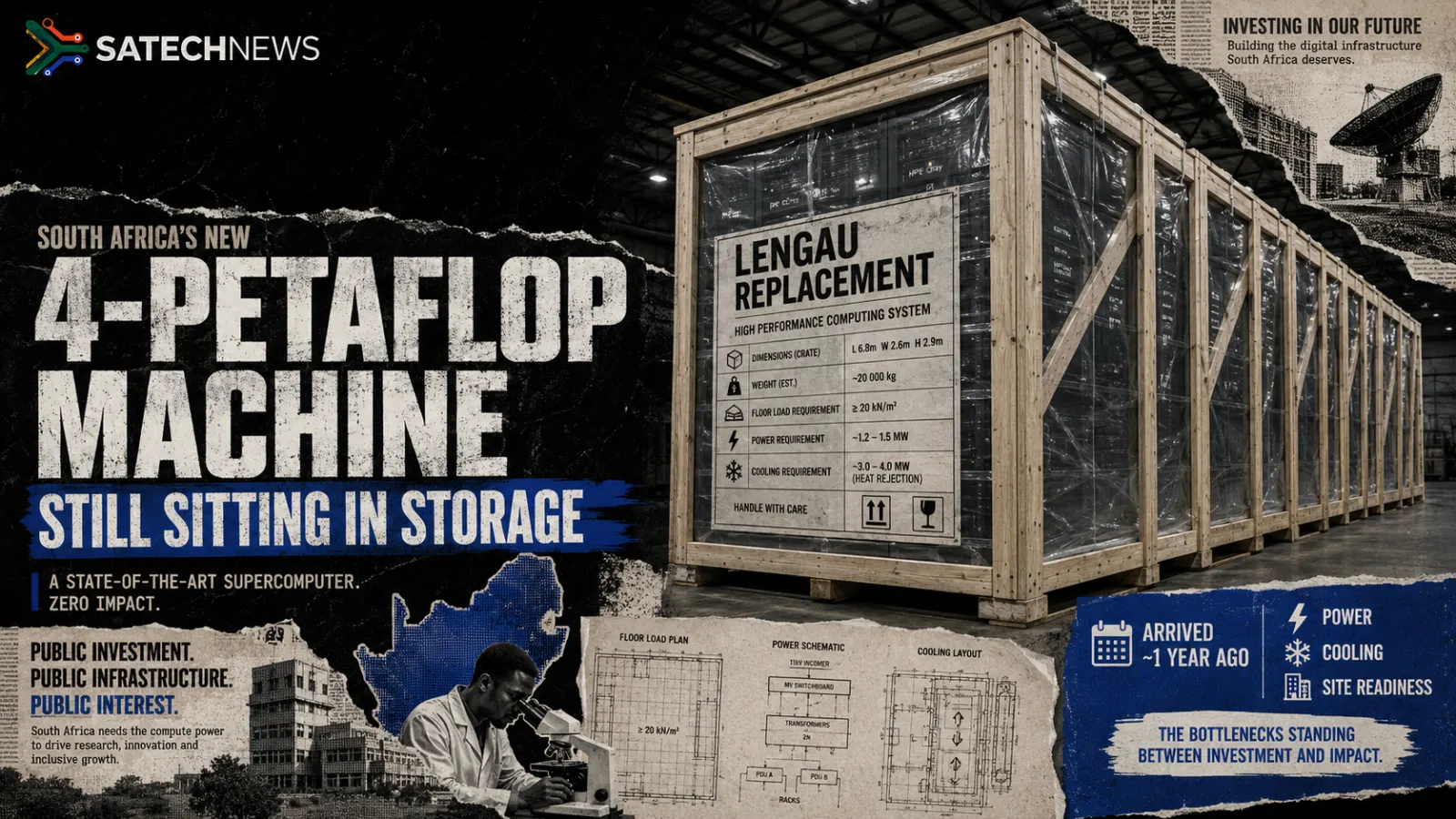
The CSIR confirms components for Lengau's 4-petaflop replacement arrived about a year ago and are still being prepared for deployment.
South Africa already has the hardware for the machine that is supposed to replace its ageing Lengau supercomputer. The problem is that much of it has been waiting to be installed for about a year.
The Council for Scientific and Industrial Research has confirmed that components for the next-generation high-performance computing system were delivered roughly a year ago and are still being prepared for deployment at the Centre for High Performance Computing.
The replacement is not a minor upgrade. CSIR tender documentation says the new system is rated at 4 petaflops and was acquired to replace Lengau at the organisation's Rosebank campus. That would make it about three times more powerful than the current system, according to government figures.
The CHPC serves more than 1,500 users and supports over 100 scientific applications spanning chemistry, materials science, astronomy, climate science and bioinformatics. That makes the delay more than a procurement footnote: it affects one of the country's most important pieces of public research infrastructure.
MyBroadband reported that a source close to the project values the stored equipment at close to R500 million. CSIR disputes the idea that more than R500 million was paid upfront, saying the system was acquired through a lease-to-own model with annual contractual payments.
The distinction matters, but it does not change the central fact. The hardware is in South Africa, and the new machine is not yet operational.
The delay appears to be largely about the physical and operational work required to host a much denser computing system.
A CSIR request for proposals published earlier this year says the CHPC data-centre floor must be reinforced to carry the weight of the new racks, while power outlets must be upgraded for the higher electrical load. The document explicitly states that the organisation has already acquired the 4-petaflop system.
CSIR says power and cooling readiness work has been completed, with deployment, migration and controlled decommissioning still under way. It attributes the longer-than-expected timeline to site readiness, procurement, governance and infrastructure dependencies.
That is plausible for a national high-performance computing installation. These are not servers that can simply be wheeled into an empty rack. The replacement involves floor loading, power distribution, cooling, network integration, workload testing and a migration plan that keeps existing researchers online while the old platform is retired.
CSIR says a project of this scale can require six to 12 months for site preparation, two to four months for installation, and another three to six months for workload migration and decommissioning.
The pressure to complete the project has increased because Lengau is already a legacy system.
Science, Technology and Innovation Minister Blade Nzimande has described the existing environment that way, and the machine recently returned to the spotlight after a cyber incident linked to legacy vulnerabilities and crypto-mining malware.
CSIR says it does not want to shut Lengau down prematurely and create an extended outage for national computing services while the replacement is brought online.
That is the right operational instinct. The bigger question is why site preparation and deployment were not aligned more tightly with hardware delivery in the first place.
NICIS has a ring-fenced R292 million budget for the 2026/27 financial year, with indicative allocations of R342 million in 2027/28 and R349 million in 2028/29. Those funds cover the wider cyberinfrastructure programme, not only the new machine.
CSIR says the replacement system should become operational before the end of the current financial year.
If that deadline holds, South Africa will finally get the substantial computing upgrade that is already physically in the country. Until then, one of the government's most important technology investments remains a very expensive collection of components waiting for its data centre to catch up.
Source: SA Tech News