
Breaking
Latest tech news from South Africa and around the world•Stay updated with breaking technology developments•Innovation and digital transformation news•AI, gaming, and gadget updates daily•Crypto and fintech news from Africa•
 SA Tech News Desk
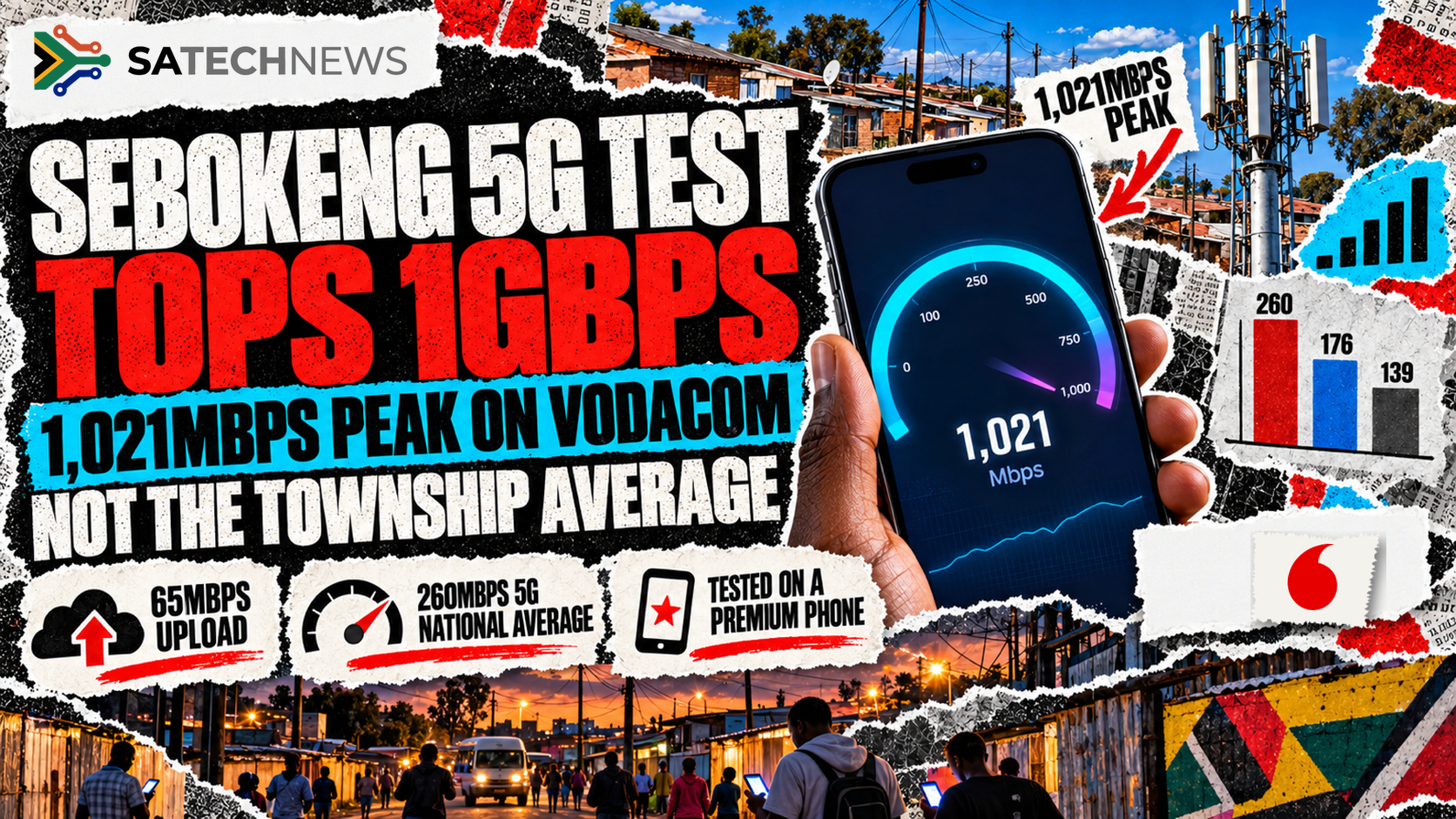
A Q3 2026 network test recorded 1,021Mbps on Vodacom 5G in Sebokeng. The peak is striking, but it does not describe typical township coverage.
A Vodacom 5G connection in Sebokeng, Gauteng, recorded 1,021Mbps download speed in MyBroadband Insights testing published on 22 October. The result came from a Samsung Galaxy S26 Ultra and formed part of the research firm's third-quarter 2026 network report.
The finding is notable for the Vaal Triangle township south of Johannesburg. It does not mean that all residents can receive the same speed, or that a peak measurement describes average coverage.
MyBroadband Insights reported national average 5G downloads of 260Mbps for Vodacom, 176Mbps for MTN and 139Mbps for Cell C. These figures describe the study's 5G measurements and are not guarantees of individual performance.
The leading Sebokeng result showed 1,021Mbps download and 65Mbps upload. A second reading reached 1,005Mbps download and 66Mbps upload. A third was 932Mbps down and 64Mbps up.
Upload performance was substantially lower than download performance in those readings. That distinction matters for people who send large files, upload videos or participate in live broadcasts.
The Samsung Galaxy S26 Ultra is a premium handset with advanced radio hardware. Entry-level and mid-range phones may not support the same network combinations. Performance also changes with signal quality, congestion, building materials and location.
A set of strong readings does not provide a township-wide median or a map of reliable indoor reception. The reported results also do not establish how many local users have compatible phones and suitable data plans.
Sebokeng is part of Emfuleni, roughly 50km south of Johannesburg. Mobile networks can be important for small businesses, schooling, remote work and digital services in places where fixed fibre is not available to every household.
Affordability remains separate from technical speed. A fast connection is useful only when residents can afford enough data to make use of it. The report does not quantify local household data costs or usage.
People choosing an operator should compare signal and performance at their own homes and workplaces, along with package terms, latency and upload speed. A national 5G average is also different from an overall mobile network quality ranking that includes 4G.
The evidence establishes that Vodacom can exceed 1Gbps at tested Sebokeng locations. It does not establish consistent gigabit coverage across the township or the typical experience of a resident using a cheaper handset.
The report's leading Sebokeng result was 1,021Mbps down and 65Mbps up. The second was 1,005Mbps down and 66Mbps up. The third was 932Mbps down and 64Mbps up. All three downloads sit in a narrow band near 1Gbps. All three uploads sit in a narrow band around 65Mbps. That pattern is the useful part of the test. The download headline is about fifteen times the upload on the same connection. Someone sending video, joining a live call or pushing a large file is living in the 65Mbps number, not the 1,021Mbps number.
Three readings are a sample of moments, taken with one phone, in the third quarter of 2026, and published by MyBroadband Insights on 22 October. They are not a median for Sebokeng. They are not an indoor map. They do not say how the speed changes between a street corner and a back room, or between a quiet hour and the hour when the cell is busy. A peak is the best result the tester recorded. A resident does not live at the peak.
The phone is part of the result. These readings came from a Samsung Galaxy S26 Ultra, a premium handset whose radio can use more of what a mast offers. An entry-level or mid-range phone may not support the same band combinations. Signal quality, congestion, building materials and where the tester was standing all move the number. None of that is a reason to throw the peak out. It is the reason not to paste it onto every household in the township.
Set the township peak next to the same study's national 5G download averages: 260Mbps for Vodacom, 176Mbps for MTN and 139Mbps for Cell C. Vodacom's national 5G average is about a quarter of the Sebokeng peak. The peak is real on the test. It is not the number the study itself uses to describe Vodacom 5G across the country.
Those national figures describe 5G measurements only. They are not an overall mobile-network ranking, because an overall ranking includes 4G. A place that shows a gigabit 5G burst can still fall back to a slower technology indoors or at the edge of the cell. The report does not give that fallback speed for Sebokeng, and it does not say what share of local connections were on 5G when the test was run.
Nor does the report say how many people in Sebokeng own a phone in the Galaxy S26 Ultra's class, or a data bundle large enough for a gigabit speed to matter. A fast radio and an empty bundle are not the same product. The test measures the network at a moment. It does not measure what a household can afford to do with it.
Sebokeng is part of Emfuleni, roughly 50km south of Johannesburg. Where fixed fibre does not reach every house, the mobile network is how small businesses, schoolwork and remote shifts get online. A test that clears 1Gbps says Vodacom's 5G can do that at the spots that were measured. It is a serious result for the Vaal Triangle. It is not a promise that the house three streets away, or a room at the back of a building, gets the same thing.
Affordability stays outside the study. The report does not price local data bundles and does not say how much of a gigabit a household can afford to use. People choosing an operator still have to compare signal at home and at work, then read the package: included data, latency, upload speed, and what the line does when it is on 4G rather than 5G. A national 5G average will not answer that, and neither will one township peak.
The evidence that is actually on the page is narrow. Vodacom 5G exceeded 1Gbps at tested Sebokeng locations on a Galaxy S26 Ultra, with uploads around 65Mbps, in MyBroadband Insights' third-quarter 2026 report. It does not establish consistent gigabit coverage across the township, or the typical experience of a resident on a cheaper handset.
Source: SA Tech News


