
Breaking
Latest tech news from South Africa and around the world•Stay updated with breaking technology developments•Innovation and digital transformation news•AI, gaming, and gadget updates daily•Crypto and fintech news from Africa•
 SA Tech News Desk
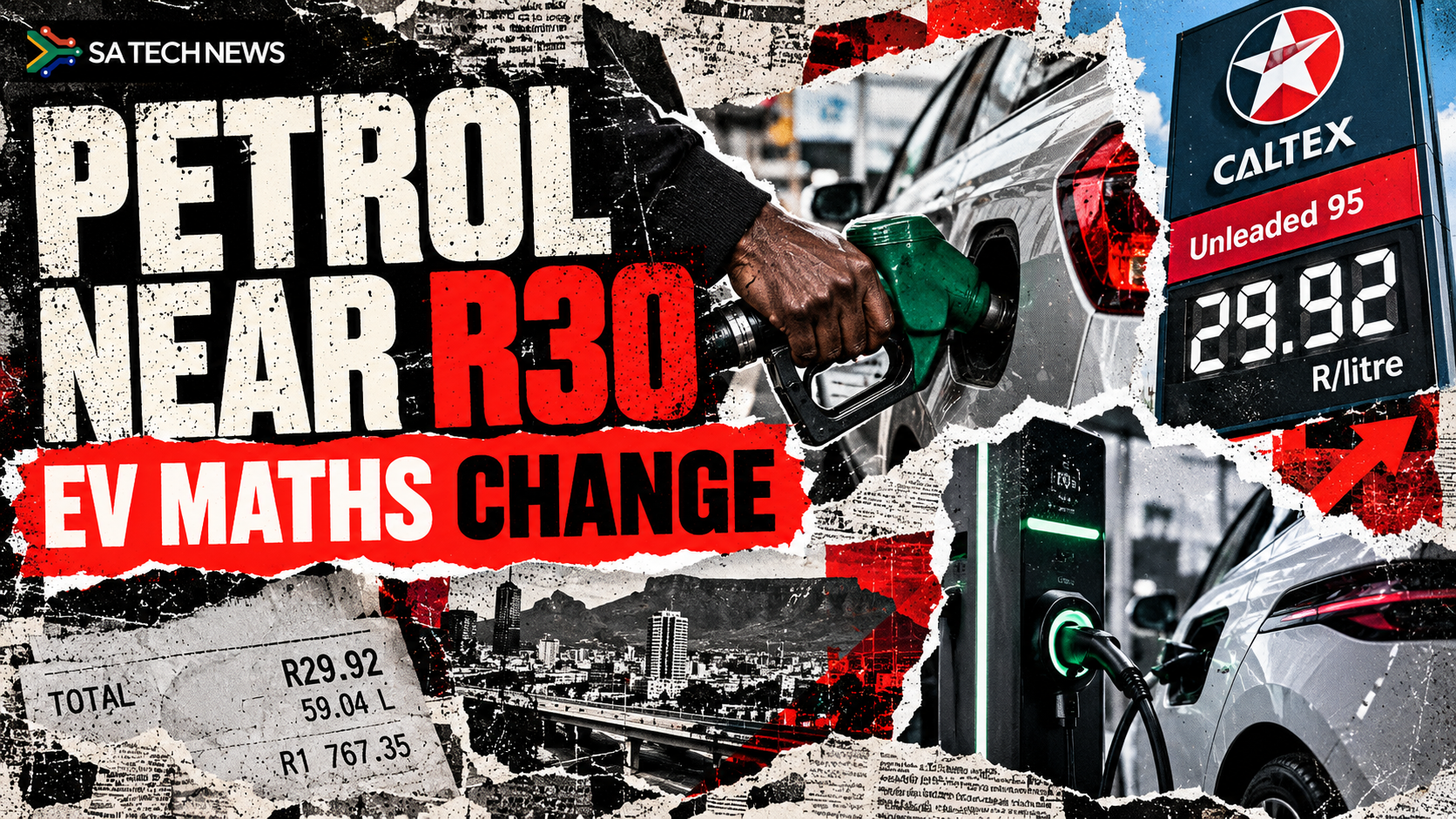
With inland 95 petrol projected near R30 a litre, the running-cost advantage of EVs widens sharply — although purchase price and charging access still decide the full ownership case.
South Africa's next fuel-price increase could make an old electric-car argument materially harder to ignore.
Latest unaudited Central Energy Fund data through 24 September pointed to an increase of about R3 a litre for unleaded 95 petrol in October. If that level holds through the review period and there is no offsetting adjustment, inland 95 could rise from R26.92 to roughly R29.92 a litre.
That figure is not final. The official October fuel price still has to be announced, and exchange rates, international product prices and levy adjustments can move the number before it reaches the pump.
But with petrol pushing toward R30 a litre, the operating-cost advantage of an electric vehicle becomes much easier to see.
Vehicle prices are difficult to compare because buyers look at different brands, finance terms and specifications. Energy cost is cleaner.
Take a petrol vehicle using 7.4 litres per 100km, roughly the average passenger-car consumption used in recent South African comparisons. At R29.92 a litre, that trip costs about R221 per 100km in fuel.
Now take an EV using 19.1kWh per 100km. At an illustrative home electricity price of R3.56/kWh, the energy cost is roughly R68 per 100km.
The difference is about R153 for every 100km travelled.
At 1,100km per month, that is around R1,680 in monthly energy savings before maintenance, insurance and finance are considered.
The exact number will vary sharply by municipality, tariff block, charging network and driving style, but the direction is difficult to miss.
The strongest EV savings generally come from home charging. Public DC fast chargers cost more per kilowatt-hour and can reduce the gap substantially.
A driver who cannot charge at home therefore has a different economic case from a homeowner with off-street parking, a favourable electricity tariff or rooftop solar.
That is important in South Africa, where apartment living and unequal access to private parking make the charging conversation inseparable from housing and infrastructure.
An EV can be cheap to run and still be impractical for a particular household.
The other side of the equation is the upfront vehicle price.
Battery EVs still make up less than 1% of South Africa's new passenger-car market, while hybrids have grown faster. One reason is that many fully electric models remain expensive relative to comparable petrol vehicles.
Higher interest rates make that gap more important. SARB's September repo-rate increase raises the cost environment for vehicle finance at the same time as petrol prices are moving the other way.
The result is a tug-of-war between purchase cost and running cost.
A buyer paying significantly more for the EV needs enough monthly mileage and enough years of ownership for fuel and maintenance savings to recover the difference.
That is the real significance of the latest fuel shock.
A petrol price around R30 does not suddenly make every EV cheaper overall. It does, however, shorten the break-even period for vehicles where the upfront price gap is already narrowing.
It also strengthens the case for hybrids, which offer lower fuel consumption without requiring charging infrastructure.
The next useful comparison for South African buyers is therefore not simply "EV versus petrol". It is a full ownership model covering cash price, finance, insurance, energy, servicing, tyres and resale value over five years.
For now, the fuel component is moving decisively in the EV's favour.
If October's official price lands close to current projections, South Africa will enter a new record fuel-price environment. The technology argument for electrification will still depend on access and affordability — but the running-cost maths will be harder to dismiss.
Source: SA Tech News


