
Breaking
Latest tech news from South Africa and around the world•Stay updated with breaking technology developments•Innovation and digital transformation news•AI, gaming, and gadget updates daily•Crypto and fintech news from Africa•
 SA Tech News Desk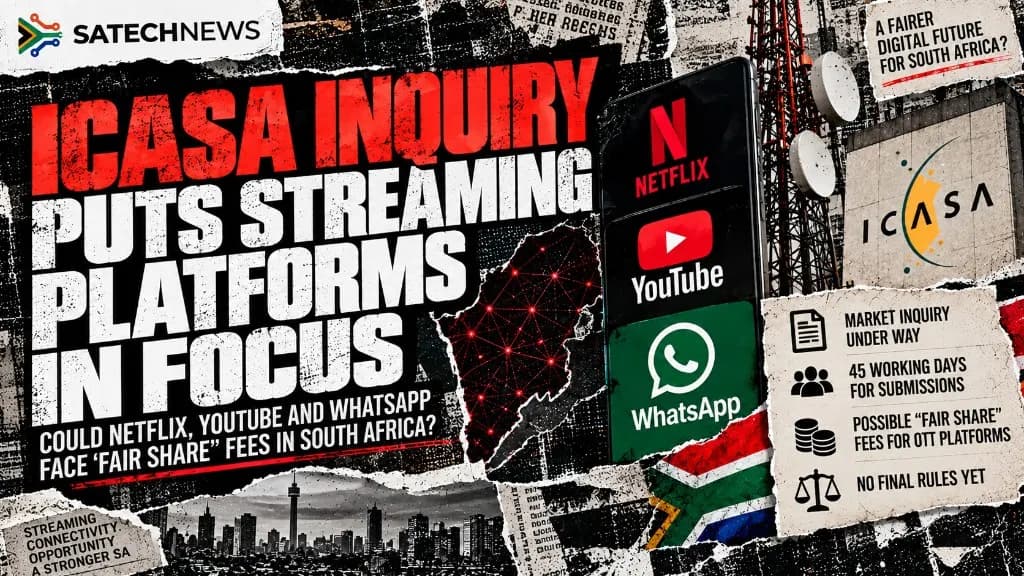
Icasa’s OTT market inquiry could revive “fair share” network fees for major platforms, but no payment rule exists yet — the first test is the discussion document.
Icasa’s market inquiry into over-the-top services has opened a route for South Africa to revisit whether large Internet platforms should contribute directly to the networks carrying their traffic.
The inquiry covers the impact of OTT services on telecommunications, broadcasting and postal licensees. That puts services such as Netflix, YouTube and WhatsApp inside a regulatory process that could eventually affect licensing, network economics and the long-running “fair share” argument backed by local mobile operators.
No fee has been imposed and Icasa has not decided that platforms must pay Vodacom, MTN, Telkom or Cell C. The inquiry is evidence-gathering, and its outcome remains open.
South African operators argue that global video, audio and messaging platforms generate large volumes of traffic while operating under different regulatory obligations from licensed local networks. The Association of Communications and Technology, which represents the major operators, has supported the principle that high-traffic platforms should contribute to broadband infrastructure costs.
For the platforms, the counterargument is that customers already pay Internet providers for connectivity, while online services invest in their own infrastructure, caching and content-delivery systems. Charging both ends of the connection can alter how services route traffic and may ultimately affect users.
South Korea’s sender-pays experience is an important warning in that debate. Disputes over network fees have previously led platforms to change infrastructure arrangements, with consequences for latency and service delivery. South African regulators will have to show they understand those trade-offs before any fee design leaves the discussion document.
The inquiry is structured in four phases. After an initial clarification period, Icasa plans to publish a discussion document and allow 45 working days for written submissions. The regulator may then hold public hearings and request further information from stakeholders.
Icasa says it will publish its final report within 90 days of the inquiry’s conclusion. That timeline is the practical calendar for operators, platforms and consumer groups that want their evidence on the public record.
The process could feed into future decisions on communications licensing, interconnection, spectrum policy and universal-service obligations. It could also end without a mandatory payment regime.
Icasa did not limit the inquiry to mobile data traffic. Broadcasting and postal licensees are also in scope, which widens the evidence fight beyond Netflix bitrates into how OTT services interact with licensed content and delivery markets.
That breadth can produce a richer record. It can also dilute the inquiry into a vague survey unless the discussion document forces concrete questions about traffic shares, caching, interconnection and consumer prices.
For households, the risk is not an overnight Netflix surcharge. It is whether any eventual cost-recovery model is passed through in higher subscription prices, throttled quality, or changed peering arrangements that hurt peak-hour performance.
“Netflix and WhatsApp could be forced to pay networks” describes one possible regulatory outcome, not a rule that exists today. The first concrete test will be the discussion document and the evidence operators and platforms put on the table.
Source: SA Tech News Desk


