Breaking
Latest tech news from South Africa and around the world•Stay updated with breaking technology developments•Innovation and digital transformation news•AI, gaming, and gadget updates daily•Crypto and fintech news from Africa•
 SA Tech News Desk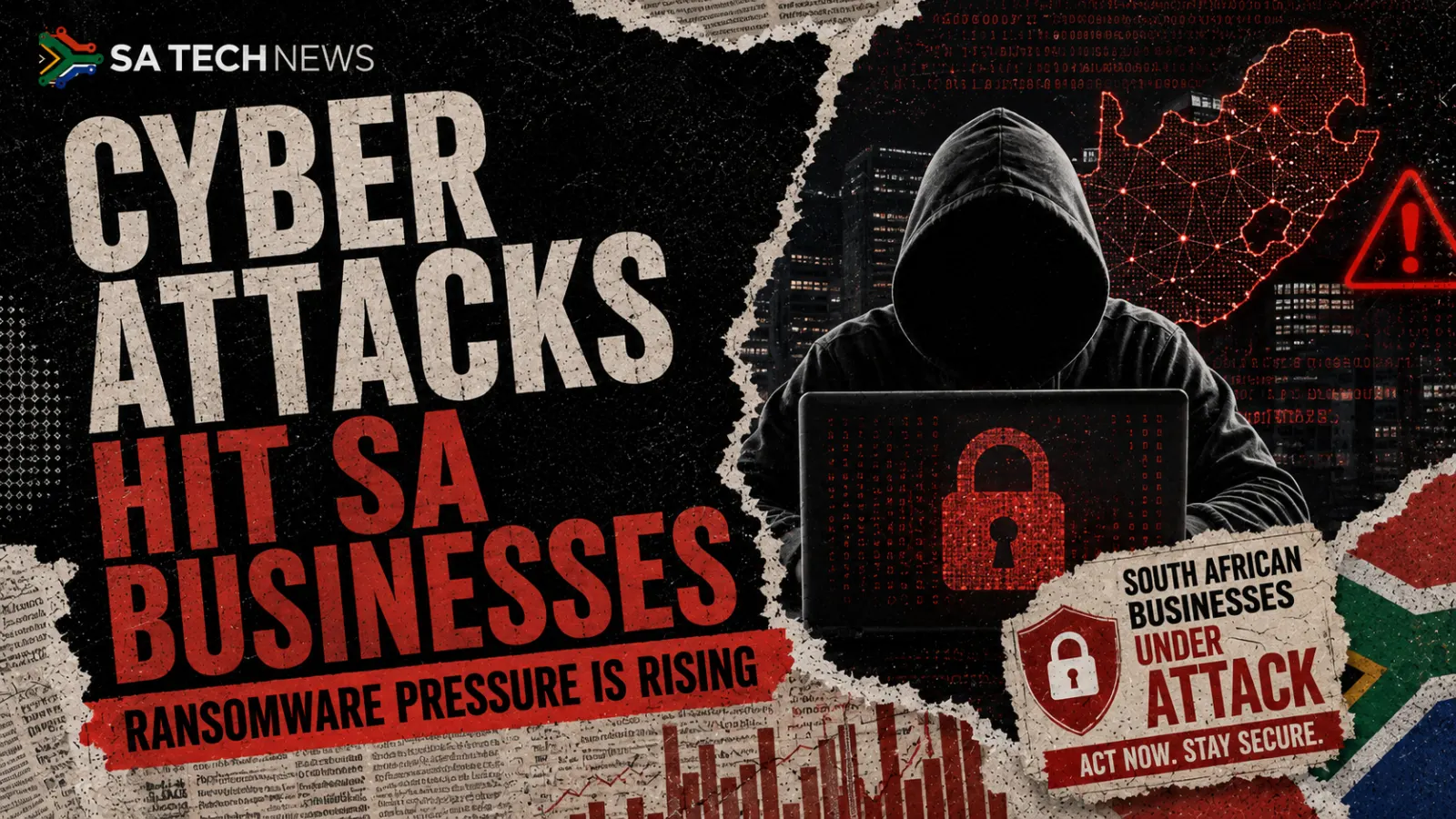
South African businesses face faster ransomware campaigns, wider attack surfaces and less time to contain a compromise.
South African businesses are facing a cyber-threat environment that is getting faster, more automated and increasingly capable of disrupting normal operations before defenders have time to react.
Ransomware remains one of the clearest operational risks. Security researchers tracking incidents in the country have warned that attackers are reducing the time between the initial compromise and the point at which they move laterally, steal data or deploy encryption. That compresses the window in which an organisation can identify suspicious activity and contain it.
The threat is not limited to large enterprises. Smaller firms are attractive because they often have weaker security controls, fewer dedicated security staff and less mature incident-response processes, while still holding valuable customer, payroll and financial information.
Cloud platforms, remote access, mobile devices and outsourced software have made businesses more productive, but they have also created more entry points. Phishing remains effective, compromised credentials are routinely traded, and attackers increasingly use legitimate administrative tools after gaining access so that their behaviour is harder to distinguish from normal activity.
AI is adding another layer. Generative tools can help criminals produce more convincing messages, automate reconnaissance and scale social-engineering attempts. At the same time, defenders are using machine learning to identify abnormal behaviour and prioritise alerts. The result is not a simple attacker advantage; it is an acceleration on both sides.
South African organisations are also dealing with growing compliance pressure after a breach. A serious incident can trigger operational downtime, regulatory reporting, forensic costs, legal exposure and a long tail of customer distrust.
The most damaging ransomware incidents do not stop at encrypted laptops. They can interrupt logistics, payments, call centres, manufacturing, healthcare systems and access to customer records. Even organisations with backups can face prolonged recovery if attackers have also stolen data or compromised identity systems.
That is why security teams increasingly focus on identity, segmentation and recovery rather than relying only on endpoint protection. Multi-factor authentication, tightly controlled privileged accounts, tested offline backups and rehearsed incident-response plans are basic controls, but they become valuable only when organisations know they actually work under pressure.
For boards and executives, the shift is equally important. Cybersecurity is now a continuity and financial-risk issue. The relevant question is no longer whether a company can prevent every attack. It is whether the business can detect a compromise early, isolate it quickly and keep critical operations running while the incident is contained.
As attackers shorten their timelines, South African companies have less room for security theatre. The organisations that recover best will be the ones that have already decided who acts, what gets isolated and which systems must come back first before an incident begins.
South African firms face the same ransomware tooling as global peers, but often with thinner security teams and legacy systems in mining, logistics and municipal IT. The Information Regulator has pushed POPIA enforcement; breach notification expectations are rising even when technical defences lag. SMEs remain the softest targets because they hold payroll and client data without dedicated SOC coverage.
Source: SA Tech News