
Breaking
Latest tech news from South Africa and around the world•Stay updated with breaking technology developments•Innovation and digital transformation news•AI, gaming, and gadget updates daily•Crypto and fintech news from Africa•
 SA Tech News Desk
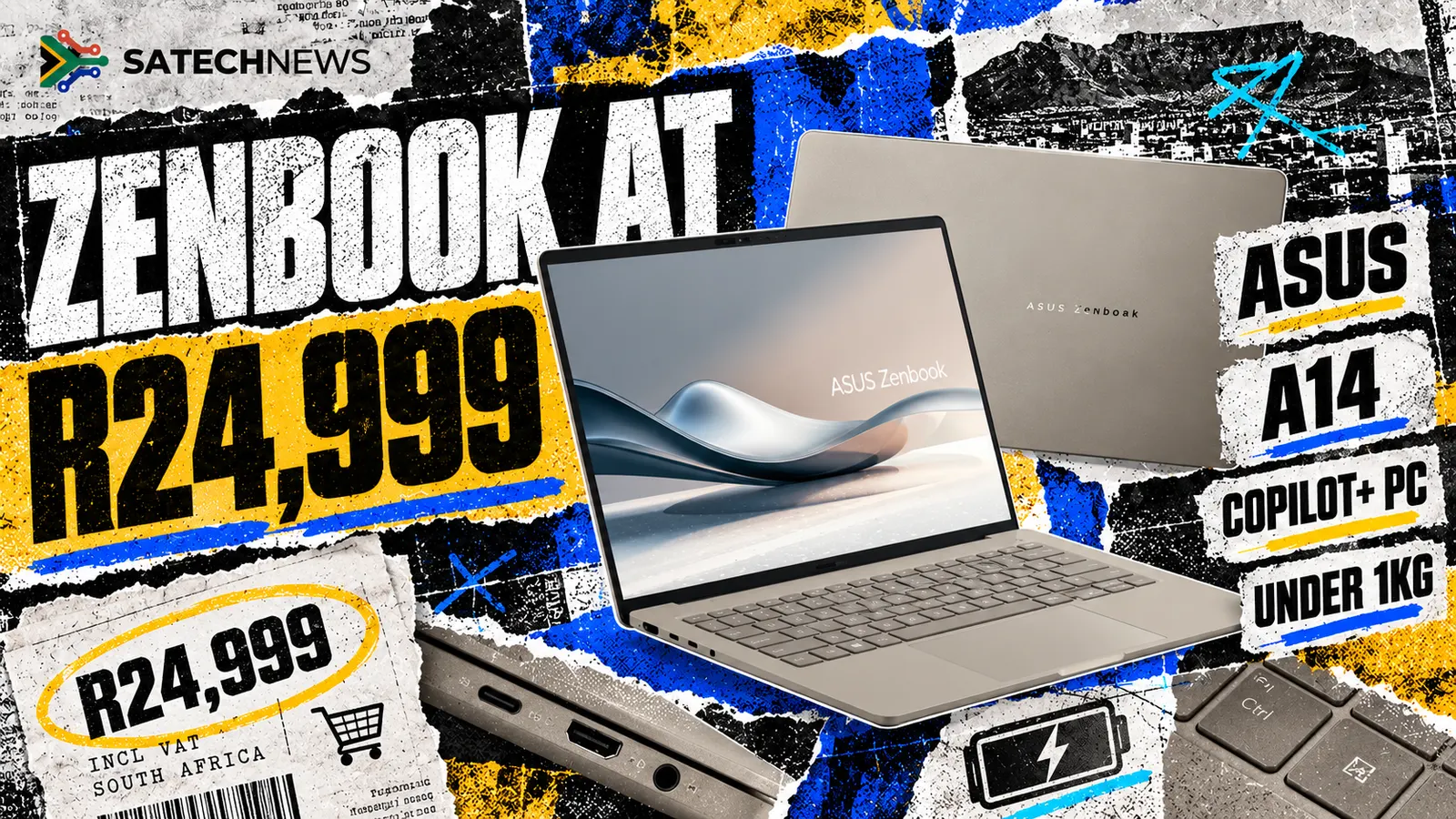
ASUS is listing the Zenbook A14 at R24,999 in South Africa, down from R40,999, pushing a sub-1kg Copilot+ PC into a more competitive bracket.
ASUS is listing the Zenbook A14 at R24,999 in South Africa, a substantial cut from the R40,999 reference price shown on its local store.
That does not make it a budget laptop, but it changes the competitive picture for buyers looking at thin-and-light Windows machines with Copilot+ PC branding. The A14 is built around Qualcomm's Snapdragon X platform and is marketed at under 1kg.
For a South African buyer who has watched AI-PC prices sit in the luxury bracket, the discount is the news. The remaining work is checking which SKU you are actually paying for.
ASUS lists configurations with up to Snapdragon X2 Elite processors, up to 32GB of LPDDR5x memory and up to 1TB of PCIe Gen 4 storage. The machine uses the company's Ceraluminum chassis and includes USB4 connectivity. ASUS also markets battery life of more than 30 hours under its own test conditions.
Quoted maximums do not describe every configuration sold locally. The company's South African store explicitly warns that specifications shown on the product family page may differ from the exact eStore configuration. Buyers should check the SKU before paying: processor, RAM, storage, display and charger matter more than the family name.
At this price the A14 sits against mid-premium Intel and AMD ultrabooks rather than against flagship MacBooks. Weight and claimed battery life are the pitch. Keyboard, screen, ports and Windows-on-Arm behaviour are the test.
Microsoft's Copilot+ PC branding is intended to signal Windows hardware with enough on-device AI capability. For most buyers, the useful question is less about the badge and more about whether the applications they use behave well on the platform.
Windows on Arm compatibility has improved, but edge cases remain around specialist drivers, older utilities and some games. A productivity buyer using browsers, Office, collaboration tools and mainstream creative apps is in a different position from someone relying on niche Windows software, VPN clients, accounting packages or industry tools that still assume x86.
South African offices are full of that second group. Banking plugins, SARS-related utilities, printer stacks and older line-of-business software are still common. A laptop that is excellent on paper can become a support ticket if a required app will not install or crawls under emulation.
The Copilot features themselves are a weaker reason to buy. If the local SKU is short on RAM, or if the buyer rarely uses the AI tools Microsoft is advertising, the badge is decoration. Battery life and weight are not.
At R40,999, the A14 had to compete with premium Intel and AMD ultrabooks and some MacBook configurations. At R24,999, the trade-off looks different. Low weight, long claimed battery life and a premium chassis become easier to justify if application compatibility is not a concern.
The discount also shows how quickly Copilot+ PC pricing is moving. Early AI-PC launches carried a premium partly because the hardware category was new. That premium is becoming harder to defend as more models reach shelves.
Rand pricing still needs a cold read. Import costs, VAT and retailer margin mean a US-dollar cut does not always land one-for-one in South Africa. A store offer can also be stock-clearing rather than a new RRP. If the configuration on promotion is last season's chip, the headline saving is real and the performance gap versus a current Intel or AMD thin-and-light may be the reason.
Warranty, carry-in support and spare parts matter more here than in markets with dense ASUS service networks. A sub-1kg laptop that needs a chassis repair in six months is only a bargain if the local service path exists.
Confirm the exact processor and memory. Confirm Windows version and whether the unit ships with the features you need, not a demo video from another region. Test the apps you cannot replace. If you game, assume disappointment until proven otherwise.
Compare street prices at local retailers against the ASUS store. Promotional stock can disappear; a matching Intel ultrabook on a similar discount may be the less exciting and more compatible machine.
If you travel, weigh the battery claim against South African realities: load-shedding, long flights, and days of meetings with nowhere to plug in. Vendor "more than 30 hours" figures are measured under conditions that are not a browser with 40 tabs and a Teams call.
The current price is a store offer, not necessarily a permanent new RRP. Stock, exact processor configuration and promotion timing can change. Battery life also needs to be judged under real workloads rather than vendor claims.
For South African buyers, the A14 is now more interesting because the price has moved closer to the mainstream premium market. The remaining question is whether the specific local SKU gives up enough performance or compatibility to explain the discount — and whether R24,999 still feels like a lot of money for a laptop that will not run everything you already own.
The A14 at R24,999 is for a South African buyer who lives in browser, Office and Teams, who cares about bag weight and unplugged hours, and who can live with Windows on Arm's remaining gaps.
It is not for CAD, niche accounting stacks, or anyone whose IT policy still says "Intel only". If that is you, the discount is a trap. If it is not, this is the first time the Copilot+ pitch has been priced like a normal premium Windows laptop on the local store — until the offer expires or the SKU on the page is not the SKU in the box.
Source: SA Tech News


