
Breaking
Latest tech news from South Africa and around the world•Stay updated with breaking technology developments•Innovation and digital transformation news•AI, gaming, and gadget updates daily•Crypto and fintech news from Africa•
 SA Tech News Desk
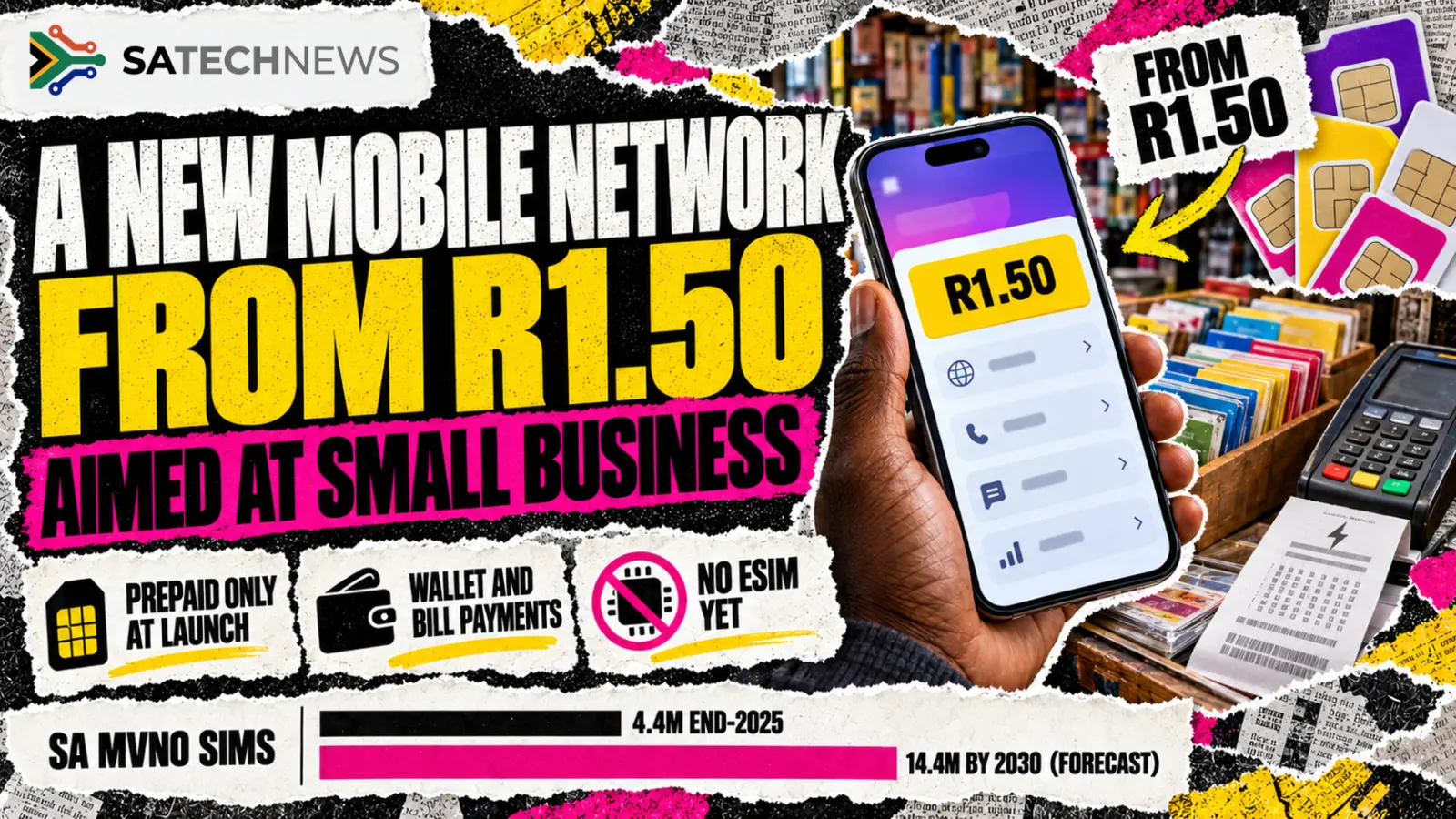
TPC Africa Mobile, a prepaid MVNO on MTN's network, launched on 24 October with bundles from R1.50, a wallet and bill payments. Data prices are not out.
South Africa has another virtual mobile network. TPC Africa Mobile, started by Bathabile Moreki, founder of the fragrance business The Perfume Co Africa, launched on Saturday, 24 October, as a prepaid MVNO running on MTN's network, with bundles starting at R1.50.
The pitch is aimed less at heavy data users than at people who run small businesses from their phones. "For an independent business owner, a phone is a working tool," Moreki told ITWeb. The app sells airtime, data, voice, SMS and combination bundles alongside a wallet, vouchers, and bill and electricity payments.
What the launch does not include matters as much. There is no eSIM and no contract option at launch, the company has not published a full price list, and Moreki said the R1.50 starting point depends on "the bundle and the terms displayed when the customer buys it". A floor price without a rate card is not yet a comparison. A customer can see that some bundle starts at R1.50. They cannot yet see how many megabytes that buys, or how it sits next to MTN's own prepaid offers.
An MVNO rents capacity from a network operator and sells under its own brand. TPC Africa Mobile does not have to build towers. Moreki said that lets the company spend on the customer offer and the app instead. The radio network customers will use is MTN's. Coverage, in practical terms, is MTN's coverage. The brand, the bundles, the wallet and the sales pitch are TPC Africa's.
The launch date is 24 October, from an Engineering News listing. The interview setting out the offer is Moreki's conversation with ITWeb on 26 October. Between those two dates the service was already in the market, and the public explanation of who it is for arrived two days later.
Customers can port their existing numbers, subject to the normal porting rules, and the app is available on Apple's App Store and Google Play. Porting means a small-business owner can keep the number clients already have, which is the point of selling a phone service to people whose trade depends on being reachable. The app is the shopfront: airtime, data, voice, SMS, combination bundles, a wallet, vouchers, and bill and electricity payments.
Moreki drew a line around that wallet. She said the wallet and payment features "do not make TPC Africa Mobile a bank". The app can take payments and sell electricity. It is not, on her account, a deposit-taking institution, and the launch does not claim a banking licence.
South Africa had about 4.4 million active MVNO SIMs at the end of 2025, up about 43% in a year, according to research firm Africa Analysis, which forecasts about 14.4 million by 2030. That is the market TPC Africa is walking into: not a blank category, but one that has already added millions of SIMs in a single year.
That growth has come mostly from brands with large existing customer bases: banks such as FNB, Capitec and Standard Bank, retailers Shoprite and Mr Price, and specialists such as Melon Mobile. Buy-now-pay-later firm PayJustNow joined the field in September with a network on Cell C. The pattern is a brand people already pay, adding a SIM as another product. A perfume company's sales network is a different kind of base, and Moreki was careful not to pretend otherwise.
TPC Africa's equivalent of a bank's customer base is its sales network. Moreki said TPC Africa reaches more than 300,000 independent business owners across the SADC region, but she was clear that this is not a subscriber forecast. She said the company intends to "create a role for qualifying entrepreneurs", without saying how they will be paid. The 300,000 figure is a reach claim about the fragrance business's sellers. It is not a target for mobile subscribers, and it is not a statement that those sellers will all take a TPC Africa SIM.
On competition, she said the company would not try to match every price change from the big networks. "We recognise that established operators can respond quickly to changes in the market," she said. That is an acknowledgement that FNB Connect, Capitec Connect and MTN can reprice faster than a new prepaid brand can, and that TPC Africa does not plan to answer every move.
At launch, a customer in South Africa can buy a prepaid bundle on MTN's network, starting somewhere at R1.50, through an app, and can port a number. They cannot, for now, take an eSIM or a contract. They cannot read a full price list. They are not being offered the service outside South Africa.
Moreki said there are no other country launch dates to announce. The SADC sales network and the South African mobile launch are separate facts. Sellers may sit across the region. The SIM, for now, is a South African product on MTN.
The entrepreneur role is the least specified part of the offer. "Qualifying entrepreneurs" will have a role. The interview does not say whether that role is a commission, a storefront in the app, a voucher business, or something else, and it does not say what they earn. Until that is published, the 300,000 figure should be read as the size of the network she already has, not as a mobile customer forecast.
TPC Africa Mobile has not published per-gigabyte data prices, so it cannot yet be compared with Capitec Connect, FNB Connect or MTN's own prepaid bundles. It has not said how many customers it is targeting, what the entrepreneurs who sell it will earn, or when eSIM and contract options will follow.
The R1.50 line will do a lot of work in advertising. Moreki's own caveat is the one to keep next to it: the starting point depends on the bundle and the terms displayed when the customer buys it. Until those terms are in a price list, the number is a floor, not a rate.
Sources: ITWeb interview with Bathabile Moreki, 26 October 2026; Engineering News listing for the 24 October launch; Africa Analysis MVNO figures, as cited in the launch coverage.
Source: SA Tech News


