
Breaking
Latest tech news from South Africa and around the world•Stay updated with breaking technology developments•Innovation and digital transformation news•AI, gaming, and gadget updates daily•Crypto and fintech news from Africa•
 SA Tech News Desk
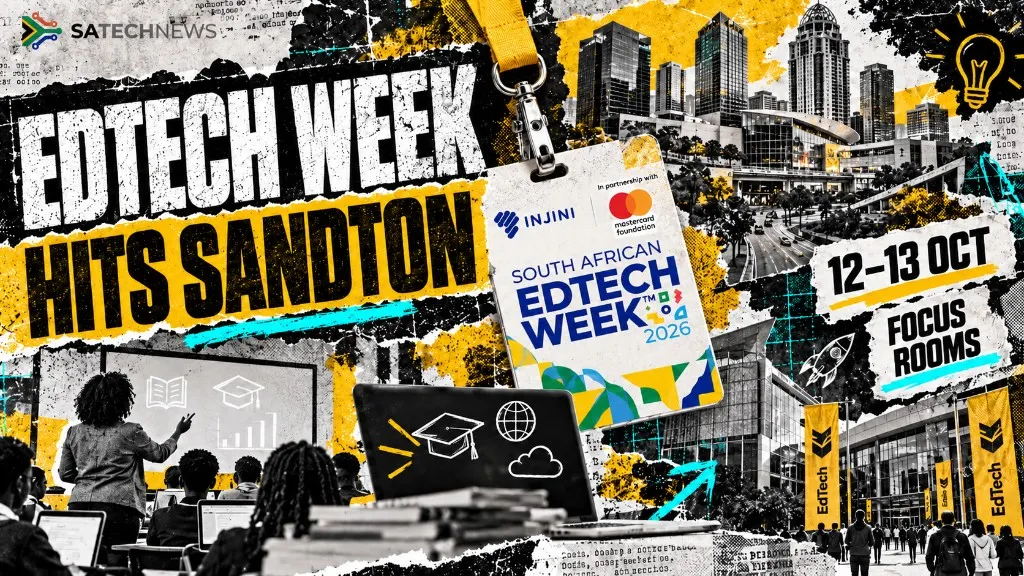
Injini and the Mastercard Foundation host EdTech Week at Focus Rooms on 12–13 October, with free teacher tickets and a Cohort 4 showcase built around classroom workload.
South African EdTech Week returns on 12 and 13 October 2026, moving to Johannesburg for its fifth edition and putting a more useful question ahead of the usual classroom technology pitch: does the software actually make a teacher’s day easier?
Injini is hosting the event with the Mastercard Foundation at Focus Rooms in Sandton. The theme is “Reclaiming the Classroom: EdTech as a Tool for Teacher Empowerment”.
The timing matters. South Africa’s education-technology problem is no longer reducible to buying devices. Schools can have hardware, connectivity and digital platforms without those tools becoming part of useful daily teaching. When technology arrives as an administrative add-on or a top-down mandate, it can add work for teachers who are already stretched.
Injini says the programme is built around teacher participation, practical workshops and co-design rather than a showcase aimed only at founders and investors.
Ten companies from the fourth cohort of the Mastercard Foundation EdTech Fellowship are due to demonstrate products on day one. The fellowship is a six-month, equity-free accelerator for companies working on South African education problems. Its 2026 focus includes young women, people with disabilities, refugees and displaced people, and rural youth.
Reported product types in the cohort include AI tools that claim large cuts in marking time, offline coding games, and assistive platforms for learners with special educational needs. Those claims still need classroom verification. The showcase is useful because it puts the products in front of teachers who can say whether they survive a real timetable.
Active classroom teachers can attend free. Ecosystem partners, builders, investors and government stakeholders can buy a two-day pass for R100, with access to showcases, co-creation tracks, catering and a closing mixer on 13 October.
South African schools have seen repeated cycles of technology procurement where the visible asset is easier to measure than the educational outcome.
A tablet count is simple. Measuring whether a tool reduces marking time, improves lesson preparation, works through poor connectivity or remains usable after the pilot funding ends is harder.
Nonku Nyathi, partnerships and ecosystem head at Injini, has framed the gap bluntly: it is not that teachers refuse to learn new tools. Few products have been shown to make teaching easier or save time in ordinary school conditions.
Useful EdTech in South Africa has to work within uneven connectivity, constrained school budgets, varying levels of digital literacy and classrooms where teachers already carry heavy administrative workloads. Products that add another login, dashboard or reporting requirement can increase the problem they claim to solve.
Wariko Waita, director of the Centre for Innovative Teaching and Learning at the Mastercard Foundation, has made the same point from the funder side: technology only transforms learning when it is designed with educators in mind, strengthens their agency and responds to classroom realities.
Previous editions sat closer to Injini’s Cape Town base. Moving the fifth edition to Sandton puts the event nearer Gauteng’s dense school system, provincial education officials and a larger pool of implementing organisations.
That does not guarantee better adoption. It does change who can walk into Focus Rooms for two days without a long-haul trip. For teachers, free tickets only help if leave, transport and substitute cover exist. For founders, a Johannesburg room full of educators is more valuable than another investor mixer if the product still cannot survive a Monday morning in a no-fee school.
The useful signals will be evidence of adoption. Which products are already being used by schools? Which can work offline or on low-cost devices? Which have measured teacher time saved or learner outcomes? Which can survive without a grant-funded pilot?
Also watch who is in the room besides startups. If provincial officials, district e-learning coordinators and teacher unions treat the programme as optional sightseeing, the co-design language will stay on the banner. If they treat it as a procurement and training conversation, Sandton becomes more than a showcase.
Registration remains open according to Injini. Exhibitor applications have closed.
Teachers are the priority audience, and free tickets make that explicit. The event still needs district subject advisors, school IT committees, NGO implementers and provincial e-learning staff if the workshops are going to change anything beyond a two-day conversation.
Founders should treat teacher feedback as product evidence, not branding. If a marking tool only works on reliable Wi-Fi, or an assistive platform needs one device per learner in a school that shares a cart of tablets, those constraints belong in the demo, not in a later FAQ.
Investors and policymakers should listen for boring operational detail: support models after the fellowship ends, teacher training time, offline behaviour, language support, and whether a product can be procured through existing provincial channels rather than a special project grant.
EdTech Week can surface better tools. It cannot, by itself, fix load-shedding at school, unpaid data, overcrowded classes or the gap between pilot funding and provincial budgets.
The unresolved issue is whether the strongest tools shown in Sandton can cross from a well-supported accelerator programme into ordinary South African classrooms — and whether teachers leave Focus Rooms with something that shortens their day rather than another platform they are expected to learn after hours.
Injini says registration remains open ahead of 12 October. The Wire Room test after the event is simpler than the theme banner: which products leave Sandton with teacher champions, measured time saved, and a path into schools that do not have fellowship-level support.
Source: SA Tech News


