
Breaking
Latest tech news from South Africa and around the world•Stay updated with breaking technology developments•Innovation and digital transformation news•AI, gaming, and gadget updates daily•Crypto and fintech news from Africa•
 SA Tech News Desk
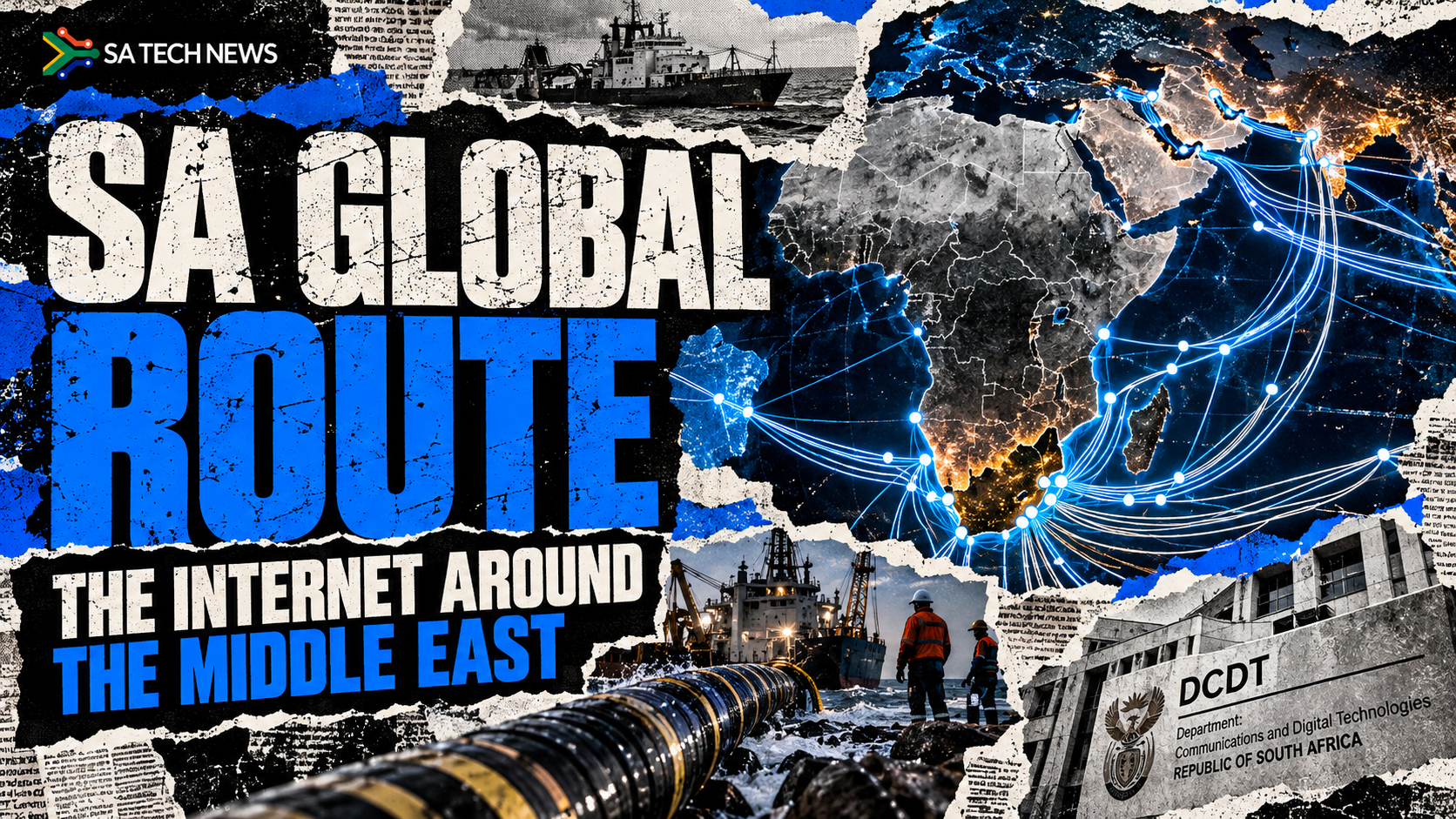
South Africa is exploring a global submarine-cable hub strategy that could turn the country into an alternative digital route between Africa, Europe, Asia and the Americas.
South Africa is looking at its geography as a technology asset rather than just a map coordinate.
Communications and Digital Technologies minister Solly Malatsi said at GovTech 2026 that he had met officials from Operation Vulindlela and the Digital Council to explore positioning South Africa as a global submarine-cable and digital-infrastructure hub. The pitch is straightforward: if geopolitical disruption in the Middle East makes existing routes less dependable, South Africa could become a more important gateway between Africa, Europe, Asia, Latin America and Australia.
That is a bigger ambition than landing another undersea cable on the coast. It would require South Africa to become useful enough to global network operators, cloud providers and data-centre companies that traffic is deliberately routed through the country rather than merely passing nearby.
The country is not starting from zero. Multiple major submarine systems already land on South Africa's east and west coasts, while Johannesburg and Cape Town host the largest concentration of data-centre capacity on the continent. South Africa also has established internet exchanges, long-haul fibre and cloud regions from global hyperscalers.
That makes the latest government position more credible than a generic infrastructure slogan. Orange is separately developing a new cable linking Réunion directly to South Africa, while international infrastructure investors are putting fresh capital into African subsea capacity. The pieces are arriving at the same time.
But being connected to many cables is not the same as being a preferred global transit hub. International traffic follows economics, latency, resilience and commercial agreements. A route that travels further but avoids a politically unstable chokepoint can be valuable, but only if the additional distance and cost are acceptable.
For South Africa to become a serious alternative route between Europe and Asia, operators would need to prove that traffic can be rerouted around conventional Middle Eastern paths without creating unacceptable latency. The country's location at the southern tip of Africa is both the opportunity and the limitation.
The opportunity is route diversity. A cable path that runs down Africa's west coast, across South Africa and back up the Indian Ocean can avoid the Red Sea and other congested or vulnerable corridors. The limitation is physics: longer routes usually mean more latency.
That trade-off matters most for cloud applications, financial markets and other workloads where milliseconds count. It matters less for bulk data transfer, backups, content distribution and resilience capacity that is only activated when primary routes fail.
Malatsi's speech framed the idea as part of a broader digital-sovereignty agenda. That means the next test is regulatory rather than rhetorical.
South Africa would need fast and predictable approvals for new cable landings, competitive access to landing stations, reliable terrestrial backhaul, enough power for data-centre expansion and a policy environment that gives long-term infrastructure investors confidence. Cable systems are built over many years and require capital commitments long before the first fibre reaches shore.
The country also needs a clear answer on how much of the value stays local. Submarine cables create strategic connectivity, but the larger economic prize comes when global platforms also place compute, storage, content caches, security infrastructure and network operations in South Africa.
That is where the government's hub argument becomes materially more interesting. A country that is only a transit point earns less than one that becomes the place where traffic, compute and digital services converge.
The next meaningful signal will be a concrete infrastructure or regulatory package: new landing-station policy, incentives for cable operators, confirmed new routes, or investment in the terrestrial networks required to move traffic between the east and west coasts.
Until then, South Africa's global internet-hub plan remains an opportunity rather than an achievement. But unlike many digital-policy ambitions, this one starts with a genuine advantage the country already has: geography, established connectivity and the continent's strongest data-centre market.
Source: SA Tech News


