
Breaking
Latest tech news from South Africa and around the world•Stay updated with breaking technology developments•Innovation and digital transformation news•AI, gaming, and gadget updates daily•Crypto and fintech news from Africa•
 SA Tech News Desk
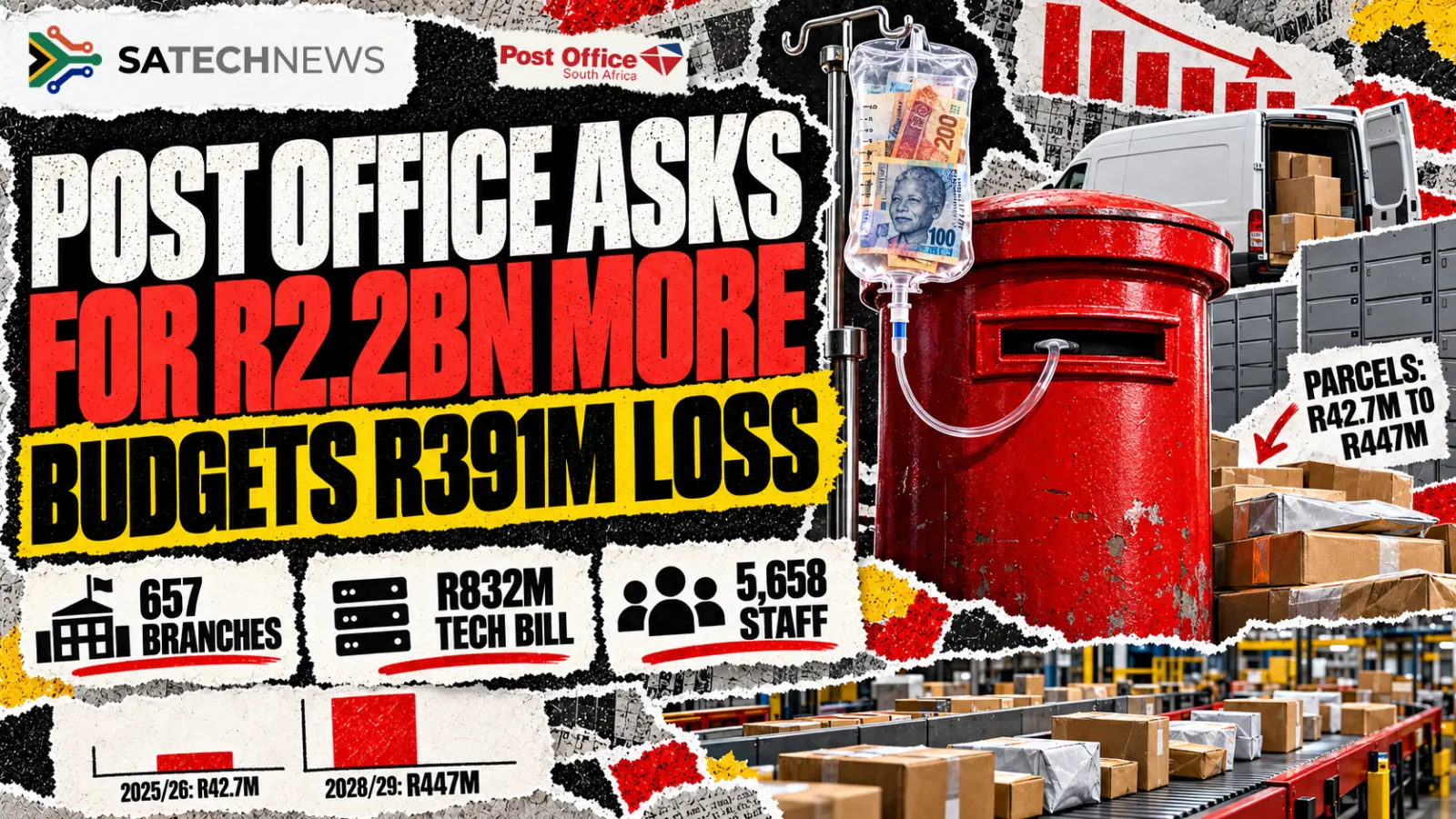
SAPO wants about R2.2bn in new money over three years and budgets a R391m loss for 2026/27. Its break-even plan needs parcels revenue to grow tenfold.
The South African Post Office (SAPO) has asked the Treasury for about R2.2bn in new money over three years while budgeting for a R391m loss in 2026/27. Its plan to break even rests on parcels and courier revenue growing more than tenfold by 2028/29.
The figures come from SAPO's 2026/27 corporate plan, presented to the National Council of Provinces' select committee on economic development and trade on 14 October and reported by TechCentral on 19 October. For South Africans the question is whether a state network of 657 branches can be rebuilt into an e-commerce delivery and government-services platform, or whether it keeps needing a cheque to stay open.
The ask is part of a R4.09bn medium-term expenditure framework (MTEF) submission lodged in June. R1.93bn of that is the universal service obligation grant, which pays SAPO to keep branches open where the cost of service is higher than the revenue. The rest, about R2.16bn, is money SAPO does not receive today.
According to the presentation, SAPO wants R1.05bn in working capital to cover staff, premises, utilities, security, transport and technology while new revenue lines grow. It wants R509m to pay the statutory and payroll creditors still owed under its adopted business rescue plan. And it wants R600m for capital investment.
That last line is a fraction of what SAPO says it needs. The plan puts the full modernisation bill at R1.89bn: R832m for a digital backbone, hosting and security, R456m for delivery fleet, R354m for buildings and hubs, and R244m for mail processing and hybrid mail automation. SAPO says it asked for only R600m "reflecting the fiscal constraints currently being managed by National Treasury", and will look for partners who fund assets in exchange for access to its sites and reach. The approved performance plan starts from a baseline of zero such partnerships, TechCentral reported.
SAPO's audited 2025/26 results show income of R1.42bn against spending of R2.51bn. Staff costs alone were R1.44bn, more than total income. Non-operating items of R1.02bn, which include public funding, narrowed the net loss to R69m, its smallest in years.
The approved financial plan then budgets for losses of R391m in 2026/27 and R309m in 2027/28, followed by a R21m profit in 2028/29. Getting there means total income must rise about 45% to R2.06bn. Postal revenue, flat at R846m for two years, is meant to pass R1bn. Courier and parcels revenue is meant to go from R42.7m to R447m.
That parcels line is the one South African online shoppers will notice. SAPO is pitching itself as a last-mile carrier for e-commerce, business and government, with parcel lockers, pick-up and drop-off points and an affordable export channel. It will be competing with private couriers that already run that business, and its parcels revenue fell from R51.2m in 2024/25.
The presentation lists 657 branches in the approved network, 258 of them rural branches carrying the universal service obligation, and 250 that handle motor vehicle licensing. SAPO had 5,658 employees at 31 March 2026. TechCentral reported that 4,342 people left during restructuring and that the network was cut from about 1,100 branches.
Acting group CEO Fathima Gany told the committee SAPO was no longer in intensive care but in "high care", according to the Parliamentary Monitoring Group's summary of the meeting.
Postbank presented separately and asked for R2.5bn: R2bn of regulatory capital to support a commercial banking licence application and R500m for infrastructure including its core banking platform and digital channels.
Government committed R6.2bn to the business rescue almost three years ago but has paid only R2.4bn, TechCentral reported; the R3.8bn second tranche for modernisation and creditors was never released. The business rescue practitioners applied on 12 June to end the process, which the Post Office Retirement Fund opposes.
SAPO also wants government to proclaim the 2024 legislative amendments that would widen the services it may offer; its presentation notes that the Postal Services Amendment Act of 2024 takes effect only on proclamation. Whether the Treasury funds even the R600m capital request will be known only when the medium-term budget allocations are published.
Source: SA Tech News


