
Breaking
Latest tech news from South Africa and around the world•Stay updated with breaking technology developments•Innovation and digital transformation news•AI, gaming, and gadget updates daily•Crypto and fintech news from Africa•
 SA Tech News Desk
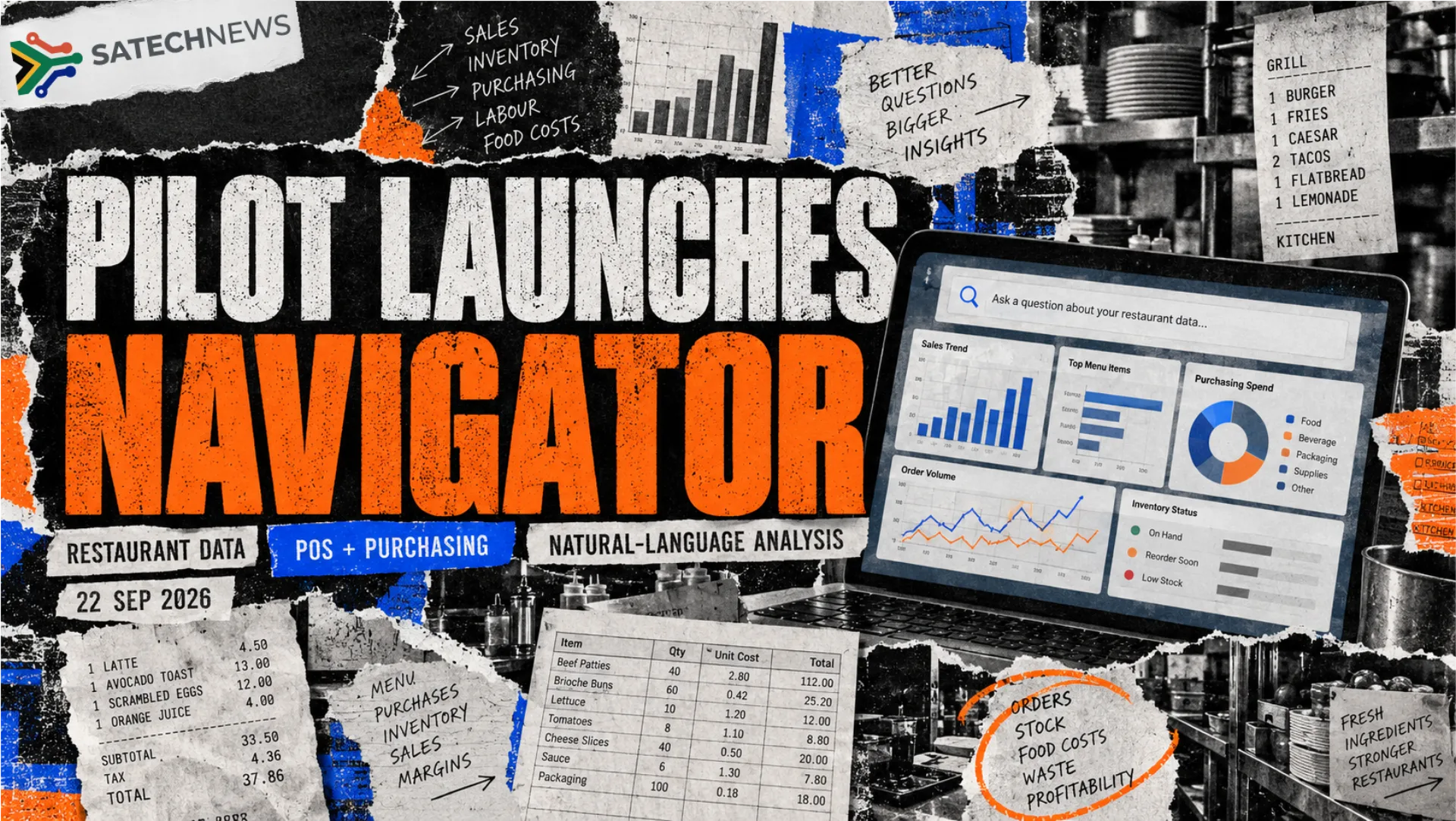
Pilot’s Navigator lets South African restaurant operators question POS, purchasing and margin data in natural language instead of building manual reports.
South African hospitality software company Pilot has launched Navigator, an AI layer that lets restaurant operators question their own point-of-sale data in natural language. The product is now available to Pilot clients after beta testing with restaurant operators.
Instead of asking a restaurant manager to build another spreadsheet or static report, Navigator is designed to answer questions such as which menu items are losing margin, where supplier prices have moved unexpectedly and how purchasing changes are affecting profitability. That is a narrow use of AI, but it is also the kind that can be tested against actual operating data.
Pilot says Navigator works across the data already held in its point-of-sale environment, including sales, payments, purchasing and performance information. It can analyse large datasets and return answers to natural-language questions without the operator constructing a report first.
During beta testing, Pilot says The Palms Plett and Club Haus used Navigator to identify supplier-pricing anomalies and unexpected increases, which were then queried with suppliers. That is a company-supplied example rather than an independent benchmark, but it shows the intended workflow: find a discrepancy, surface it quickly and let a human decide what action to take.
The timing is relevant to South African restaurants. Pilot points to Statistics South Africa’s June 2026 Food and Beverage Survey, where restaurants and coffee shops recorded a 2.3% quarter-on-quarter fall in real income. In a low-margin sector, small movements in ingredient prices, purchasing or menu mix can materially change the economics of a store.
Pilot has operated in hospitality technology for 35 years and now works across Africa and Europe. Paycorp acquired the business in 2025. Navigator is the first major product under Pilot’s refreshed positioning as a hospitality control centre.
The product still needs a harder test than launch examples. Restaurant data can be messy, permissions matter across multi-site groups, and a plausible AI answer is not necessarily an accounting truth. The useful questions are therefore accuracy, auditability and whether operators can trace an answer back to the underlying transactions before acting on it.
Source: SA Tech News


