
Breaking
Latest tech news from South Africa and around the world•Stay updated with breaking technology developments•Innovation and digital transformation news•AI, gaming, and gadget updates daily•Crypto and fintech news from Africa•
 SA Tech News Desk
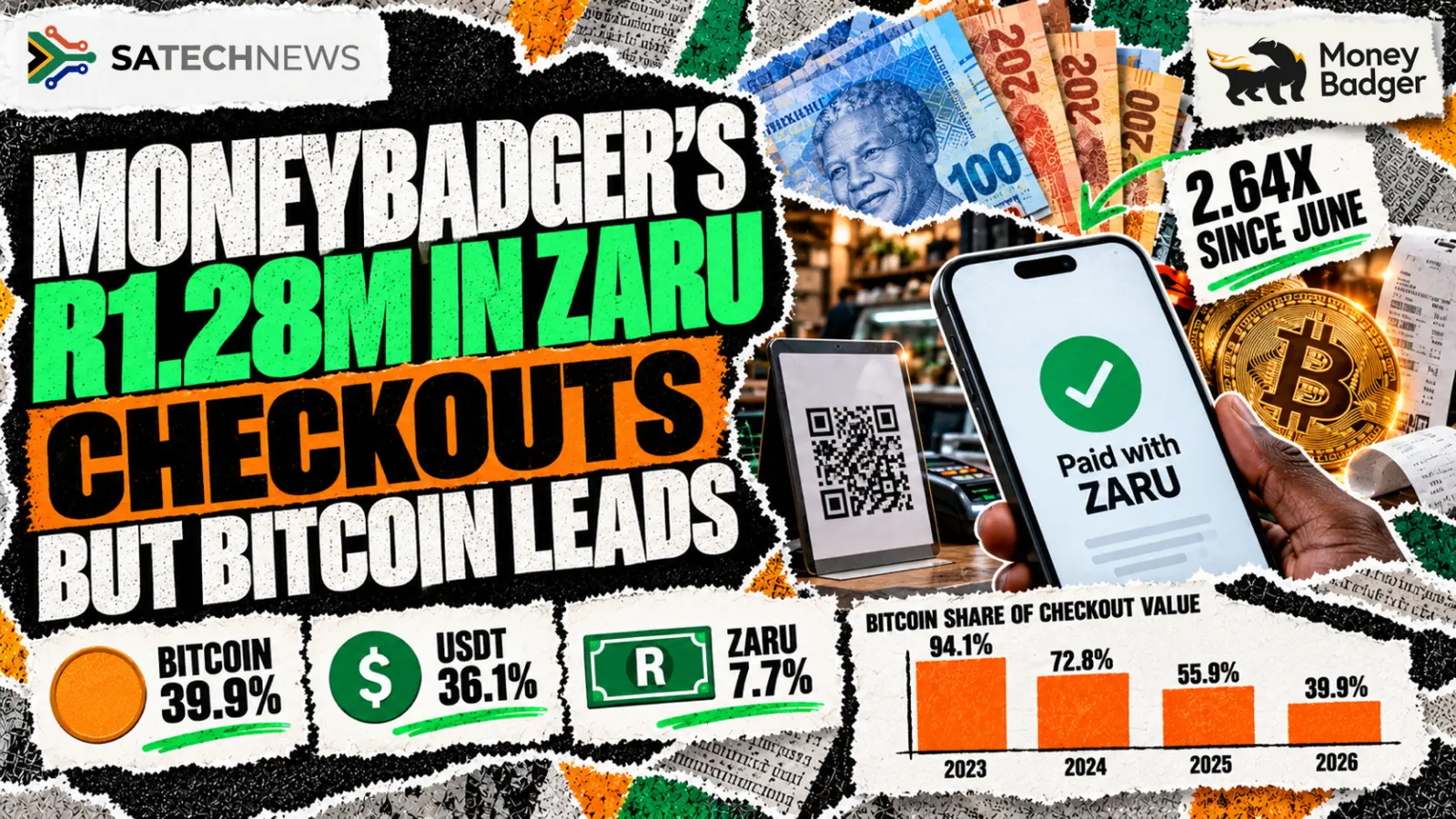
MoneyBadger reports R1.28m in September ZARU checkouts, while Bitcoin remains its biggest payment asset. The data covers one network, not all SA retail.
MoneyBadger recorded R1,276,650.27 in checkout payments using the rand-backed ZARU stablecoin during September 2026, up from R484,206.80 in June. That is a 2.64-fold increase over three months, according to the South African crypto payments company's own transaction data.
The figure measures payments processed on MoneyBadger's network. It is not the total value of ZARU in circulation, and it is not the size of South Africa's stablecoin market. It matters because it captures a narrower question that trading volumes cannot answer: whether people actually use a digital asset to pay a merchant.
MoneyBadger's October report puts Bitcoin at 39.9% of checkout value so far in 2026, USDT at 36.1%, and ZARU at 7.7%. The two stablecoins therefore represent 43.8% together. Bitcoin remains the largest individual asset on the network, even after its share fell from 94.1% in 2023, to 72.8% in 2024, to 55.9% in 2025, and to 39.9% so far this year. ZARU's September total can rise quickly and still be a small slice of the till.
ZARU launched in February 2026 through an arrangement involving BlockTower South Africa, Luno, EasyEquities, Lesaka, and Sanlam Specialised Asset Management. Sanlam manages the rand reserves. Standard Bank and Absa are named as banking partners. MoneyBadger says Moore Johannesburg performs independent agreed-upon monthly procedures on the reserves, with reports published by the token issuers.
That structure is relevant to someone who wants a rand-denominated checkout option without converting the purchase price through a volatile crypto asset. It does not turn ZARU into legal tender. It does not make a token balance identical to a deposit in a South African bank. Redemption depends on the issuer's arrangements and on the channels available to holders. Moore's work, as MoneyBadger describes it, is agreed-upon procedures on the reserves, not a guarantee that a shopper can redeem every token at every till.
The September jump also has a commercial explanation inside the company's own account. MoneyBadger links some of the uptake to Luno Pay cashback and to workplace programmes. Those are incentives. The R1,276,650.27 should not be read as proof that users would choose ZARU at the same rate once the rewards stop. June's R484,206.80 is the base of the 2.64-fold comparison. Both numbers are MoneyBadger's. Neither is a regulator's tally of rand stablecoin payments in the country.
The wider network also expanded, on figures the company reports. Payment count rose 95% and rand value rose 176% in the first half of 2026 compared with the same period of 2025. Active participating stores increased from 57 in August 2025 to 2,927 a year later. These describe MoneyBadger's participating network. They do not describe every shop that could accept a compatible QR code, and they do not say how many of those 2,927 stores took a ZARU payment in September. A store that is "active" on the network and a store that settled ZARU are not the same count. The company has not split them.
For a retailer, the useful test is operational. Can a shopper complete the payment? Can the merchant reconcile it? How quickly does the merchant receive rand? The token's price stability is only one part of that calculation. Fees, refunds, customer support, and disputes also matter. MoneyBadger's October report does not publish those costs next to the R1.28 million.
The asset mix is the other half of the headline. Bitcoin is still the single largest payment asset, at 39.9% of checkout value so far in 2026. USDT, a dollar stablecoin, is close behind at 36.1%. ZARU, the rand token, is 7.7%. A reader who stops at "rand stablecoin payments hit R1.28 million" misses the comparison the company itself published: most of the value on this network is still not ZARU.
The growth also arrives while South Africa is debating the treatment of crypto assets in cross-border transactions. Domestic checkout adoption should not be confused with permission to move funds internationally outside exchange-control requirements. A QR payment in a local shop and a transfer across the border are different acts. This report is about the first.
MoneyBadger's data is a meaningful indication of how one local payment network is changing. It does not establish national market share, a representative sample of South African shoppers, or long-term demand after promotional rewards end. The numbers that are published are the September ZARU total, the June comparison, the 2023-to-2026 Bitcoin share, the USDT and ZARU shares, the reserve partners, and the store count. A rate card, a redemption record, and a count of ZARU payments that were not attached to cashback are still unpublished.
Set beside the September total, the shares keep the claim in proportion. R1,276,650.27 is the ZARU checkout value on this network for one month. 7.7% is ZARU's share of checkout value so far in 2026. 39.9% is Bitcoin's, down from 94.1% in 2023, 72.8% in 2024, and 55.9% in 2025. 36.1% is USDT. The 2.64-fold rise is September against June's R484,206.80. The store count, 57 to 2,927, is the company's participating network, not a ZARU census. None of those figures is a national market share. A shopper paying in ZARU and a shopper paying in Bitcoin can use the same QR flow and still show up in different slices of this report. September's rand-token total does not move Bitcoin off the top of the 2026 table.
Sources: MoneyBadger's October 2026 report, as carried in the draft, including the September and June ZARU checkout totals and the asset-share series.
Source: SA Tech News


