Breaking
Latest tech news from South Africa and around the world•Stay updated with breaking technology developments•Innovation and digital transformation news•AI, gaming, and gadget updates daily•Crypto and fintech news from Africa•
 Tech Team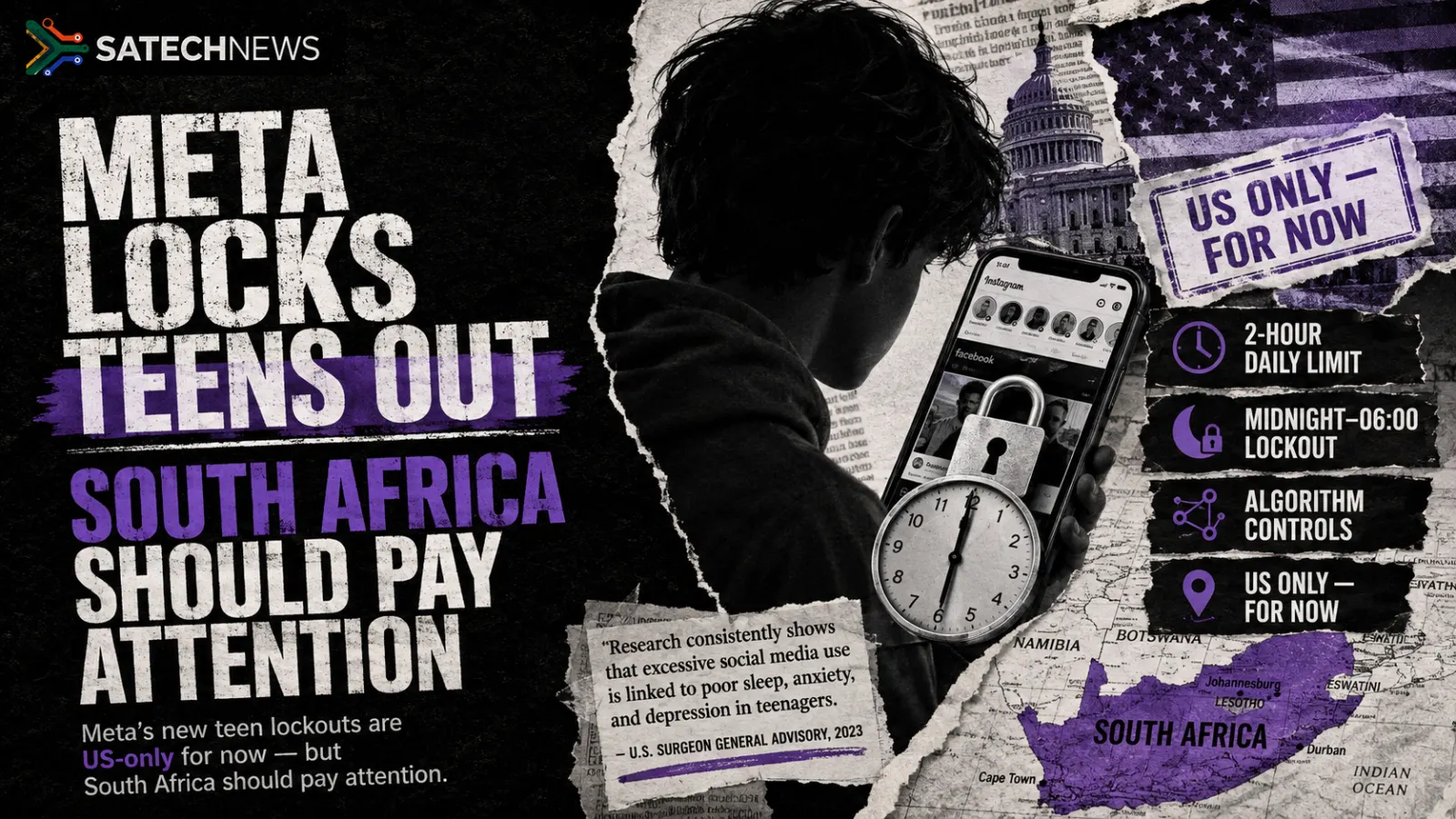
Meta's US settlement adds two-hour daily limits, midnight lockouts and algorithm controls for teens. The rules skip South Africa for now, but may shape.
Meta has agreed to some of the toughest default restrictions it has ever placed on teenage users of Instagram and Facebook. They are not South African rules, at least not yet, but they point directly at the kind of controls platforms may increasingly be expected to build for minors everywhere.
Following a settlement with a bipartisan group of US attorneys general, Meta will impose a default two-hour daily limit on under-18s across Facebook and Instagram in participating US states and territories. Teenagers will need parental permission to switch that limit off.
The company will also block access to major parts of its apps between midnight and 06:00 by default. During that window, teenagers will not be able to post or view Feed, Stories, Explore or Reels.
School hours get another layer of friction. Push notifications will be muted between 08:00 and 15:00, with exceptions for direct messages and account-safety alerts. Meta will also prompt teenagers after every 15 minutes of continuous use and again when total daily usage reaches 60 and 90 minutes.
The settlement was approved by a US judge on 27 August 2026. Meta says most of the terms must remain in place for 10 years.
The most interesting changes are not only about screen time.
Teen users will be able to choose a non-algorithmic feed as their default, and parents can require that setting. Autoplay can also be switched off, while likes and reaction counts will be hidden by default for teenage accounts.
Those measures go closer to the mechanics that keep people scrolling. They target recommendation systems, autoplay and feedback loops rather than simply adding another warning after a user has already spent hours inside an app.
That matters in South Africa because platform accountability is already becoming a live regulatory and human-rights issue. The South African Human Rights Commission has recently put recommender systems and information integrity under scrutiny, while government has also explored stronger age-verification measures for major online platforms.
There is no basis to say South African teenagers will automatically receive the new midnight lockout or two-hour limit. The legal agreement applies to participating US states and territories.
Meta does, however, have a history of expanding teen-safety features beyond the markets where they first appear. Instagram Teen Accounts launched internationally after an initial rollout in major markets, and Meta has continued widening age-appropriate content controls across Facebook and Messenger.
That makes the US settlement relevant as a product signal even where it has no direct legal force.
The bigger question is whether South Africa should wait for platforms to voluntarily export these protections, or set its own minimum standards for teenage users.
South African cybercrime and digital-safety attorney Rene Mattheus has also warned that technical restrictions are not a complete answer. Teenagers can misstate their age, use alternative accounts, switch services or use tools such as VPNs to get around geographically or account-based controls.
That does not make the controls pointless. It does mean enforcement and digital literacy matter as much as interface design.
For years, debates about protecting children online have focused on harmful content: what teenagers can see, who can message them and what material platforms should remove.
The Meta settlement pushes the argument further. It treats product design itself, the hours an app is available, how long users can stay, whether feeds are personalised and whether content automatically continues playing, as part of the safety problem.
That is a much more consequential direction for regulation because it reaches directly into the engagement systems that social platforms use to keep people active.
South Africa is not bound by this settlement. But if the approach becomes a new baseline in larger markets, local regulators, parents and platforms are likely to face the same question soon enough: whether protecting teenagers online requires changing not only the content they see, but the way the apps are allowed to work.
Source: SA Tech News