
Breaking
Latest tech news from South Africa and around the world•Stay updated with breaking technology developments•Innovation and digital transformation news•AI, gaming, and gadget updates daily•Crypto and fintech news from Africa•
 SA Tech News Desk
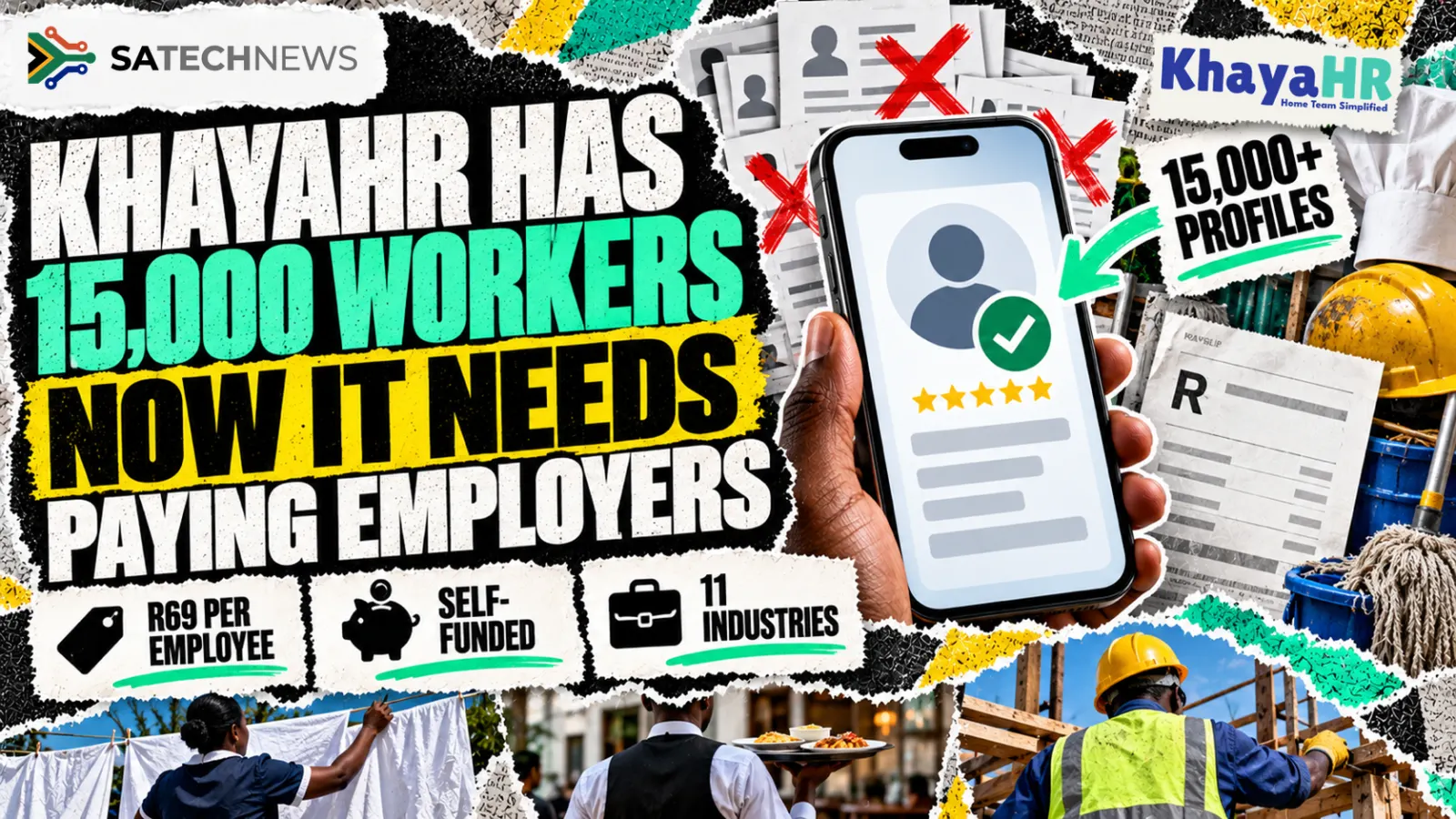
KhayaHR now lists 15,000 worker profiles after a May launch. The self-funded startup must get employers paying for hiring and R69-a-head payroll.
KhayaHR, a self-funded South African startup run by a husband-and-wife team, now lists more than 15,000 worker profiles on its hiring platform, up from the 12,000 sign-ups it reported to Disrupt Africa on 14 October since its May launch. Demand is strongest for work that rarely comes with a CV: domestic work, cleaning, care, hospitality, retail and general labour.
The company pairs those profiles with payroll software for households and small businesses, priced from R69 per employee per month. The question for South African readers is whether a two-person company can get employers to change how they hire, now that workers have signed up faster than it expected.
KhayaHR's own pitch starts with the household. Its about page says millions of South African homes employ domestic workers, too often without a contract, without UIF and without the records that protect both sides. Founder Jacques Roux told Disrupt Africa that "most recruitment technology assumes that candidates already have formal CVs", which shuts out much of the frontline workforce.
The product has three parts. Khaya Connect is a free-to-browse directory of worker profiles across eleven industries and all nine provinces, which workers build and control themselves, often starting on WhatsApp. The payroll and HR side calculates PAYE, SDL and UIF, issues payslips and keeps contracts, leave and disciplinary records. KhayaHR Academy sells short phone-based courses whose certificates attach to a worker's profile.
KhayaHR says every live profile has passed an identity-document review and admin approval, meaning a staff member looks at the worker's ID before the profile goes public. Its site is explicit that this is not a government-record, criminal or reference check. Work history and references come from workers and their past employers.
A planned Trust Score, a rating out of 100 drawn from payroll history, warnings, references and profile activity, is not live yet. The company says the calculation does not run on a schedule and employers will not see scores on the public site today.
On payroll, KhayaHR does the calculations but not the payments. Employers still pay UIF contributions themselves, either directly to the UIF or to SARS with their EMP201 return. KhayaHR will register an employer for UIF for a once-off R400 if asked. Annual billing knocks 10% off the subscription, and there is a 14-day free trial.
Roux described several revenue lines to Disrupt Africa: employers paying to connect with workers, per-employee payroll subscriptions, paid Academy courses, and sourcing and placement work for larger employers. "We are generating early revenue, but the business remains in its initial commercialisation stage," he said. KhayaHR has not raised outside funding.
Roux also named the main obstacle: "Building a workforce supply base has proven faster than changing employer recruitment behaviour." The plan is to win South African employers first and later move into selected Southern African markets through local partners.
KhayaHR has not disclosed how many employers pay for payroll or how many hires have come through Connect. Its site does not list a price for connecting with a worker, even though the founder describes connection fees as a revenue line. There is also a tension in the worker pitch: the about page promises "R0 cost to the worker", while Academy courses show their own prices and only some are free. The next number that matters is paying employers, and the company has not published it.
Source: SA Tech News


