
Breaking
Latest tech news from South Africa and around the world•Stay updated with breaking technology developments•Innovation and digital transformation news•AI, gaming, and gadget updates daily•Crypto and fintech news from Africa•
Reviews
 SA Tech News Desk
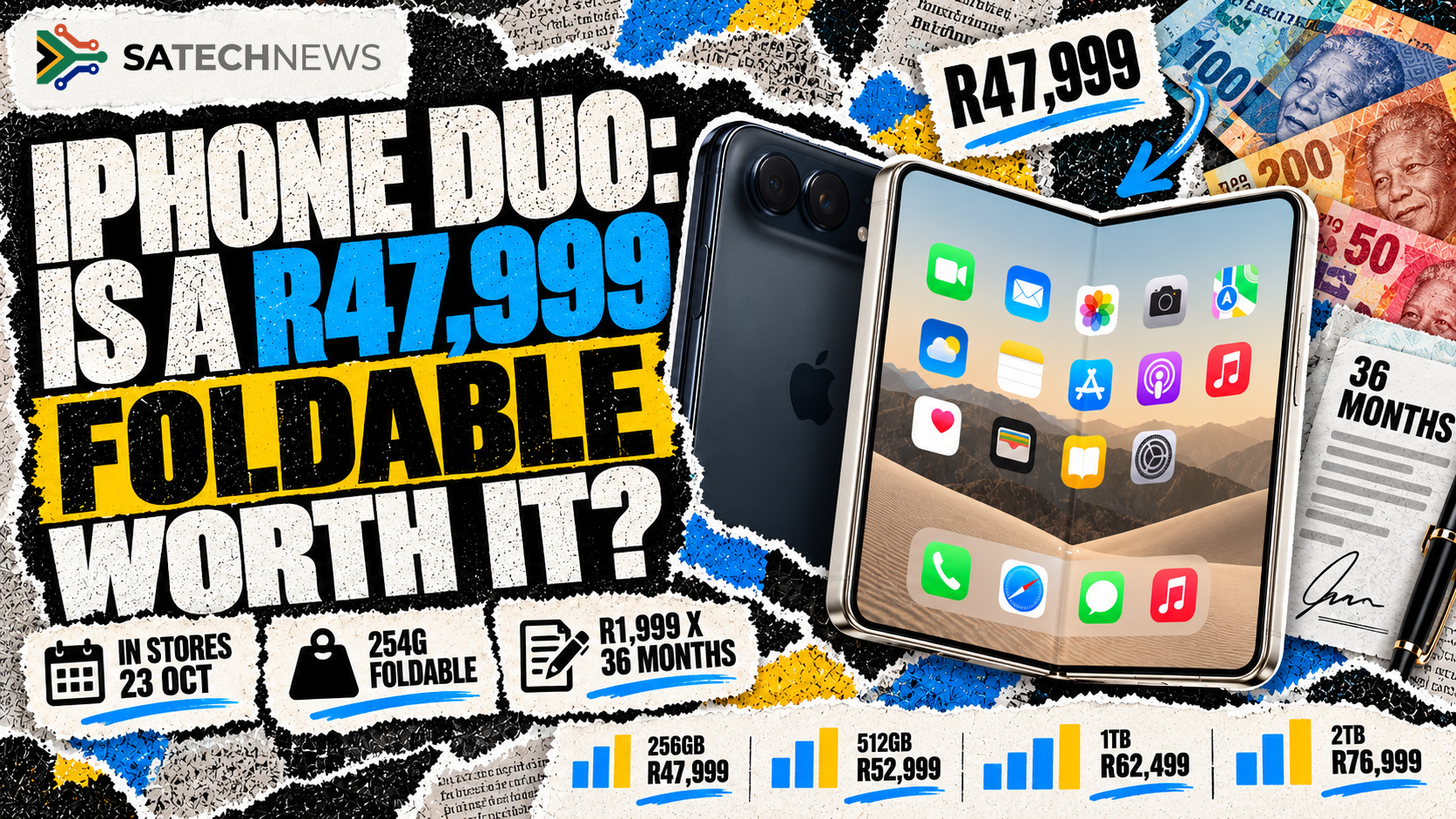
Apple's iPhone Duo is in SA stores from 23 October at R47,999. Our verified review weighs price, specs, contracts and early tests against the trade-offs.
The iPhone Duo is in South African stores from today, 23 October, and the entry price is R47,999 for 256GB at iStore. That makes Apple's first foldable the most expensive iPhone sold here, and it puts one blunt question in front of buyers: is a phone that opens into a 7.6-inch tablet worth paying close to R48,000, or R71,964 over a three-year contract?
This is a verified briefing, not a hands-on review. SA Tech News has not tested the iPhone Duo. The specifications below come from Apple's own spec sheet, local prices come from iStore's product page, and test results are credited to the international outlets that published reviews on 21 October.
iStore lists four storage tiers, each in Night Sky or Star White: R47,999 for 256GB, R52,999 for 512GB, R62,499 for 1TB and R76,999 for 2TB. Pre-orders opened on 16 October, and iStore told MyBroadband that stock would reach stores from 23 October. iStore is also advertising trade-in credit of up to R25,000 against a new device.
Contracts are thin so far. MyBroadband reported that Cell C was the only operator with a live deal at launch: the 256GB Star White model at R1,999 a month for 36 months, with 750 minutes, 750 SMSes and 7.5GB of data a month. That works out to R71,964, or R23,965 more than paying cash. The bundled minutes and data have value, but at 7.5GB a month most buyers of a R48,000 phone will need more. Vodacom, MTN and Telkom have contract links on iStore's page, but no prices were posted there when we checked.
In the US the Duo starts at $1,999 for 256GB before sales tax. When local pricing was revealed last week, we calculated the South African price at about 27% above the US figure. The US price excludes sales tax; the local price includes 15% VAT.
The Duo has two OLED screens. The 5.4-inch outer display (1398 by 2034 pixels) is for one-handed use. The 7.6-inch inner panel (1878 by 2670 pixels, 430ppi) is the reason to buy it. Both run at up to 120Hz, and Apple rates both at 1,000 nits typical brightness, 1,600 nits for HDR and 3,000 nits outdoors.
Opened, the phone is 5.2mm thick. Closed, it is 11.3mm, and it weighs 254g either way. Inside is Apple's A20 Pro chip with a six-core CPU and a seven-core GPU. Unlock is by Touch ID in the side button, not Face ID.
Apple quotes up to 31 hours of video playback on the inner display, 44 hours on the outer screen and up to 24 hours of typical use. With a 60W-capable adapter, it says the battery reaches 50% in about 20 minutes. The adapter is sold separately; the box contains a USB-C cable. MagSafe and Qi2 wireless charging run at up to 25W.
The rear camera system is a 48MP main camera and a 48MP ultra wide. The main sensor also produces what Apple calls a 12MP optical-quality 2x telephoto. There is no separate zoom lens, which matters to anyone who shoots sport or stage events from a distance. A 12MP camera sits on the outer screen and an under-display camera on the inner one.
The Duo is rated IP68, to 6 metres for up to 30 minutes. It does not take a physical SIM card. It supports two active eSIMs, so anyone who swaps prepaid SIMs or uses a work SIM card should confirm their operator can issue an eSIM on their package before buying.
Reviews published on 21 October largely agree that the crease is hard to see in everyday use. A matte nano-texture coating on the inner screen hides most of it, though reviewers at PCMag and elsewhere said it can still be felt and seen at some angles or with the screen off.
Battery results vary with the test. PCMag recorded 18 hours 15 minutes streaming YouTube on the inner display at maximum brightness, ahead of its results for the Galaxy Z Fold 8 and Pixel 11 Pro Fold. Engadget logged 28 hours 48 minutes of local video playback. Tom's Guide measured 13 hours 20 minutes in its web-browsing test. The Verge was less convinced, saying the phone gets warm, sometimes hot, and did not seem ready to last a full day of heavy use.
Weight was the most common complaint. At 254g, the Duo is 5g heavier than the iPhone 18 Pro Max. Apps are the other weak point for now. Wired and Tom's Guide found unoptimised apps running with thick black bars on the inner screen, and developers need Apple's iOS 27.1 software kit to adapt their apps to the new shape.
The strengths are clear on paper and in early testing. The inner screen is large, bright and less creased than many earlier foldables. Battery results from PCMag and Engadget are strong for the category. The phone is thin when open, has an IP68 rating and gets Apple's software support.
The trade-offs are the price, the weight, the lack of a true telephoto lens and an app library that still has to catch up. Touch ID instead of Face ID will suit some people and annoy others. The no-charger box and eSIM-only design add small costs and admin.
The Duo makes sense for someone who already reads, edits documents or watches video on a tablet and wants to carry one device instead of two. If the inner screen replaces an iPad, the R47,999 price looks less extreme.
Anyone buying mainly for the camera should compare it with the iPhone 18 Pro, which local retailers listed from about R27,099 to R28,799 for 256GB at launch, roughly R20,000 less. People who keep phones for four or five years may want to wait for the second generation, as Wired and WAtoday both advised.
Several questions can't be answered from a spec sheet or a week of overseas reviews. Vodacom, MTN and Telkom have not yet posted contract prices on iStore's page. Long-term durability of the hinge and the inner screen is unknown. Local repair costs for the folding display have not been published, and that number matters on a phone this expensive. We will update this review if we are able to test the device.
Source: SA Tech News


