Breaking
Latest tech news from South Africa and around the world•Stay updated with breaking technology developments•Innovation and digital transformation news•AI, gaming, and gadget updates daily•Crypto and fintech news from Africa•
 SA Tech News Desk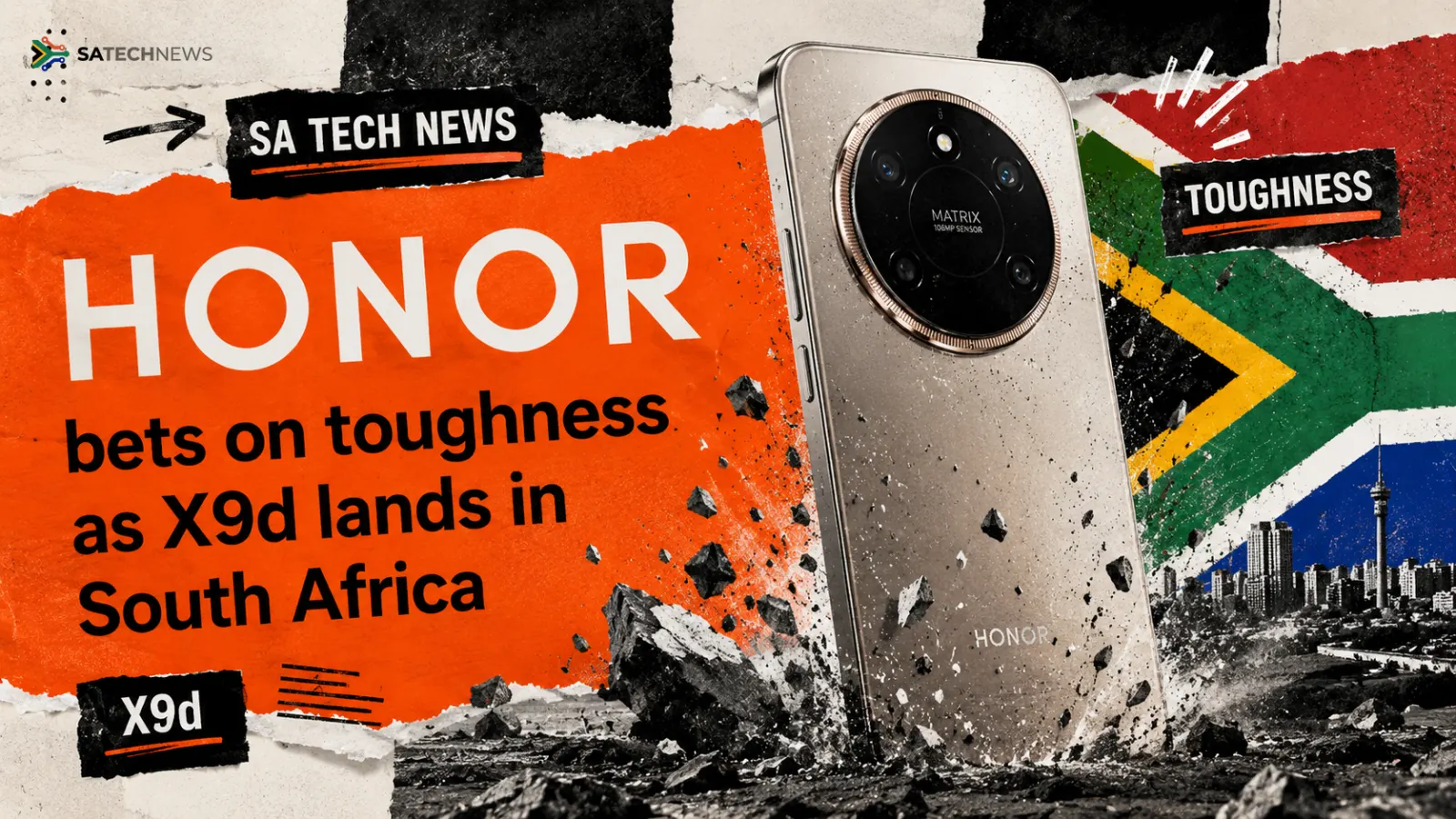
HONOR's X9d 5G launch in South Africa leads with drop, water and dust resistance. Durability is the pitch, and AI features sit firmly second.
Phones were dropped onto tiled flooring before the formal presentation began. One unit was submerged in a clear tank. Another had already been in a freezer backstage.
That was the tone in Sandton as HONOR introduced the HONOR X9d 5G to the South African market.
Executives repeated a simple claim. Midrange phones fail early. Screens crack. Moisture gets in. Performance tapers off after a year or two. The company says the X9d 5G is designed to interrupt that cycle.
Fred Zhou, a regional executive, framed durability as the primary buying decision in this segment. Replacement fatigue was the phrase used in discussion afterwards. Users do not want to upgrade because a device has physically degraded.
The demonstrations were theatrical but controlled. Devices were dropped from height, sprayed with water, buried in soil and wiped down. No local independent verification was presented at the event. The company relied on external certification.
HONOR says the X9d 5G carries an SGS Triple-Resistant Premium Performance Certification. The rating includes:
It also uses a six-layer internal cushioning structure intended to disperse impact forces internally rather than at the frame edge. That system received more airtime than the chipset.
The constraint that kept surfacing was physical failure. Not processing speed. Not camera sensors. Physical failure.
The display supports touch input in rain and with gloves. The pitch is straightforward. Outdoor usability without compromise.
No teardown data was shared. No long-term degradation testing either.
Battery capacity is where the device shifts the conversation again. The X9d 5G ships with an 8,300mAh cell. HONOR claims this is the largest battery currently available in a smartphone sold in South Africa. That figure stands on its own. It was not benchmarked against specific competitors during the presentation.
Capacity does not equal endurance. It suggests fewer daily charges. Sustained performance under heat, and how the charging curve behaves after hundreds of cycles, still need independent checks once review units circulate.
South African midrange buyers already choose between Samsung A-series durability stories, Tecno and Infinix value specs, and Xiaomi feature density. HONOR is trying to own a narrower lane: survive drops and weather first, argue software later.
Whether that wins depends on street price, warranty handling and how the phone ages after six months of taxis, dust and load-shedding charge cycles. Launch demos can only prove the first afternoon.
Retail availability and contract pricing will decide the rest. If the X9d lands near the crowded R7,000–R10,000 band with genuine IP69K hardware, durability becomes a real differentiator. If it prices like a soft flagship, the Sandton drop tests will not matter.
For now, treat launch demos as theatre until independent drop tests and battery drain numbers land from South African reviewers.
Street price and carrier deals will decide whether durability marketing actually moves units in this crowded midrange.
Source: SA Tech News