
Breaking
Latest tech news from South Africa and around the world•Stay updated with breaking technology developments•Innovation and digital transformation news•AI, gaming, and gadget updates daily•Crypto and fintech news from Africa•
 SA Tech News Desk
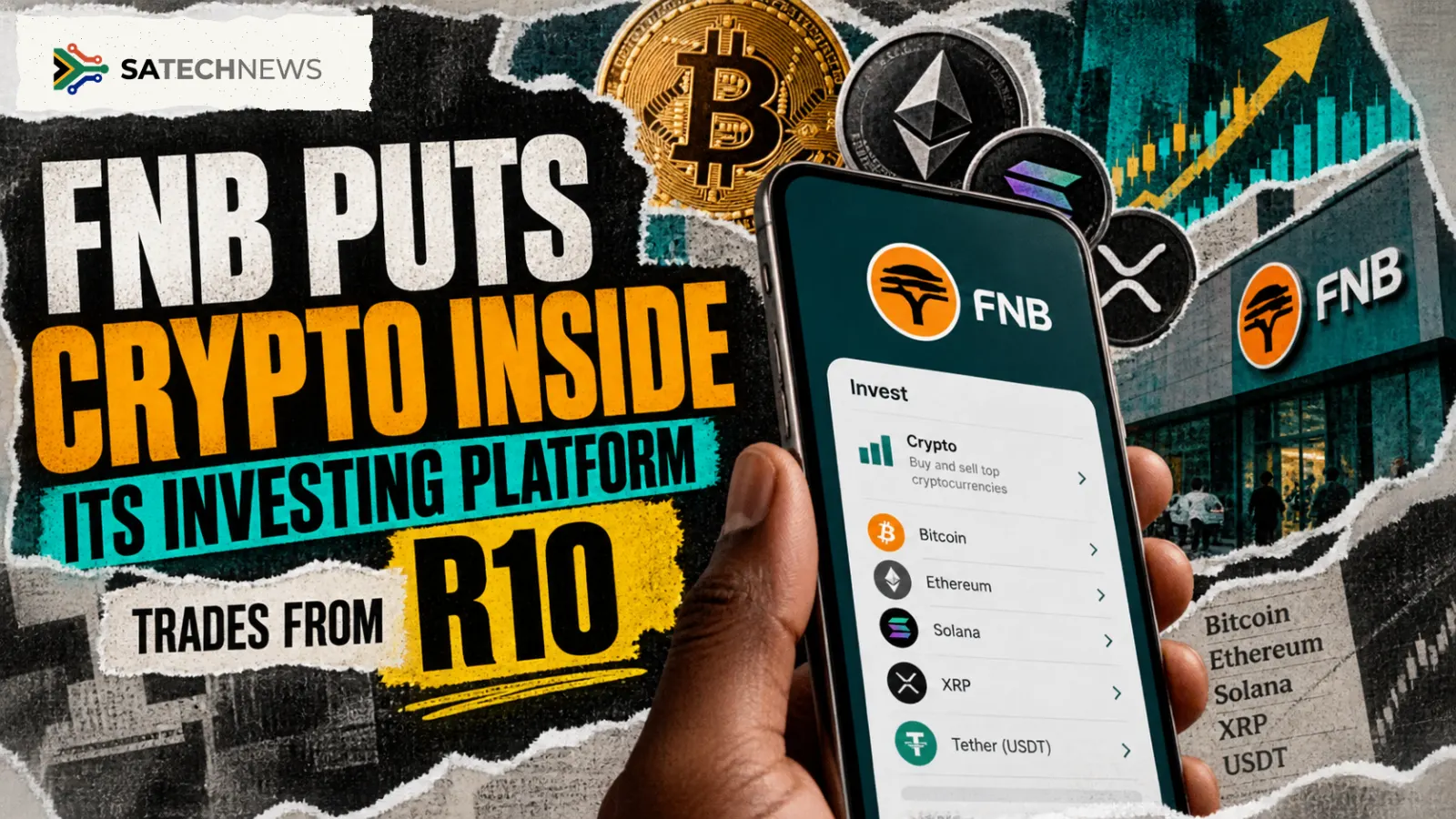
FNB has partnered with VALR to let customers buy five crypto assets from R10 through its existing share-investing products.
FNB has added crypto investing to its banking platform through a partnership with South African exchange VALR, giving customers access to a small set of digital assets from R10.
The launch matters because it moves crypto another step into mainstream South African banking. FNB says the feature sits inside its existing share-investing products rather than operating as a separate exchange account, putting digital assets alongside more conventional investments in a bank-controlled interface.
Customers can access Bitcoin, Ethereum, XRP, Solana and the US dollar-linked stablecoin USDT through Share Saver, Share Builder, Share Investor and Share Zero. Moneyweb and ITWeb both reported the launch on 6 October.
The practical change is distribution.
South Africans have long been able to buy crypto through licensed exchanges, but FNB is bringing that access into products already used for shares and other investments. The bank has close to nine million retail customers, giving the feature a potentially large addressable base even if only a fraction use it.
VALR provides the crypto-market infrastructure behind the service. FNB retains the customer relationship and investment interface.
The R10 minimum also lowers the entry point. That does not remove crypto volatility, custody risk or the possibility of losses. It simply makes small allocations possible without opening a separate exchange relationship.
For customers who already use FNB's share products, the friction is lower: same app, same funding path, fewer KYC loops. For active traders who need advanced order types, withdrawals to self-custody or a wide altcoin list, an exchange account will still look more complete. The product is built for allocation, not for day trading.
South African banks spent years treating crypto businesses cautiously, particularly where compliance and banking relationships were concerned.
That position has softened as the regulatory framework has become clearer. Crypto asset service providers now operate under Financial Sector Conduct Authority licensing requirements, while exchange-control questions around cross-border crypto flows remain unresolved.
FNB is not first. Discovery Bank previously integrated crypto trading through Luno. FNB's move is still significant because of the size of its retail base and the way the feature is being folded into established investment products.
The pattern is becoming familiar: a licensed exchange supplies market access, the bank supplies distribution and trust. That can widen the customer pool. It can also concentrate operational dependence on a small number of CASPs. If VALR has an outage, FNB customers feel it inside a bank app.
Including USDT makes this more than a Bitcoin-and-Ethereum product.
Dollar-linked stablecoins are increasingly used for settlement and cross-border value transfer, but South African regulators are still working through how those flows should interact with exchange-control rules.
For FNB customers, USDT is being offered as an investable crypto asset. That does not mean the bank has opened an unrestricted dollar-payment rail.
The distinction matters as stablecoins move closer to everyday financial products. Holding USDT in a Share product is not the same as paying a foreign supplier with a stablecoin. Luno's separate capital-flow lobbying shows how contested that line still is. FNB's launch puts a dollar token next to shares without resolving the payments question.
FNB has not yet published enough detail for a full cost comparison with buying directly through a crypto exchange. Trading spreads, custody arrangements, withdrawal functionality and the exact boundaries between FNB and VALR will determine how competitive the product is for active users.
Retail buyers should check whether they can move coins off the platform, how tax reporting is handled, and what happens if they leave FNB. A R10 ticket size is marketing. The spread on a R50 purchase is the real cost.
SARS already treats crypto disposals as potentially taxable. Folding trades into a bank investing product may make the gains more visible in statements — which is good for compliance and less convenient for people who treated exchange apps as informal.
The larger shift is already visible: crypto is no longer sitting outside the South African banking interface. It is becoming another product banks expect some customers to hold, even while the regulatory treatment of digital assets continues to develop.
Watch three things next: the fee schedule against VALR and Luno, whether withdrawals to private wallets are allowed, and whether USDT stays an investment token or starts to look like a payments feature. The Wire Room test is simple — is this a bank product that happens to hold crypto, or a crypto product wearing a bank brand?
Discovery Bank already proved a bank-plus-exchange wrapper can ship. FNB's version will be judged on whether nine million retail accounts translate into meaningful volume or a quiet toggle most customers never touch.
If the product stays inside Share Saver and never supports a clean exit to a VALR wallet, it is a closed loop. Closed loops are fine for cautious savers. They are a hard sell for anyone who wants crypto as portable money.
The Wire Room position is narrow: five assets from R10 inside FNB's investing stack is a distribution story, not a crypto-market revolution. Fees, custody and USDT's role will decide whether it sticks.
Open the app and find Share Saver before you celebrate. Confirm the five assets, the R10 entry, and whether you can send crypto out of the bank or only hold and sell inside FNB. If outbound transfers are blocked or fee-heavy, treat the product as a savings wrapper, not as portable crypto.
Ask support three plain questions: who is the custodian of record, what happens if VALR has an outage during a sell, and how USDT is treated for tax reporting. Vague answers mean you are early and the paperwork is unfinished.
Compare the all-in cost against buying the same assets on VALR or another exchange directly. Bank convenience is worth something. It is not worth a permanently worse spread if you intend to trade often.
South Africa's crypto retail story keeps circling the same tension: regulators want clearer rails, banks want distribution without balance-sheet drama, and customers want something that works on payday. FNB's R10 pitch sits in the middle of that triangle. Delivery quality will decide whether it is a durable product or a press-cycle feature.
Source: SA Tech News


